Arcana 20 in a child’s matrix
Steady, attached to their own, and sensitive to fairness, this child grows by listening to the elders’ stories, surrounded by stable guideposts.
- family roots
- sense of fairness
- stable guideposts
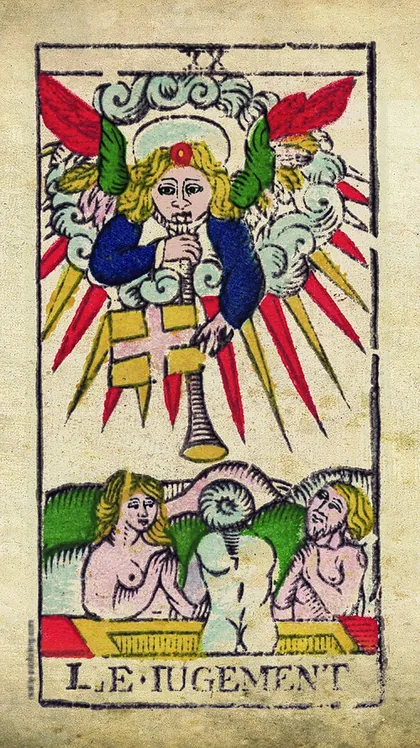
Arcana 20 in a child’s matrix at a glance
Your child listens to their grandparents’ stories, studies old photos, and questions those who came before. They have a reassuring maturity and a taste for keeping one’s word. In a stable setting, they readily take on small responsibilities and prove reliable, attentive, and loyal to their family.
They count the portions: an unequal split between siblings stays in their mind a long time. They also hold on to grudges. Avoid passing on your own family grievances to them, or loading them with mending the tensions of grown-ups. They are a child, and they have the right to be light.
- The card
- XX · Judgement
- The position
- A child’s matrix
By Thomas Guilhot · updated
Their character
A child with the 20 is thoughtful, serious for their age, and very attached to their family.
They like listening to their grandparents’ stories, looking at old photos, and asking questions about their ancestors and about what happens after life. They observe a great deal before acting and often sense how a situation is likely to turn out. They have a keen sense of justice: they count what each person receives and get offended quickly if they think they are treated worse than a brother or sister. Sudden changes, like a move or a new school, worry them. They need stable reference points, family rituals, and adults who keep their word. What helps them thrive: a united family, living ties with their grandparents, and the chance to take on small responsibilities where they feel useful.
Advice for parents
- Share family stories with them and show them photos of the elders
- Build an illustrated family tree with them
- Prepare each major change by explaining the steps to them in advance
- Treat siblings fairly and explain this to them
- Give them a small family responsibility, like organizing a birthday
- Answer their questions about the end of life simply
- Help them forgive after an argument instead of sulking
- Keep regular contact with the grandparents
With others
At school, the 20 child stands out for their maturity.
They readily take the class representative role, remind everyone of the rules of the game in the schoolyard, referee disputes, and earn the respect of younger kids. Teachers describe them as serious, composed, sometimes a bit preachy. They learn well when they understand what they are being taught is for, and they enjoy history, stories, and presentations. They handle criticism and injustice poorly: being corrected in front of everyone can stay with them for weeks, and they hold a grudge against a classmate. Help them acknowledge a mistake without shame, forgive, and listen to others’ opinions before imposing their own.
In everyday life
Sunday at the grandparents’.
Your child settles beside their grandmother with an album and asks who is who in each photo. Later, they notice that their cousin was served a much bigger slice of pie than theirs. Do not brush off the remark: explain the rule of sharing, then suggest they cut the slices themselves. Fairness becomes a game they master, not a wound.
A symbolic reading to better understand a child: never a diagnosis or a label; a childhood professional remains the reference.
Go further
Judgement
The card of energy 20Arcana 20 in the portrait
The same energy, in another position of the matrixPortrait 20 and its twelve talents
The same energy, in another position of the matrixArcana 20 in your personal brand
The same energy, in another position of the matrixArcana 20 in the couple matrix
The same energy, in another position of the matrix
How is it calculated?
Nothing changes compared with an adult’s matrix.
Fictional example: a child born on March 14, 2018. The day gives a = 14; the month gives b = 3; the year gives 2 + 0 + 1 + 8 = 11, so c = 11. The lesson d = 14 + 3 + 11 = 28, reduced to 10. The center e = 14 + 3 + 11 + 10 = 38, reduced to 11. Character reads at 14 and 3, the relationship to others at 11.
Frequently asked questions: arcana 20 in a child’s matrix
How can I talk to them about the death of a loved one?
With simple, true words, no confusing phrases, at a time when they are available. Answer their questions one by one, and admit that you do not know everything. Invite them to a ritual if they wish: lighting a candle, looking at a photo. Your calm and your presence count more than perfect sentences.
Why do they hold a grudge after an argument?
They experience unfairness as a debt that stays open. Help them say what hurt, then imagine a gesture that makes amends: a word, a drawing, an explanation. Forgiveness is shown as much as it is asked for: tell them once about a time you forgave. They learn that one can let go without being wrong.
What if their energy is like mine?
You probably understand each other often without words, and you may share the same taste for family stories. The risk is projecting your own wounds or old grudges onto them. Keep in mind that they are living their story, not yours. Tell them what you learned at their age, then let them find their own way. A resemblance then becomes a bridge.
A child’s matrix: the 22 energies
Illustrations: Nicolas Conver’s Tarot de Marseille, dated 1760, restored by Tarot World Project, CC BY-SA 4.0 license, via Wikimedia Commons — images resized and compressed by Versana.