Arcana 16 in a child’s matrix
Energetic and inventive, this child takes things apart to understand, bounces back after every fall, and needs to move and to know why.
- raw energy
- rebuilding
- sense of fairness
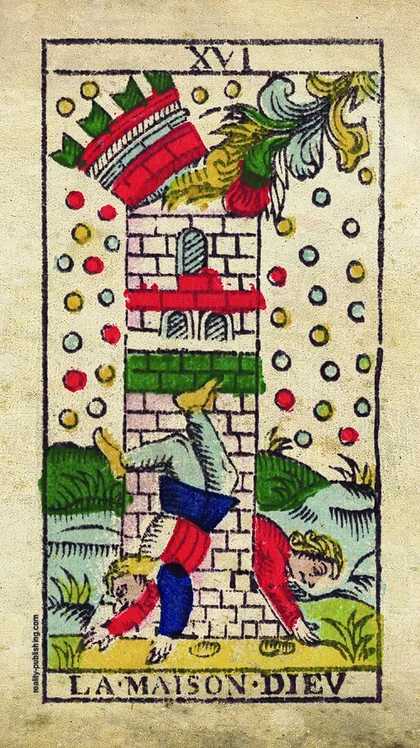
Arcana 16 in a child’s matrix at a glance
Your child is not afraid to break something to understand it: an alarm clock opened, a hideout rebuilt better. After a setback, they start again, often with a bolder idea. This ability to begin again differently is precious, and it grows when you entrust them with real projects that fit their size.
Rules with no explanation make them jump, and an outburst easily draws an adult outburst. Do not answer their storms with shouting: it feeds them. Avoid smoothing away every obstacle too. They learn to rebuild by trying, and by sensing that you believe they can. Anger without an audience settles faster.
- The card
- XVI · The Tower
- The position
- A child’s matrix
By Thomas Guilhot · updated
Their character
A child carrying the 16 overflows with energy and cannot sit still.
They climb everywhere, take apart alarm clocks and remote-control cars to understand how they work, build forts and then wreck them to build a better one. They handle injustice and unexplained rules poorly, and may explode when they feel constrained: shouting, slammed doors, thrown toys. Fights with siblings are frequent, and a dark mood can take over after a failure. Yet they bounce back fast and adapt better than others to a move or a change of school. They need to move every day, calm adults who do not get swept up in their storms, and challenges that suit them. What helps them thrive: nature, sports, building projects, and their parents’ confidence in their ability to solve their own problems.
Advice for parents
- Sign them up for a high-energy sport: judo, climbing, swimming, soccer
- Teach them to express anger with words or by punching a cushion
- Go hiking or to the mountains as a family several times a year
- Let them look for a solution before offering yours
- Talk to them about faith and values without imposing your convictions
- Entrust them with a small project: assembling a piece of furniture, fixing a bike
- Accept them as they are, even if they do not resemble you
- Keep your calm during their outbursts and discuss them once they have settled
With others
At school, the 16 child does not go unnoticed.
They challenge an instruction they find absurd, defend a classmate punished unfairly, and may clash with an overly authoritarian teacher. On the playground, they lead the action games and invent new rules; the others follow them for their daring. Their teachers find them sharp, brave, and inventive, but sometimes rowdy and quick to fight. They learn better by experience than by repetition: science experiments, outings, hands-on work. The sore spot remains frustration: a bad grade or a mocking remark can set off an outburst or a sulky withdrawal. Help them express disagreement without being aggressive, wait their turn, and see a mistake as a chance to start again differently.
In everyday life
A rainy Sunday: your child has taken apart the kitchen radio and the parts are spread across the table.
Before scolding, look, they have a plan. State the rule (we ask before opening anything in the house), then suggest putting it back together side by side, or giving them an old appliance that no longer works. By evening they hold a trophy rather than a punishment, and they have understood the limit.
A symbolic reading to better understand a child: never a diagnosis or a label; a childhood professional remains the reference.
Go further
The Tower
The card of energy 16Arcana 16 in the portrait
The same energy, in another position of the matrixPortrait 16 and its twelve talents
The same energy, in another position of the matrixArcana 16 in your personal brand
The same energy, in another position of the matrixArcana 16 in the couple matrix
The same energy, in another position of the matrix
How is it calculated?
Nothing changes compared with an adult’s matrix.
Fictional example: a child born on March 14, 2018. The day gives a = 14; the month gives b = 3; the year gives 2 + 0 + 1 + 8 = 11, so c = 11. The lesson d = 14 + 3 + 11 = 28, reduced to 10. The center e = 14 + 3 + 11 + 10 = 38, reduced to 11. Character reads at 14 and 3, the relationship to others at 11.
Frequently asked questions: arcana 16 in a child’s matrix
Why do they react so strongly to what they find unfair?
In them, the sense of fairness is very keen, and an arbitrary rule feels like an offense. Explain your decisions in one clear sentence, even if you change nothing. Listen to their point of view before deciding. They can then object by talking rather than slamming doors, and feel that their voice counts.
What can I do about the constant fights with siblings?
Avoid naming a culprit every time. Separate them calmly, let things settle, then bring them together to look for a solution. Suggest physical activities outside the home to burn off their surplus. In a sibling group, a lively child needs a space of their own, and a moment alone with you each week.
How can I support them after a failure that knocks them down?
First let the disappointment pass, without playing it down or commenting. Then, once they are ready to talk, ask what they would do differently. Building projects help them a lot: you see the mistake, change a piece, start again. Share a failure from your own childhood, with humor: a fall says nothing about who they are.
A child’s matrix: the 22 energies
Illustrations: Nicolas Conver’s Tarot de Marseille, dated 1760, restored by Tarot World Project, CC BY-SA 4.0 license, via Wikimedia Commons — images resized and compressed by Versana.