Arcana 13 in a child’s matrix
An intense, changing child who moves forward in big stages and needs help getting through endings as well as new beginnings.
- stages completed
- transitions prepared
- intensity welcomed
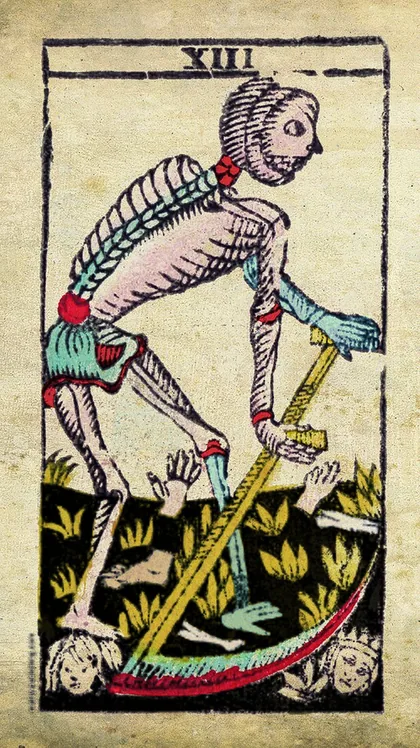
Arcana 13 in a child’s matrix at a glance
Your child has a real talent for bouncing back: after a disappointment, they get up with surprising energy and straight away suggest another idea. They dare to decide that a game no longer amuses them, or to invent a new rule. Well accompanied, this force of renewal becomes courage: the courage to change what does not suit them.
The pitfall is trying to spare them every change, or the opposite, imposing changes without warning. Both unsettle them. Your child needs transitions that are announced, explained, and marked by ritual. Also avoid reducing their intensity to restlessness: it calls for a framework and challenges, not a label.
- The card
- XIII · Death
- The position
- A child’s matrix
By Thomas Guilhot · updated
Their character
A child carrying the 13 is intense, curious about everything, and rarely where you expect them.
They often change their favorite activity, going from soccer to theater to climbing, and quickly find a routine that is too fixed wearying. They ask early questions about birth, about the end of life, about what happens to animals that are gone, and they deserve simple, true answers. They like to climb high, go fast, and test their limits, which sometimes worries adults. Some 13 children keep everything, from pebbles to old drawings, and take every separation hard, whether a lost stuffed toy, a teacher who leaves, or a friend who moves away. They need supervised adventures, regular novelty, and adults who stay calm during their outbursts. They flourish in a family that prepares changes with them, that allows them to reinvent themselves, and that helps them finish what they start.
Advice for parents
- Sign them up for a thrill-based physical activity: climbing, judo, sailing
- Tell them in advance about every change of school, home, or routine
- Sort through their toys with them twice a year and give away those no longer used
- Answer their questions about life and the end of life honestly
- Offer them one challenge a month, with a small celebration when it is met
- Stay calm during their outbursts, then talk about it once the storm has passed
- Encourage them to carry each project to the end before the next one
With others
At school, the 13 child does not go unnoticed.
They readily take the lead of a gang on the playground, invent slightly risky games, and keep their cool when a classmate gets hurt. Teachers describe them as lively, brave, sometimes scattered and provocative. They work better on short, varied projects than on long series of identical exercises. Their vulnerabilities show up with changes forced on them: a new class, a best friend who leaves, or parents who separate can bring on aggression or an unusual withdrawal. Teach them to put words to their anger, to respect other people’s pace, and to see each ending as the beginning of something else.
In everyday life
Last day before the holidays: your child leaves their classroom and the habits of a whole year.
That evening they get upset over nothing, then burst into tears at bedtime. Rather than distract them, suggest a small passage ritual: writing a note for classmates, putting the year’s notebook in a memory box, talking about what awaits them after the break. An ending that is acknowledged settles faster than one passed over in silence.
A symbolic reading to better understand a child: never a diagnosis or a label; a childhood professional remains the reference.
Go further
Death
The card of energy 13Arcana 13 in the portrait
The same energy, in another position of the matrixPortrait 13 and its twelve talents
The same energy, in another position of the matrixArcana 13 in your personal brand
The same energy, in another position of the matrixArcana 13 in the couple matrix
The same energy, in another position of the matrix
How is it calculated?
Nothing changes compared with an adult’s matrix.
Fictional example: a child born on March 14, 2018. The day gives a = 14; the month gives b = 3; the year gives 2 + 0 + 1 + 8 = 11, so c = 11. The lesson d = 14 + 3 + 11 = 28, reduced to 10. The center e = 14 + 3 + 11 + 10 = 38, reduced to 11. Character reads at 14 and 3, the relationship to others at 11.
Frequently asked questions: arcana 13 in a child’s matrix
Is this arcana’s name worrying for a child?
No. The name is impressive, but the energy speaks of transformation, growth in stages, and renewal. It says nothing grave about your child’s future. It points to an intense temperament that feels beginnings and endings strongly, and that gains from being accompanied through changes rather than protected from all of them.
How can I help them see an activity through?
Set a clear trial period with them, a term for example, before they may stop. Celebrate the end of that period, even if they then choose something else: they learn that one can leave an activity cleanly. Keeping every activity matters less than closing each stage with pride instead of fleeing it.
What should I do when a big change is coming for the family?
A move, a birth, parents separating: tell your child early enough, in simple, true words. Involve them in whatever can be shared, choosing the color of their room, preparing a goodbye party. Give them the right to be sad or angry. A change that is prepared becomes an adventure for them; a change that is endured can set them against it for a long time.
A child’s matrix: the 22 energies
Illustrations: Nicolas Conver’s Tarot de Marseille, dated 1760, restored by Tarot World Project, CC BY-SA 4.0 license, via Wikimedia Commons — images resized and compressed by Versana.