Upright, card XIII says that a cycle is coming to its end and that it is better to recognize it than to prolong it.
It may be a role, a habit, a way of working, or a relationship in its current form: something has served its purpose and asks to be set aside. Many readers see in it less a loss than a clearing, like the field of the untitled card that is scythed so that the yellow sprouts can receive light. The moment can feel abrupt, because the card offers no half measures. It invites you to look at what is already finished within you, to say so, then to let the ground empty out before replanting it. The meaning is that of a transformation, never a punishment. For a question that hopes everything will stay the same, the tendency leans rather toward reserve: the card suggests that something is changing form.
end of a cycle
transformation
passage
Death in your life
In love
One form of bond closes so that another can appear, which invites you to say clearly what has changed between you.
In a bond, the card can say that one form of relationship has run its course and that another is seeking to be born, with the same person or with someone else. It invites you to say clearly what has changed, rather than pretend that nothing is moving.
At work
A position, a project, or a method comes to its end: the card invites you to close cleanly before setting out again.
On the work side, a position, a project, or a method may be reaching its end. The card invites you to close cleanly, to put files back in order, and not to cling to what no longer produces anything, before setting out again on a cleared base.
With money
A way of managing or spending is coming to its end; the card invites you to sort things out before rebuilding more simply.
For money, the card evokes a way of spending or managing that has run its course. It invites you to sort through habits, to cut what no longer serves, and to rebuild more simply. It is never investment advice.
As a feeling, as an action
As a feeling
A mix of relief and dizziness, as at the moment of setting down something you have carried for a long time.
As an action
Name what is finished, let it go plainly, and keep your hands free for what is already growing.
Reversed
Blocked energy, folded in on itself: the end is held back, the change refused, and what was meant to close lingers.
Main reading
Energy blocked or turned inward
In love
A bond already emptied of its meaning goes on out of habit; the card invites you to look at what you hold on to and why.
At work
A work situation is kept in place even though its cycle seems over; the refused change ends up weighing on you.
With money
A way of doing things is maintained out of fear of changing; the card invites you to see what this refusal costs.
A question
What change am I refusing to look in the face?
Readability
Readable reversed in both decks.
resistance
held-back ending
refused change
In a yes or no reading
Rather reserved
Rather reserved tendency: the card speaks of a cycle closing. A question that hopes for continuity calls for nuance.
Questions to ask yourself
What is already finished in me that I keep holding on to?
Which habit am I keeping only because it is familiar to me?
If this chapter were closed, what would I plant in its place?
A sentence to keep: “I recognize what is finished and I make room for what is beginning.”
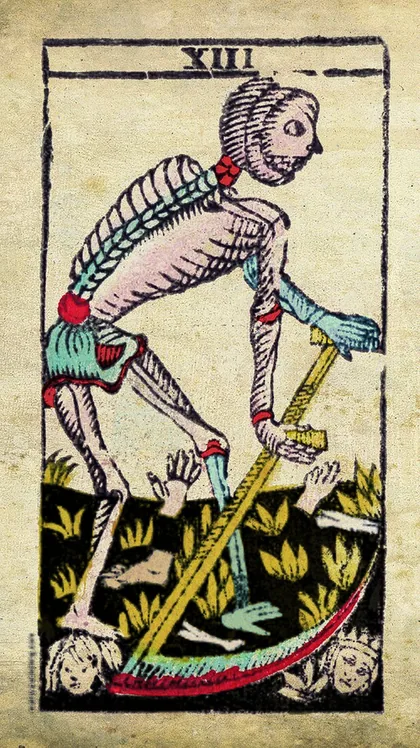
On the untitled card of the Marseille deck, a flesh-colored skeleton scythes a black ground. Hands, feet, two heads (one crowned), and yellow sprouts emerge from it.
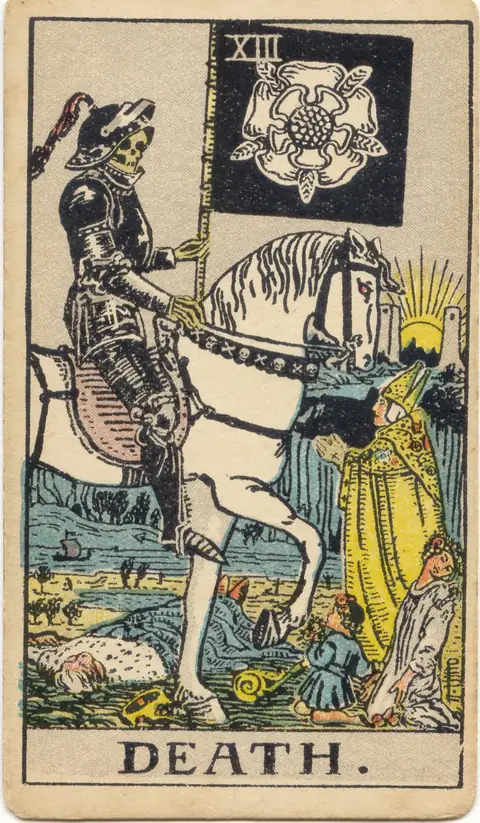
The line is direct: a scythe, dark ground, scattered fragments of bodies. Nothing is hidden, and yet nothing is staged as drama. The crown on one of the two heads is a reminder that the end of a cycle does not choose by rank. The yellow sprouts show that the worked ground is anything but sterile. In the Rider-Waite, the scene changes: a skeleton in black armor rides a white horse and carries a black banner with a white rose. Before it are a fallen king, a bishop with joined hands, and two younger figures. On the horizon, a sun rises between two towers, while a boat follows the river. The two drawings say the same thing: the passage is plain, and something rises on the other side.
The scythe
The reaper’s tool: cutting what has finished growing, so the field stays alive.
The flesh-colored skeleton (Marseille)
The structure that remains when the superfluous has fallen: the essential, laid bare.
Black ground and yellow shoots
Dark but fertile soil: what is already rising in the midst of what is ending.
The crowned head
Kings and the anonymous pass alike: no role, however high, escapes change.
The black banner with a white rose (Rider-Waite)
Waite sees the mystic rose there, which signifies life: the ending already carries something else.
The sun between two towers (Rider-Waite)
On the horizon, a light rises; Waite calls it the sun of immortality.
Two decks
Death, Marseille and Rider-Waite
The same card in the two reference decks: Conver’s drawing, dated 1760, and Pamela Colman Smith’s scene, 1909.
Tarot de Marseille · Conver, dated 1760DeathXIIIRider-Waite · London, 1909DeathXIII
Death: what changes from one deck to the other
Aspect
Tarot de Marseille
Rider-Waite
Name
L’Arcane sans nom
Death
Number
XIII
XIII
Image
The Marseille deck gives the card no title and stresses the scythe and the black ground that grows back.
The Rider-Waite names it Death and adds a white horse, a banner, and a rising sun between two towers.
Tarot de Marseille: Nicolas Conver, dated 1760, restored by the Tarot World Project, CC BY-SA 4.0 license, via Wikimedia Commons. Rider-Waite: drawings by Pamela Colman Smith, 1909, public domain, via Wikimedia Commons. Images resized and compressed by Versana; Marseille Minor Arcana diagrams and card back drawn by Versana.
Death: nuances and combinations
In love, depending on your situation
Two situations, two readings: in a current relationship, then in a period without one, and reversed.
In a current relationship
When a relationship lasts, the card can signal that a way of being together is coming to an end: habits, roles, a rhythm that no longer look like you. The bond can continue in another form, provided you name what has changed and sort things out together.
In a period without a relationship
Between two stories, the card invites you to frankly close an old chapter: a story replayed in your mind, a regret you keep alive. Cutting this ground has nothing sad about it; it is what leaves room for the shoots in the image, for an encounter that would not have found a place to land.
Reversed
Reversed, the card shows an ending being held back: you keep a relationship out of fear of emptiness, or you keep reopening a story that is closed. It is worth asking what this refusal protects, and what it keeps from growing.
Depending on the position in a spread
The position changes the reading: 7 common positions, each upright then reversed.
The situation
A cycle has closed: you come from a clear ending, a passage where something stopped to make room for another stage. The starting point is a threshold.Reversed: An ending you hold on to: the stage is over, but you prolong it, out of habit or fear of what would follow.
What helps
Knowing how to close helps: recognize what is complete, thank it, then let it go so that space opens up for the next stage.Reversed: Support is found in acceptance, which the refusal of change keeps at a distance: naming what is finished is already a first step.
What holds you back
The obstacle lies in what you do not want to let go: attachment to the old form delays the transformation that the situation is already calling for.Reversed: A refused change holds everything back: you hold tight to what should end, and the new waits at the door without being able to come in.
Your way of being
A way of being that cuts without detour: you know how to let go of what is finished, you go through change with frankness and sobriety.Reversed: A refusal of change: you stay close to the familiar, you delay what should be closed, and the transformation waits outside.
What connects you
A bond that is transforming: an old form is ending and another becomes possible, provided you accept this passage together, without rushing it.Reversed: The bond keeps a form that no longer makes sense: you hold on to what should change, and silence sets in.
What is at stake
It is about letting what must end end: the hope of a real transformation, the fear of losing what was reassuring, and the courage to pass through.Reversed: What is at stake is accepting an ending that is already here: between the hope of staying as before and the fear of the unknown, the refused change weighs more heavily.
Where it can lead
What may open up: room, once what no longer lives has been cut away. Cleared ground, where something new could grow back at its own pace.Reversed: A held-back prospect: you hold on to what should end, and the new waits for you to let go of the old.
Which cards it reads well with
Six cards calculated by the combination rules: two that reinforce it, two that nuance it, two in friction. None is “bad.”
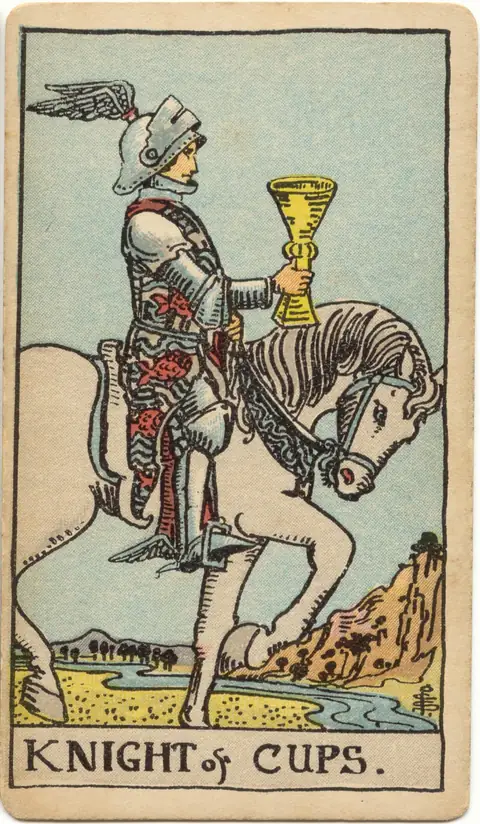
Cards that reinforce itKnight of CupsKnight of Cups: tones transition and momentum, elements water and waterRead the pair
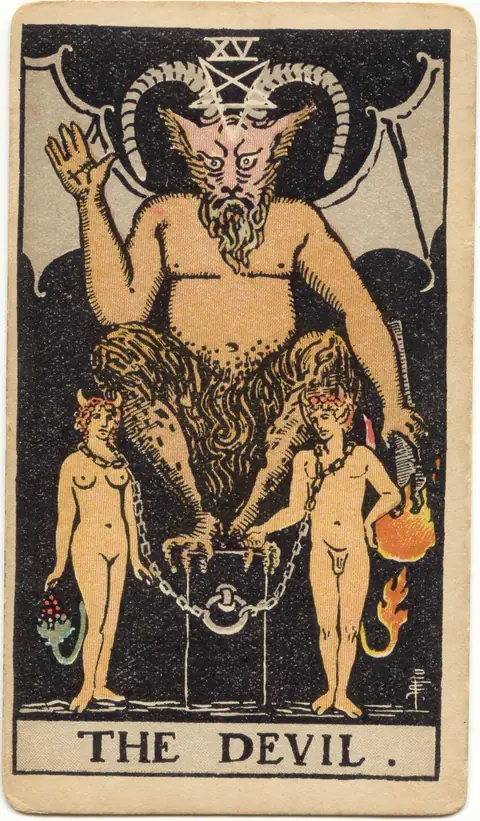
Cards that reinforce itThe DevilThe Devil: tones transition and questioning, elements water and earthRead the pair
Thirteenth Major Arcana, numbered XIII in the Marseille deck and 13 in Waite’s, it reduces to the number 4, that of foundations.
The Marseille deck leaves this card untitled, which gave it its customary name, the nameless arcana, while the Rider-Waite calls it Death and French usage also speaks of La Mort, the name of the card and not of an event. As for correspondences, the Golden Dawn associates it with Scorpio and the Hebrew letter Nun. Its reduced number, 4, adds an idea of base: you do not clear in order to destroy but in order to rebuild on clean ground.
Tarot birth card and numerology
Death is also the tarot birth card for dates that add up to 13; its reduced number, 4, links it to numerology.
Numbers and names read on Conver’s cards and in Waite’s text; correspondences reported according to the Golden Dawn tradition, never as facts.
Number
XIII in the Marseille deck · XIII in Waite’s
Name in the Tarot de Marseille
L’Arcane sans nom
Golden Dawn
Scorpio, letter Nun
Hebrew letter
Nun נ
Sign
Scorpio
Reduced number
4
Tendency (yes / no)
Rather reserved: Versana’s proposal, to be confirmed
Tone
Transition: Versana’s proposal, to be confirmed
Sources
Golden Dawn, Book T (The Tarot), published by Israel Regardie in The Golden Dawn
Nicolas Conver (1760), Tarot de Marseille restored by the Tarot World Project
A. E. Waite, The Pictorial Key to the Tarot (1910)
Sefer Yetzirah: three mother letters, seven doubles, twelve simples
Frequently asked questions about Death
What does Death mean in tarot?
The nameless arcana, or card XIII, speaks of the end of a cycle and of transformation. It shows what ends to make room for something else, like a field that is scythed before it is replanted. It does not describe a dreaded event.
What does Death mean reversed?
Reversed, the card is read as blocked energy, folded in on itself: the end is held back, the change refused. What was meant to close lingers, and the spread invites you to measure what this refusal costs.
Which cards go well with Death?
When the nameless arcana meets a luminous card, it gives an ending that frees; near a card of measure, the transformation happens in stages; near a card of rupture, the turning point is plain. With a card of a new bond, another form takes shape. The six pairs calculated above give examples.
Death in a yes or no reading?
The tendency is rather reserved, because the card speaks of what closes more than of what continues. It calls for nuance depending on the question: to know whether a page can be turned, it becomes more encouraging.