Skip to content

The High Priestess tarot card: meaning, upright and reversed

The High Priestess is the card of hidden knowledge: study in silence and trust your intuition.

  • silence
  • study
  • intuition
The essentials

The High Priestess at a glance

For you

Listen before acting: a knowledge that is kept, an answer that ripens in silence rather than in words.

A strength

Listening, study, and intuition: knowing how to wait until an answer takes shape before speaking it.

Something to watch

Stepping back can become a closed door: you keep to yourself what needed to be said or asked.

Tone
Withdrawal
Yes or no
Nuanced
Read more

By Thomas Guilhot · updated

Upright

The High Priestess is the card of inhabited silence.

The figure is seated, an open book resting on the lap, the gaze turned away, as if absorbed in a reading that no one sees. Many readers see in it study, waiting, and intuition: a knowledge that does not show off.

Upright, she calls for slowing down: observing, listening, letting an answer take shape. She does not push you to act but to understand, and her presence is often read as a sign that some information or some time to ripen is still missing. Her number, two, speaks of duality: two pillars in Waite’s deck, the outside and the inside, the words spoken and those you keep. She imposes nothing: she leaves room for what is ripening.

  • silence
  • study
  • intuition

The High Priestess in your life

In love

A closeness that needs no big speeches, or a time of withdrawal to sort out what you really feel.

In matters of the heart, the High Priestess speaks of reserve and depth: a bond that is built slowly, feelings that need time before they are said. She can also point to a need to withdraw, to take time to understand yourself.

At work

A time of study, preparation, or research: the file is worked on behind the scenes before it is presented.

On the professional level, the High Priestess leans toward study, training, and behind-the-scenes preparation. Tasks of concentration and discretion suit her better than those where you have to be in the spotlight. She suggests weighing things before committing.

With money

Getting informed, comparing, letting things ripen: the card looks at patience and knowledge of the subject, not a quick move.

On the money side, the High Priestess describes a way of acting: getting informed, comparing, waiting until things are clear. She says nothing about what to do with a sum; she looks at patience and knowledge of the subject rather than speed.

As a feeling, as an action

As a feeling

A focused calm, the impression that the essential is already inside and does not need to be said.

As an action

Take the time to read, observe, and stay quiet for a while before deciding or answering.

Reversed

Blocked energy turned inward: the knowledge you do not listen to, the silence that closes and lets nothing through.

In a yes or no reading

Nuanced

An answer to qualify: the High Priestess invites you to wait, get informed, and listen before deciding. The question is not closed; it still needs time.

Questions to ask yourself

  • What do I already know, deep down, that I have not yet listened to?
  • What answer do I already sense, without yet allowing myself to listen to it?
  • What time of silence would I need before answering or deciding?

A sentence to keep: “I give what I feel the time to express itself at its own pace.”

Yes or no tarot

What the card shows

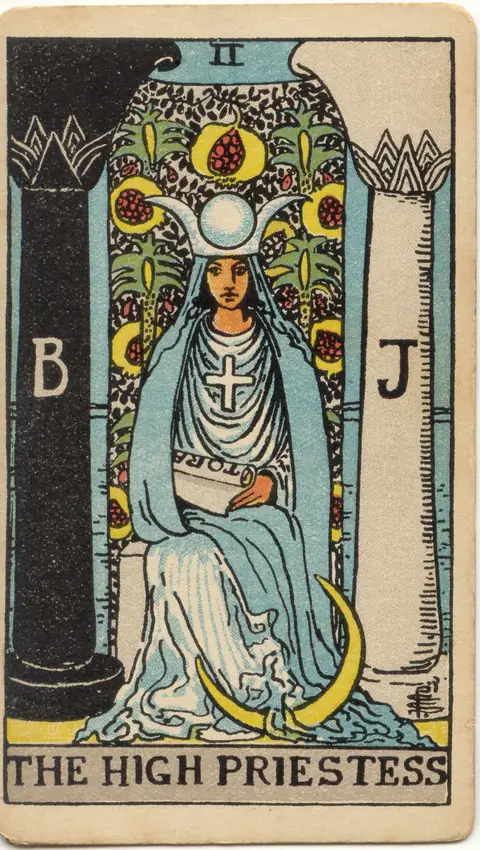
A seated figure wearing a three-tiered crown holds an open book on the lap; the gaze slides to one side, a veil stretched behind: the image invites silent reading.

The red cloak covers a blue dress, and the book stays open on the lap without any of its contents being shown. In the Marseille deck, the veil stretched behind the head separates the figure from the background. In the Rider-Waite version, the High Priestess sits between two pillars, one black and marked B, the other white and marked J. Behind her stretches a veil covered with pomegranates. A crown of lunar horns surrounds a disc, a cross marks the chest, a scroll marked TORA is half hidden in the garment, and a crescent moon rests at her feet. In both images, what is known is not put on display.

Two decks

The High Priestess, Marseille and Rider-Waite

The same card in the two reference decks: Conver’s drawing, dated 1760, and Pamela Colman Smith’s scene, 1909.

Tarot de Marseille · Conver, dated 1760The High PriestessII
Rider-Waite · London, 1909The High PriestessII
The High Priestess: what changes from one deck to the other
AspectTarot de MarseilleRider-Waite
NameLa PapesseThe High Priestess
NumberIIII
ImageThe Marseille deck shows a three-tiered crown, a red cloak over a blue dress, and a sideways gaze above an open book.In Waite’s deck, the High Priestess sits between two pillars marked B and J, in front of a veil of pomegranates, with a TORA scroll half hidden.
ReversalOften not readCommonly read (reversed cards)

Tarot de Marseille: Nicolas Conver, dated 1760, restored by the Tarot World Project, CC BY-SA 4.0 license, via Wikimedia Commons. Rider-Waite: drawings by Pamela Colman Smith, 1909, public domain, via Wikimedia Commons. Images resized and compressed by Versana; Marseille Minor Arcana diagrams and card back drawn by Versana.

The High Priestess: nuances and combinations

In love, depending on your situation

Two situations, two readings: in a current relationship, then in a period without one, and reversed.

Depending on the position in a spread

The position changes the reading: 7 common positions, each upright then reversed.

Which cards it reads well with

Six cards calculated by the combination rules: two that reinforce it, two that nuance it, two in friction. None is “bad.”

The history of the card

Number II in the Marseille deck and 2 in Waite’s, the Popess follows the Magician. The Moon and the letter Gimel are her reference points.

Go further

How is it built?

Numbers and names read on Conver’s cards and in Waite’s text; correspondences reported according to the Golden Dawn tradition, never as facts.

Frequently asked questions about The High Priestess

What does the High Priestess mean in tarot?

The High Priestess is read as study, waiting, and intuition. Her image shows an open book and a stretched veil: a knowledge that is kept. The card invites you to listen, get informed, and let things ripen before acting or answering.

What does the High Priestess mean reversed?

Reversed, the silence closes: blocked energy stays turned inward, and inner knowledge goes unheard. The reading is about a held-back word and an intuition set aside, not about an unfortunate event.

Which cards go well with the High Priestess?

The High Priestess is read in contrast with cards of drive, next to which withdrawal becomes a choice or an enforced pause, and in echo with cards of study or creation, where the silence goes on. The neighboring cards tell whether the waiting is chosen. The “Which cards it reads with” section, above, offers six.

The High Priestess in a yes or no reading?

For a closed question, the answer is to qualify: the High Priestess neither moves forward nor blocks, she asks for time and further information. Reread the question once a new element has appeared.