Skip to content

Five of Cups tarot card: meaning and reversed

The Five of Cups means regret: a loss that holds your gaze, even though there is still something to bounce back with.

  • regret
  • disappointment
  • setback
The essentials

Five of Cups at a glance

For you

A regret to acknowledge, then a gaze to lift: what has been lost does not erase what remains.

A strength

A regret faced squarely: the card acknowledges what has spilled, and reminds us that two cups remain standing.

Something to watch

A gaze fixed on what is spilled can make you forget what remains: regret should not hide the rest of the scene.

Tone
Withdrawal
Read more

By Thomas Guilhot · updated

Upright

The Five of Cups puts emotion to the test.

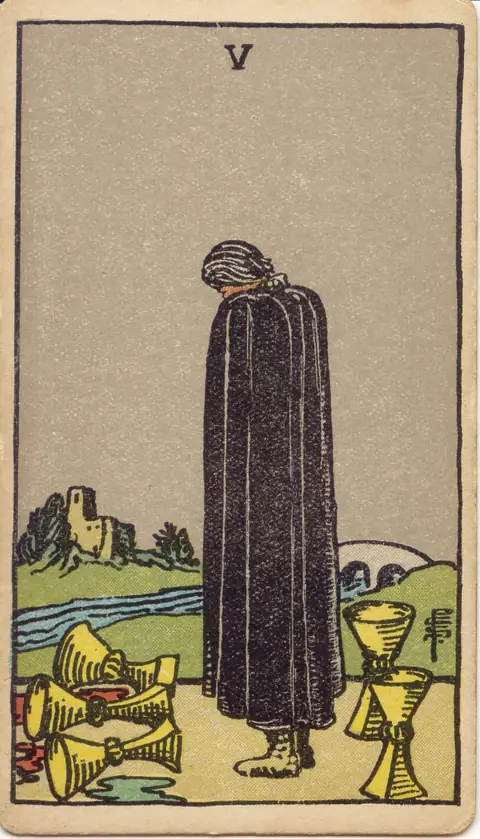
After the withdrawal of the four, a disappointment is voiced: three cups are spilled, and the gaze clings to them. The card is often read as regret, a sadness over what did not hold, a way of going back over what has been spilled.

It does not deny the pain: it invites you to acknowledge it, then to notice the two cups still standing and what the landscape lets you glimpse in the distance.

The turn of the card lies in this movement: turning around, seeing that something is left, and deciding what to do with it. What is lost matters; what remains matters too.

  • regret
  • disappointment
  • setback

Five of Cups in your life

In love

A regret or disappointment weighs on the bond; acknowledging the pain lets you see what remains precious.

In close relationships, it carries regret: a disappointment, a conversation that keeps coming back, a bond that has changed shape. It invites you to acknowledge the pain, then to look at what remains precious.
At work

A project that did not succeed or a missed opportunity occupies the mind; what can be learned is still within reach.

In a team, it evokes disappointment: a project that did not succeed, a missed opportunity. It invites you to draw out what can be learned, then to look at what remains within reach.

With money

A regret over a purchase or a project: the card invites you to take stock of what remains, without concluding quickly.

On the money side, it shows what was lost and what remains: a regret over a purchase or a project. Better to take stock on both sides, without concluding in haste.

As a feeling

A regret turned inward, a gentle sadness over what has spilled.

As an action

Admit the disappointment without playing it down, then turn around: look at the cups still standing and what you can draw from them.

Reversed

Reversed, grief lightens: you finally turn toward the two cups still standing and your gaze lifts.

In a yes or no reading

Rather reserved

The leaning is rather reserved: attention goes to what has spilled. The two upright cups nonetheless invite nuance.

Questions to ask yourself

  • What is left standing behind what I regret, and what can I do with it?
  • What sorrow do I need to say aloud for it to ease?
  • What precious thing do I keep from this bond, even transformed?

A sentence to keep: “I acknowledge my sorrow without letting it hide what still stands around me.”

Yes or no tarot

What the card depicts

A figure in a black cloak, head bowed, looks at three spilled cups; behind them, two cups remain upright. A river, a bridge, a house in the distance.

Two decks

Five of Cups, Marseille and Rider-Waite

The Tarot de Marseille repeats the suit’s pips; the Rider-Waite illustrates each card with a scene.

VFive of CupsDiagram
Tarot de Marseille · pip diagramFive of Cups
Rider-Waite · London, 1909Five of Cups
Five of Cups: what changes from one deck to the other
AspectTarot de MarseilleRider-Waite
NameCinq de coupesFive of Cups
ImageIn the Marseille deck, the Five of Cups offers neither cloak nor river: the suit is read through its patterns, and reversed it says little.Rider-Waite draws the regret: a figure in a black cloak before three spilled cups, two cups upright, a river, a bridge, a house in the distance.
ReversalOften not readCommonly read (reversed cards)

Tarot de Marseille: Nicolas Conver, dated 1760, restored by the Tarot World Project, CC BY-SA 4.0 license, via Wikimedia Commons. Rider-Waite: drawings by Pamela Colman Smith, 1909, public domain, via Wikimedia Commons. Images resized and compressed by Versana; Marseille Minor Arcana diagrams and card back drawn by Versana.

Five of Cups: nuances and combinations

In love, depending on your situation

Two situations, two readings: in a current relationship, then in a period without one, and reversed.

Depending on the position in a spread

The position changes the reading: 7 common positions, each upright then reversed.

Which cards it reads well with

Six cards calculated by the combination rules: two that reinforce it, two that nuance it, two in friction. None is “bad.”

The card’s place in the suit

Fifth number of water, the five follows the withdrawal of the four and precedes the Six of Cups. Mars, in the first decan of Scorpio, is its planet.

The card’s number

The card carries the number 5: in numerology as in the suit, one stage of a progression from 1 to 10.

Go further

  • Scorpio 1st decanThe decan the Golden Dawn assigns to this card
  • VeualiahThe angel of the same decan, according to Lenain
  • IelahiahThe angel of the same decan, according to Lenain

How is it built?

Suit and number read on the deck; decan and planet reported according to the Golden Dawn tradition, never as facts.

Frequently asked questions about Five of Cups

What does the Five of Cups mean in tarot?

The Five of Cups reads as a regret: three spilled cups, a black cloak, a bowed head. It speaks of disappointment and sadness, but also shows two cups still upright, which invite you to look at what remains.

What does the Five of Cups mean reversed?

Reversed, the Five of Cups speaks of a pain being untangled: the gaze leaves the spilled cups for the two still standing. Grief weighs less, and what remains becomes visible again.

Which cards go well with the Five of Cups?

The Five of Cups follows the card of withdrawal, whose weariness it extends into regret, and precedes the one of memory. Tied to the suit’s opening card, it recalls that emotion can be renewed after disappointment, without promising it. The pairings above offer cards to try.

The Five of Cups in a yes or no reading?

For a closed question, the Five of Cups leans rather reserved: attention goes to what has spilled. The two upright cups nonetheless invite nuance, with the help of the neighboring cards.