Skip to content

Five of Wands tarot card: meaning and reversed

The Five of Wands embodies rivalry: points of view that clash and spur each person to make progress.

  • rivalry
  • emulation
  • confrontation
The essentials

Five of Wands at a glance

For you

A lively rivalry, between play and quarrel, where each person looks for their place and sharpens their arguments.

A strength

A lively emulation: opinions confront each other, each person asserts their place, and the project gains in precision.

Something to watch

When everyone pulls their own way, confusion wins; without a common rule, the game can turn into a real quarrel.

Tone
Questioning
Read more

By Thomas Guilhot · updated

Upright

Upright, the Five of Wands is read as a confrontation of forces that have not yet found their order.

Several ways of doing things coexist, no one gives way completely, and each measures themselves against the others. This friction is not necessarily negative: it can stimulate, clarify, push you to refine an idea. The card invites you to listen to opposing views, to spot what is play and what is conflict, then to set a frame that allows cooperation.

  • rivalry
  • emulation
  • confrontation

Five of Wands in your life

In love

Opinions that clash, teasing, or a disagreement to reconcile, with a part of play.

In a relationship, it evokes opinions that clash, teasing, or disagreements to reconcile. For someone who is single, it can speak of a game of seduction where each tests the other.

At work

Competition between colleagues or methods at odds: setting common rules would calm the scene.

At work, it corresponds to competition between colleagues, a project where several methods are at odds, a lively meeting. It invites you to set common rules of the game.

With money

Measuring yourself against others, comparing offers, negotiating: the card speaks of a ground of rivalry, not of a result.

On the resources side, the card describes a gesture: measuring yourself against others, comparing offers, negotiating. Nothing is said about the result, only about a ground of rivalry to be framed.

As a feeling

A stimulating agitation, the impression of having to defend your place while keeping a sense of play.

As an action

Listen to each position, name what sets them against each other, then propose a common rule to move forward together.

Reversed

Reversed, the card sees the intensity ease: the rivalry subsides, the wands lower, and the positions can be listened to.

In a yes or no reading

Rather reserved

The card leans toward reserve: the question meets opposing views that will need to be reconciled before moving forward.

Questions to ask yourself

  • Is this confrontation a game that stimulates or a disagreement that needs a frame?
  • Which disagreement looks more like a game than a real conflict?
  • What shared rule would you need to talk without confronting each other?

A sentence to keep: “I can tell a game of strength from a disagreement that needs to be laid out.”

Yes or no tarot

What the card depicts

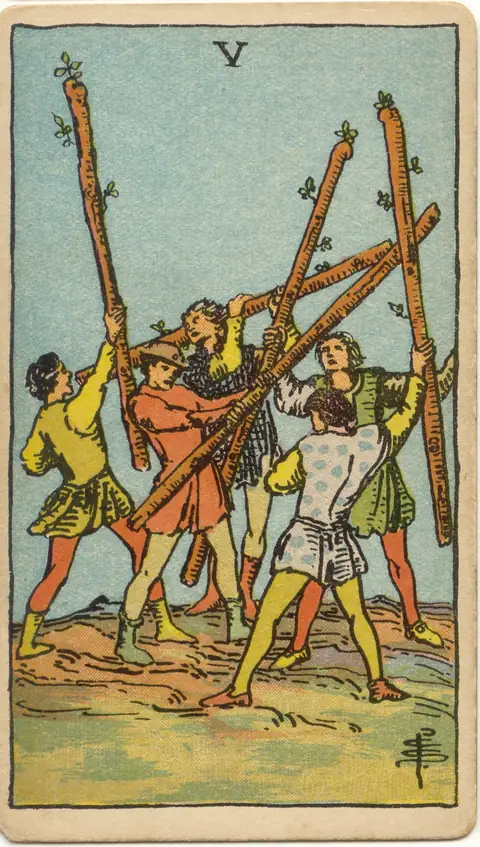
Five figures brandish wands and clash them together; no one is hurt, and the gesture is as much play as quarrel.

Two decks

Five of Wands, Marseille and Rider-Waite

The Tarot de Marseille repeats the suit’s pips; the Rider-Waite illustrates each card with a scene.

VFive of WandsDiagram
Tarot de Marseille · pip diagramFive of Wands
Rider-Waite · London, 1909Five of Wands
Five of Wands: what changes from one deck to the other
AspectTarot de MarseilleRider-Waite
NameCinq de bâtonsFive of Wands
ImageThe Marseille deck keeps the wands as patterns, without a scene of struggle; the reversed card offers little hold for interpretation there.In the Rider-Waite deck, the scene shows five figures with clashing wands, no injury, between play and quarrel.
ReversalOften not readCommonly read (reversed cards)

Tarot de Marseille: Nicolas Conver, dated 1760, restored by the Tarot World Project, CC BY-SA 4.0 license, via Wikimedia Commons. Rider-Waite: drawings by Pamela Colman Smith, 1909, public domain, via Wikimedia Commons. Images resized and compressed by Versana; Marseille Minor Arcana diagrams and card back drawn by Versana.

Five of Wands: nuances and combinations

In love, depending on your situation

Two situations, two readings: in a current relationship, then in a period without one, and reversed.

Depending on the position in a spread

The position changes the reading: 7 common positions, each upright then reversed.

Which cards it reads well with

Six cards calculated by the combination rules: two that reinforce it, two that nuance it, two in friction. None is “bad.”

The card’s place in the suit

Fifth of the suit of Wands, the Five carries the number 5: that of instability, where the forces present measure themselves.

The card’s number

The card carries the number 5: in numerology as in the suit, one stage of a progression from 1 to 10.

Go further

  • Leo 1st decanThe decan the Golden Dawn assigns to this card
  • Nith-HaiahThe angel of the same decan, according to Lenain
  • HaaiahThe angel of the same decan, according to Lenain

How is it built?

Suit and number read on the deck; decan and planet reported according to the Golden Dawn tradition, never as facts.

Frequently asked questions about Five of Wands

What does the Five of Wands mean in tarot?

The Five of Wands represents rivalry and emulation: five figures clash their wands, with no injury, between play and quarrel. It invites you to listen to opposing views and to set a common frame in order to move forward.

What does the Five of Wands mean reversed?

Reversed, the Five sees its intensity ease: the rivalry subsides, the tensions calm down. It remains to check that the calm is not simply silence. The Tarot de Marseille offers hardly any marker for this reversed position.

Which cards go well with the Five of Wands?

The Five of Wands confronts the stability gained with opposing views, after the card of frame that precedes it. Next to another suit, the clash changes shade: discussion, competition, or lively emulation, depending on the cards around it. The pairings above show it.

The Five of Wands in a yes or no reading?

The tendency is rather reserved: the question meets opposing views to be reconciled before moving forward. It remains to be nuanced according to the mood, play or quarrel, and the neighboring cards help to decide.