Skip to content

The Devil tarot card: meaning, upright and reversed

The Devil is the card of attachments: desires, habits, and bonds that hold, to be faced in order to free yourself.

  • attachment
  • questioning
  • clear sight
The essentials

The Devil at a glance

For you

A bond pulls and binds: desire, habit, or fear, it is to be faced, for the chains are often looser than you imagine.

A strength

It puts words on what binds, tempts, or holds you back, and makes visible a tie that you can loosen.

Something to watch

Its image impresses, but it describes a hold that can be looked at and untied, never an outside threat.

Tone
Questioning
Read more

By Thomas Guilhot · updated

Upright

Upright, the Devil speaks of what binds: a habit, an attraction, a fear, a relationship in which you stay without knowing why.

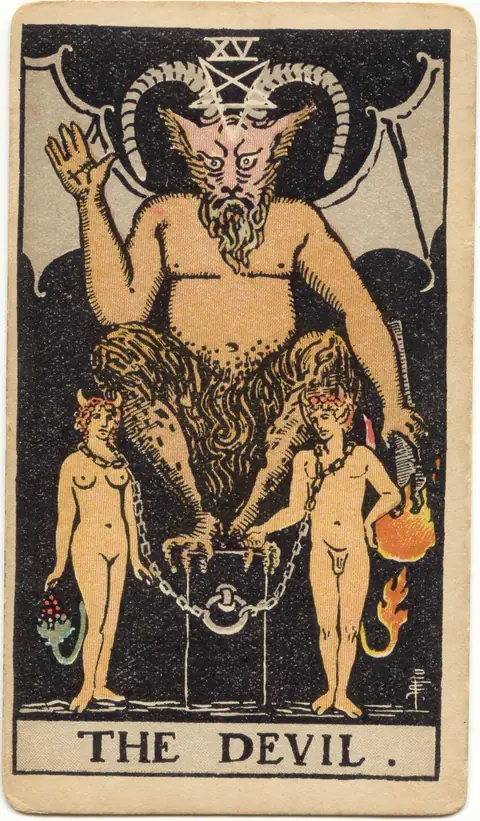
The card does not judge, it shows. The pedestal is solid, but the ties are often looser than you think, like the chains of the Rider-Waite. Many readers see in it an invitation to face what pulls at you, to recognize the part of choice in the attachment, and to question what it brings you. The card also touches desire, ambition, the pull of what is intense. It proposes a questioning: what is holding me back, and what do I get from it? That question, asked calmly, is often enough to shift how you see the situation. For a commitment to make, the tendency stays cautious: the card asks for clear sight first. Seeing yourself tied is already the first step toward loosening.

  • attachment
  • questioning
  • clear sight

The Devil in your life

In love

A powerful attraction or a habitual attachment: the card invites you to ask whether the bond is freely chosen.

In a relationship, the card can evoke a powerful attraction or an attachment that goes on out of habit. It invites you to ask what really holds you, and whether the bond is freely chosen or simply maintained.

At work

You stay in place out of obligation, ambition, or fear; the card invites you to see the room for maneuver that remains.

On the work side, the card can speak of a situation in which you stay out of obligation, ambition, or fear of losing. It invites you to look at what holds you and to ask what room for maneuver still exists.

With money

A strained relationship to possession or to habitual spending; the card invites you to look at what drives you to act.

For money, the card evokes a strained relationship: a pull toward possession, a commitment that is too heavy, spending habits that tug at you, purchases made by reflex more than by choice. It is a way of acting to examine calmly, never investment advice.

As a feeling, as an action

As a feeling

A strong attraction mixed with discomfort: you sense what pulls, without yet knowing how to free yourself.

As an action

Look at the bond squarely, note what it brings and what it costs, then choose to keep it or loosen it.

Reversed

Loosening a hold: you notice that the ties were loose and you begin to free yourself from them.

In a yes or no reading

Rather reserved

Rather reserved tendency: the card calls for clear sight. A question driven by attraction or pressure asks to be looked at closely.

Questions to ask yourself

  • What holds me here, and what does this bond really bring me?
  • What quiet advantage do I draw from this situation, even if it weighs on me?
  • If the cord were looser than I believe, what would I try?

A sentence to keep: “I look at what binds me without judging myself, and I choose what I keep.”

Yes or no tarot

What the card shows

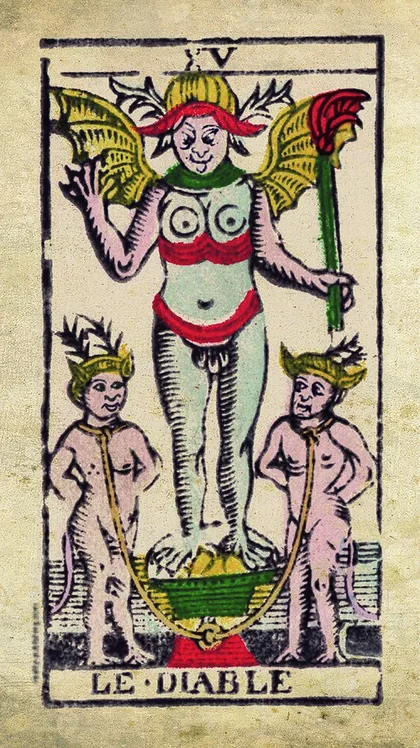
In Conver’s Marseille deck, a figure with bat wings and stag antlers on the head stands on a pedestal, one hand raised, the other holding a torch.

Two small horned figures, hands behind their backs, are tied by a rope at the neck to the pedestal. The drawing is frontal: nothing hidden, everything offered to the gaze from the first instant. In the Rider-Waite, the figure with goat horns, an inverted pentagram on the forehead, and bat wings sits on a black cube, right hand raised, torch lowered. Two naked, horned, tailed figures are chained to it by the neck. A decisive detail: the chains are loose, and it would be enough to lift them off. The image thus shows both the hold and the way out, which gives the card its particular reversed reading.

Two decks

The Devil, Marseille and Rider-Waite

The same card in the two reference decks: Conver’s drawing, dated 1760, and Pamela Colman Smith’s scene, 1909.

Tarot de Marseille · Conver, dated 1760The DevilXV
Rider-Waite · London, 1909The DevilXV
The Devil: what changes from one deck to the other
AspectTarot de MarseilleRider-Waite
NameLe DiableThe Devil
NumberXVXV
ImageIn the Marseille deck, two small horned figures with hands behind their backs are tied by the neck to the pedestal.The Rider-Waite sets the figure on a black cube and shows two naked silhouettes with loose chains.
ReversalOften not readCommonly read (reversed cards)

Tarot de Marseille: Nicolas Conver, dated 1760, restored by the Tarot World Project, CC BY-SA 4.0 license, via Wikimedia Commons. Rider-Waite: drawings by Pamela Colman Smith, 1909, public domain, via Wikimedia Commons. Images resized and compressed by Versana; Marseille Minor Arcana diagrams and card back drawn by Versana.

The Devil: nuances and combinations

In love, depending on your situation

Two situations, two readings: in a current relationship, then in a period without one, and reversed.

Depending on the position in a spread

The position changes the reading: 7 common positions, each upright then reversed.

Which cards it reads well with

Six cards calculated by the combination rules: two that reinforce it, two that nuance it, two in friction. None is “bad.”

The history of the card

Fifteenth Major Arcana, written XV in the Marseille deck and 15 in Waite’s, it reduces to the number 6, that of bonds and choice.

Go further

  • CapricornThe sign the Golden Dawn assigns to this card
  • 15:15The hour that bears the card’s number

How is it built?

Numbers and names read on Conver’s cards and in Waite’s text; correspondences reported according to the Golden Dawn tradition, never as facts.

Frequently asked questions about The Devil

What does the Devil mean in tarot?

The Devil, card XV, speaks of attachments: attraction, habit, hold, a desire that pulls. The ties in the drawing are loose, a reminder that you keep a part of the choice. The card invites you to see the bond before deciding to loosen it.

What does the Devil mean reversed?

Reversed, the Devil is most often read as its opposite: detaching, loosening a hold, taking back your freedom. It is the only card in the deck where the opposite meaning is the default reading of the reversal.

Which cards go well with the Devil?

The Devil invites you to find a measure again near the cards of balance, lets awareness shake a structure near the cards of upheaval, and stands gently near the cards of patience. Near a card of clarity, clear sight is lit up. Six cards above shed light on it.

The Devil in a yes or no reading?

The tendency is rather reserved: the card asks you to look at what holds you back before committing. Depending on the question, the reading can soften, because awareness also opens a freer path.