Skip to content

Knight of Swords tarot card: meaning and reversed

The Knight of Swords expresses determination: a thought that charges ahead and shrinks from no obstacle.

  • drive
  • determination
  • speed
The essentials

Knight of Swords at a glance

For you

Charging toward a goal cleanly: the drive of an idea launched at full speed, tenacious in the face of resistance and determined to succeed.

A strength

Taking action cleanly, holding your course, and moving an idea forward without waiting.

Something to watch

Momentum can outrun reflection: haste misses details and jostles those who follow.

Way of acting
Acting
Yes or no
Nuanced
Read more

By Thomas Guilhot · updated

Upright

The Knight of Swords speaks of decision and movement.

He evokes a frank, quick way of acting: an idea is chosen, then pursued with tenacity. Many readers see in him a moment when you push against resistance, speak loudly and plainly, and want to get there without dragging your feet. His vigor is an asset when the goal is clear. It also calls you to keep an eye on the road, because momentum, left alone, sometimes neglects what it pushes aside on the way. The neighboring cards say whether to speed up or slow down.

  • drive
  • determination
  • speed

Knight of Swords in your life

In love

A direct approach that proposes and follows up without waiting: appealing if it respects the other person’s pace.

In a relationship, the card evokes a direct approach: saying things right away, proposing, following up. This frankness can charm or overwhelm. Watching the other person’s pace lets the drive remain an invitation.

At work

A file driven quickly, a clear-cut decision, an idea defended with tenacity: efficiency is there if the essentials are checked.

In the professional field, he describes a file driven forward at full tilt, a quick decision, an idea defended with tenacity. Efficiency gains if the essential steps are checked before setting off.

With money

A quick move to prepare with care: compare before acting rather than giving in to haste.

For money, the card speaks of a quick move that is poorly prepared if made in haste. It invites you to compare before acting; it is neither financial advice nor an encouragement to spend or invest.

As a feeling

A strong conviction and the impatience to move forward, with the feeling that every hesitation loses ground.

As an action

Move frankly toward the goal, checking the decisive points before setting off so as not to leave details behind you.

Reversed

Haste: drive outruns reflection, you charge ahead before looking at the road and jostle whatever is in the way.

In a yes or no reading

Nuanced

A “maybe”: the card leans toward quick action, but haste remains its risk. It invites you to check the essentials before moving on, and the neighboring cards refine the meaning.

Questions to ask yourself

  • What am I heading toward with drive, and have I checked what I am pushing aside on the way?
  • What am I chasing so fast, and who is it really for?
  • Whom or what have I passed on the way without looking?

A sentence to keep: “I keep my momentum and also look at what lies beside the road.”

Yes or no tarot

What the card depicts

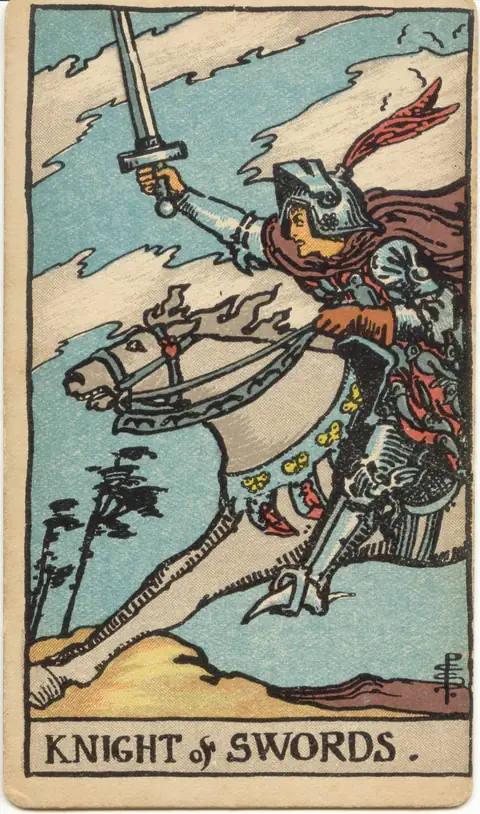
A knight in armor, sword raised, gallops against the wind. Around him, torn clouds and bent trees.

Two decks

Knight of Swords, Marseille and Rider-Waite

The Tarot de Marseille repeats the suit’s pips; the Rider-Waite illustrates each card with a scene.

Knight of SwordsDiagram
Tarot de Marseille · pip diagramKnight of Swords
Rider-Waite · London, 1909Knight of Swords
Knight of Swords: what changes from one deck to the other
AspectTarot de MarseilleRider-Waite
NameCavalier d’épéesKnight of Swords
ImageIn the Tarot de Marseille, the reading starts from the Knight’s rank and the suit of Swords; the storm and the bent trees are specific to the Rider-Waite.The Rider-Waite version shows the ride in the middle of a storm, with torn clouds and bent trees, which underlines the drive against resistance.
ReversalOften not readCommonly read (reversed cards)

Tarot de Marseille: Nicolas Conver, dated 1760, restored by the Tarot World Project, CC BY-SA 4.0 license, via Wikimedia Commons. Rider-Waite: drawings by Pamela Colman Smith, 1909, public domain, via Wikimedia Commons. Images resized and compressed by Versana; Marseille Minor Arcana diagrams and card back drawn by Versana.

Knight of Swords: nuances and combinations

In love, depending on your situation

Two situations, two readings: in a current relationship, then in a period without one, and reversed.

Depending on the position in a spread

The position changes the reading: 7 common positions, each upright then reversed.

Which cards it reads well with

Six cards calculated by the combination rules: two that reinforce it, two that nuance it, two in friction. None is “bad.”

The card’s place in the suit

Among the court cards of Swords, the Knight sits between the Page and the Queen, as the moment when the idea sets itself in motion.

How is it built?

Suit and number read on the deck; decan and planet reported according to the Golden Dawn tradition, never as facts.

Frequently asked questions about Knight of Swords

What does the Knight of Swords mean in tarot?

The Knight of Swords is read as drive put to the service of an idea: quick decision, direct speech, tenacity in the face of obstacles. He describes a movement rather than a character: that of charging toward a goal with total conviction.

What does the Knight of Swords mean reversed?

Reversed, haste takes the controls: you act before thinking, you jostle, you forget details. Rereading the plan and checking what was forgotten along the way lets you take back control.

Which cards go well with the Knight of Swords?

With other Swords, he accentuates the speed and sharpness of exchanges. Next to Cups, the drive meets emotions; next to Pentacles, it runs into the concrete and into patience; next to Wands, it adds to the ardor of a project.

The Knight of Swords in a yes or no reading?

When you need a clear-cut answer, the Knight leans toward action while reminding you of the risk of haste; only the neighboring cards and a check of the facts let you refine the answer.