Skip to content

Page of Swords tarot card: meaning and reversed

The Page of Swords means an alert mind: vigilance, fresh ideas, and a wish to understand everything.

  • curiosity
  • quickness
  • questions
The essentials

Page of Swords at a glance

For you

Observing, questioning, learning fast: the lively curiosity of someone discovering the power of ideas and words.

A strength

Asking frank questions, quickly grasping a new idea, and daring to say it out loud.

Something to watch

Curiosity can turn into prying, and a word that is too quick can hurt before it has been weighed.

Way of acting
Learning
Yes or no
Nuanced
Read more

By Thomas Guilhot · updated

Upright

The Page of Swords invites an attitude of alertness: looking, questioning, checking, learning by handling ideas and words.

It is a way of acting more than a fixed state, the tone of a passage in which you test your arguments and discover that a well-turned phrase can open or close a door. For many readers, it is a stage of learning, a quickness of mind that prefers to understand before concluding. The card also asks for vigilance: the faster the word, the more it gains from being set down with care.

  • curiosity
  • quickness
  • questions

Page of Swords in your life

In love

A relationship that opens through conversation: getting to know each other by asking questions and daring to say what you think.

In a relationship, the card is read as a taste for getting to know each other through conversation: asking questions, listening to the answers, risking a confidence. Frankness has value, as long as everyone keeps the freedom to answer at their own pace.

At work

Quick learning, staying informed, and exchanges of ideas: a new subject is best approached through questions.

At work, it evokes quick learning, staying informed, exchanges of ideas, and first attempts. A new subject is best approached through questions. Checking before passing on information, and keeping sensitive matters to yourself, avoids many misunderstandings.

With money

Getting informed, comparing, and reading the details before acting: a learning approach rather than investment advice.

As for money, it is better to get informed before acting: compare, ask questions, read the details. The card describes a way of educating yourself, never financial advice or a forecast about an amount.

As a feeling

A mind on the alert, curious to understand everything, with the wish to say and check what you have just discovered.

As an action

Ask your questions, check what you put forward, and take time to weigh a sentence before sending it.

Reversed

Curiosity turning into prying, the word too quick: the excess of a mind that speaks before it has weighed its words.

In a yes or no reading

Nuanced

A “maybe”: the card speaks of a passage, a phase of observation, and invites you to check the facts before deciding. Neighboring cards tip the balance, depending on whether they support observation or action.

Questions to ask yourself

  • Which question do you dare to ask, and do you phrase it with tact?
  • Which question are you keeping in reserve, and when would it be welcome?
  • What did you check before putting forward what you think you know?

A sentence to keep: “I ask my questions with curiosity, and I give each person time to answer.”

Yes or no tarot

What the card depicts

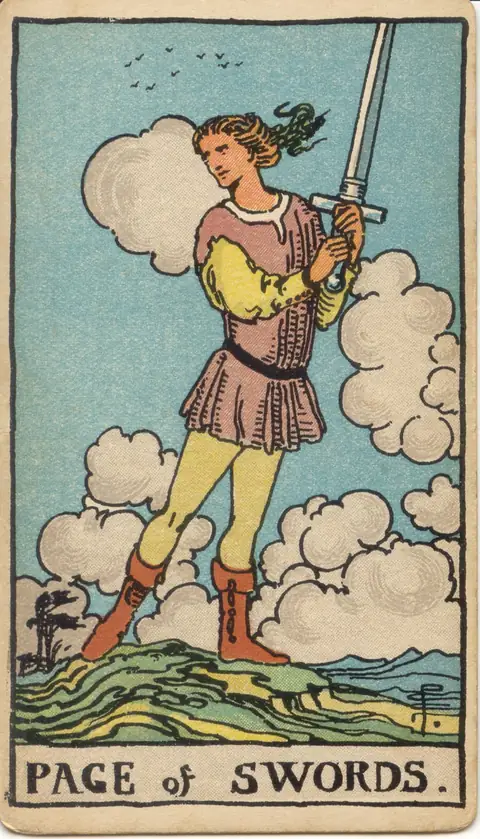
A person stands on windswept ground, sword raised in both hands, looking back over one shoulder. Above, clouds and birds.

Two decks

Page of Swords, Marseille and Rider-Waite

The Tarot de Marseille repeats the suit’s pips; the Rider-Waite illustrates each card with a scene.

Page of SwordsDiagram
Tarot de Marseille · pip diagramPage of Swords
Rider-Waite · London, 1909Page of Swords
Page of Swords: what changes from one deck to the other
AspectTarot de MarseilleRider-Waite
NameValet d’épéesPage of Swords
ImageThe Tarot de Marseille looks first at the figure’s rank and the suit of Swords; this version adds a scene, which a reading can set alongside that foundation.In the Rider-Waite version, the wind, the glance over the shoulder, and the birds give the figure its vigilance, which other decks do not always show.
ReversalOften not readCommonly read (reversed cards)

Tarot de Marseille: Nicolas Conver, dated 1760, restored by the Tarot World Project, CC BY-SA 4.0 license, via Wikimedia Commons. Rider-Waite: drawings by Pamela Colman Smith, 1909, public domain, via Wikimedia Commons. Images resized and compressed by Versana; Marseille Minor Arcana diagrams and card back drawn by Versana.

Page of Swords: nuances and combinations

In love, depending on your situation

Two situations, two readings: in a current relationship, then in a period without one, and reversed.

Depending on the position in a spread

The position changes the reading: 7 common positions, each upright then reversed.

Which cards it reads well with

Six cards calculated by the combination rules: two that reinforce it, two that nuance it, two in friction. None is “bad.”

The card’s place in the suit

Among the court cards of Swords, the Page comes first, right after the numbered cards of the suit and before the Knight.

How is it built?

Suit and number read on the deck; decan and planet reported according to the Golden Dawn tradition, never as facts.

Frequently asked questions about Page of Swords

What does the Page of Swords mean in tarot?

The Page of Swords is read as curiosity in action: observing, questioning, learning fast. It speaks of a passage and of a way of handling ideas and words, with liveliness. Many readers see in it a call to check what you put forward before saying it.

What does the Page of Swords mean reversed?

Reversed, excess takes over: curiosity becomes prying, the word too quick. The card then invites you to slow down, weigh your words, and respect what belongs to another person’s privacy.

Which cards go well with the Page of Swords?

With other Swords, it reinforces the register of ideas and exchanges. Next to a Cups card, the word touches emotions; next to a Pentacles card, it turns toward the concrete; next to a Wands card, it becomes drive and project.

The Page of Swords in a yes or no reading?

Faced with a closed question, this Page calls for nuance. It describes a time of observation and learning more than a clear-cut decision; the answer sharpens thanks to the neighboring cards and the wording you choose.