Reversed tarot cards: four ways to read a reversal
A reversed card adds a nuance to its meaning: the same theme lived differently, which you choose to read or not.
By Thomas Guilhot · updated
Reversed cards at a glance
A card drawn upside down offers a second nuance to its meaning, which you choose to read or set aside depending on how you draw.
By Thomas Guilhot · updated
Reversed cards, in practice
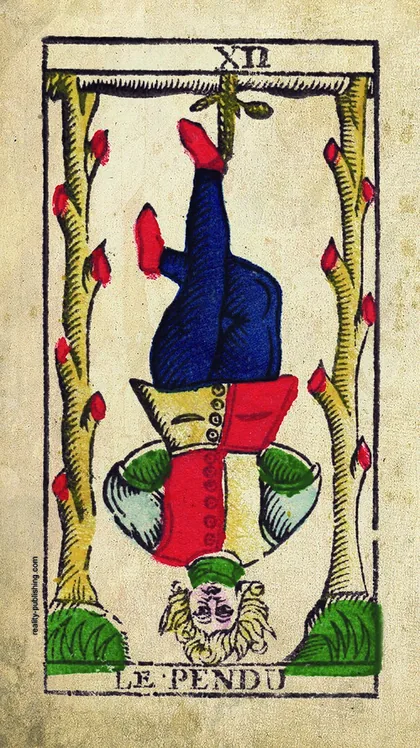
| Method | The Hanged Man reversed |
|---|---|
| Blocked energy | Blocked energy: the Hanged Man reversed can be read as a suspension that leads nowhere, a stop where you stay frozen and nothing turns around. |
| Excess | Excess reading: the reversed Hanged Man sometimes evokes a stop that stretches too long, a pause prolonged until not acting becomes a habit. |
| Softened intensity | Softened reading: the Hanged Man turned over could be read as a stop that loosens, a pause that weighs less as the need to suspend everything gradually fades. |
| Opposite | Opposite reading: the Hanged Man turned over stands upright, and the stop gives way to a return to action. |
What you need to know
A tradition, not a rule
Reading reversals is not required. Many readers of the Tarot de Marseille do not do it, and look only at the image, the number, and the position of the card. Rider-Waite readers do it more often, because each scene there has an obvious top and bottom. On Versana, reversals are turned off by default: you turn them on if this way of reading speaks to you.
Four ways to read it
There is no single reading of a reversal. Some see a blocked force struggling to express itself, others a force pushed too far. A third approach hears it as a softened, more discreet version, and a fourth as the opposite of the usual meaning. Versana offers these four methods and leaves them to your choice, without imposing one. Try them in turn on the same spread to see which one sheds the most light for you.
When the card comes out reversed
Most often, a reversal comes from the shuffle: a card slips into the deck upside down, with no particular intention. On Versana, once reversals are turned on, each card has a one-in-two chance of being reversed, as in a shuffled deck where you do not line up the cards. Nothing requires you to make it an event. You can turn it upright, read it as it is, or look at it as an invitation to ask what, in the situation, is showing up the wrong way around. That question also applies to a card that was already upright.
Frequently asked questions: Reversed cards
Reversed cards: what matters most?
Reversed cards are cards drawn upside down. Some traditions attribute to them a nuance of the usual meaning: blockage, excess, softening, or inversion. Others read them like upright cards. It is a reading option, which you can turn on or off on Versana.
Is it a rule or a tradition?
It is a tradition, not a rule. Tarot de Marseille readers often do without it, Rider-Waite readers practice it more readily. No method is more right than another: what matters is the insight it brings you on a situation.
How do you apply it in a reading?
First choose a method and keep it for the whole spread. When a card is reversed, read its usual meaning and then the chosen nuance, and see whether it sheds light on the question asked. If it tells you nothing, turn it upright without hesitation.
To go further
- How to draw the cardsShuffle, cut, choose, lay out: the steps of a tarot reading, and what each layout lets you look at.
- Reading a cardRead a card from its image, its number, and its position in the spread, without a memorized dictionary of meanings.
- Elements and suitsWands, Cups, Swords, Pentacles: the four suits, their elements according to tradition, and how they answer each other.
- History of tarotFrom the Italian card game of the 15th century to the readings of the late 18th century, then the Rider-Waite of 1909: the key stages.