Skip to content

Ten of Swords tarot card: meaning and reversed

The Ten of Swords marks the full stop: what had to end ends, and another page can open.

  • clean ending
  • closing
  • page turned
The essentials

Ten of Swords at a glance

For you

A clean ending: a situation has run its course, and reading it literally would be a misreading; the horizon is already clearing.

A strength

Recognizing that a situation has run its course, and detaching from it without prolonging it.

Something to watch

Insisting on reviving what is finished, or reading the image as a drama rather than a clean ending.

Tone
Transition
Read more

By Thomas Guilhot · updated

Upright

Upright, the Ten of Swords is read as a clean ending: a situation, an expectation, a way of thinking comes to its end.

The image is exaggerated to mark that there is nothing left to add. On the thought side, everything has been turned over and over: the mind has gone all the way around. The card invites you to accept this conclusion, to stop replaying what has already been said, and to turn your gaze toward the clearing horizon. It describes nothing literal: no violence, no harm to anyone. In a spread, the neighboring card indicates what can come after.

  • clean ending
  • closing
  • page turned

Ten of Swords in your life

In love

A chapter coming to its end, which you gain by naming rather than replaying.

A chapter of a relationship may be reaching its end: a habit, an expectation, a misunderstanding that lasted a long time. Naming this ending avoids replaying it endlessly. The card describes a stage, not the worth of a bond.
At work

The closing of a project or a worn-out method, which frees up room for something else.

It can evoke the closing of a project, a job, or a method that has had its day. Taking stock, then preparing what follows, is more useful than being relentless.

With money

The end of a habit or a commitment, closed cleanly so you can start again on a new footing.

It evokes the end of a way of managing money, of a commitment, or of a spending item. Closing it cleanly, in writing, leaves room for a new organization.

As a feeling

A mix of fatigue and relief, that of a page being turned.

As an action

Close what needs closing with a clear decision, then turn your gaze toward the clearer horizon.

Reversed

The intensity subsides: the hardest part is behind you, and you get back up little by little, at your own pace.

In a yes or no reading

Rather reserved

Reservation dominates: what is being asked seems to have had its day, and it is better to look elsewhere.

Questions to ask yourself

  • What is truly finished, and what do you keep replaying?
  • Which part of this story has already ended without your acknowledging it?
  • What first light, even a thin one, do you glimpse on the horizon?

A sentence to keep: “I acknowledge what is ending and let the light in the distance gain ground.”

Yes or no tarot

What the card depicts

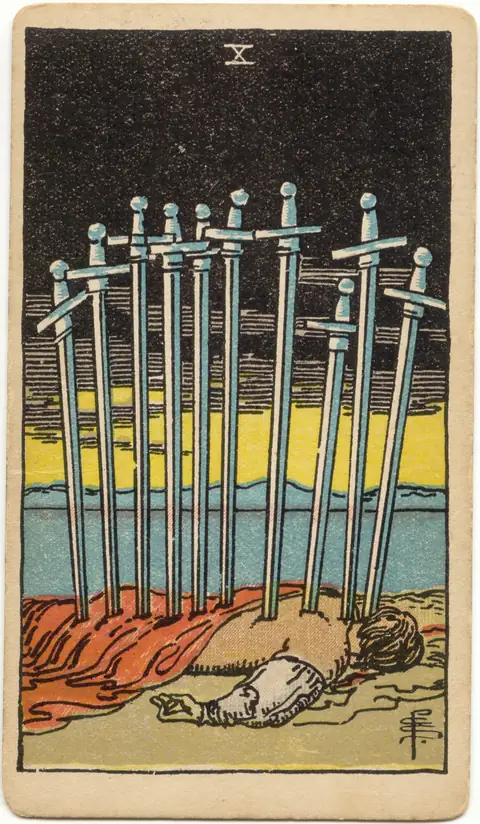
A figure lies face down, ten swords planted in the back, with a red cloth; the black sky lightens to yellow above the water, at the horizon.

Two decks

Ten of Swords, Marseille and Rider-Waite

The Tarot de Marseille repeats the suit’s pips; the Rider-Waite illustrates each card with a scene.

XTen of SwordsDiagram
Tarot de Marseille · pip diagramTen of Swords
Rider-Waite · London, 1909Ten of Swords
Ten of Swords: what changes from one deck to the other
AspectTarot de MarseilleRider-Waite
NameDix d’épéesTen of Swords
ImageNothing but ten swords arranged in a pattern: in the Marseille deck, the number ten alone carries the reading.A strong scene: a figure lying down, ten swords in the back, a red cloth, and a black sky lightening to yellow.
ReversalOften not readCommonly read (reversed cards)

Tarot de Marseille: Nicolas Conver, dated 1760, restored by the Tarot World Project, CC BY-SA 4.0 license, via Wikimedia Commons. Rider-Waite: drawings by Pamela Colman Smith, 1909, public domain, via Wikimedia Commons. Images resized and compressed by Versana; Marseille Minor Arcana diagrams and card back drawn by Versana.

Ten of Swords: nuances and combinations

In love, depending on your situation

Two situations, two readings: in a current relationship, then in a period without one, and reversed.

Depending on the position in a spread

The position changes the reading: 7 common positions, each upright then reversed.

Which cards it reads well with

Six cards calculated by the combination rules: two that reinforce it, two that nuance it, two in friction. None is “bad.”

The card’s place in the suit

The tenth card of Swords, it follows the worry of the nine and closes the suit: the mind reaches the end of what it could turn over and over.

Go further

  • Gemini 3rd decanThe decan the Golden Dawn assigns to this card
  • LauviahThe angel of the same decan, according to Lenain
  • CalielThe angel of the same decan, according to Lenain

How is it built?

Suit and number read on the deck; decan and planet reported according to the Golden Dawn tradition, never as facts.

Frequently asked questions about Ten of Swords

What does the Ten of Swords mean in tarot?

The Ten of Swords represents a clean ending: a situation has run its course, and insisting serves no purpose. The image is deliberately over the top, with ten swords in the back of a figure lying down, but it is never read literally; the sky clears at the horizon.

What does the Ten of Swords mean reversed?

Reversed, the card speaks of an intensity that subsides: the hardest part is behind you, and you get back up little by little. In the Marseille deck, the reversed card is almost unreadable.

Which cards go well with the Ten of Swords?

It pairs with a card of opening or renewal, which shows what can follow the closing, or with a supporting card. The associations offered on the page, drawn from the calculation, extend this reading without a verdict.

The Ten of Swords in a yes or no reading?

Its tendency is rather reserved: what is being asked seems to have had its day. This is not a refusal, but an invitation to close before opening something else: what needs to end?