Upright, the World is read as a completion: the figure at the center of its wreath forms a whole, and the four
presences in the corners give the set a balance.
Its number, XXI, reduces to 3; the tone is one of stability, a solid base from which to look back at the road traveled.
In a concrete situation, the World can accompany the end of an undertaking carried through, the recognition of a
path, or the impression that the pieces finally hold together. It invites you to celebrate what is done, to draw
lessons from it, then to choose what opens up. It is not a final arrival: a closed cycle gives the foothold for the
next one.
completion
balance
unity
The World in your life
In love
A bond finding its balance, a stage crossed together, the pleasure of what has been built together.
For a relationship, the World can speak of a bond finding its balance, a stage crossed together, or the joy of a full presence beside the other person. It makes you want to savor what has been built without hurrying toward the next stage.
At work
A project carried through to the end, work recognized: the moment to present what is finished and prepare what follows.
On the professional level, the card evokes a project carried through, a recognized assignment, the moment to present finished work. It also suggests preparing the next cycle before closing the previous one.
With money
A balance found, deadlines met: looking at the whole rather than each detail.
On the resources side, the World invites you to look at the whole rather than the detail: a budget that holds, deadlines met, a balance found. It describes a way of acting, a way of keeping your affairs in order, nothing more.
As a feeling, as an action
As a feeling
The feeling that the whole stands upright and that every piece has found its place.
As an action
See through what is almost finished, thank what has served, then calmly choose the next starting point.
Reversed
The cycle stays nearly complete without closing: a last gesture is missing, and blocked energy stays folded back on itself.
Main reading
Energy blocked or turned inward
In love
A stage that drags on, a closing conversation never held: the bond is waiting for one last word to move on.
At work
A project a few steps from its end but never delivered; naming what is missing would help conclude it.
With money
Accounts or deadlines left open: a last gesture of closure would make the whole easier to read.
A question
What last gesture am I missing to close this cycle?
Readability
Readable reversed in both decks.
unfinished
delay
last gesture
In a yes or no reading
Rather favorable
The tendency is rather favorable when the question concerns an achievement; it becomes clearer with the wording used and the neighboring cards.
Questions to ask yourself
What cycle am I closing, and what remains to be wrapped up?
What have I accomplished that I have not yet taken the measure of?
What would I like to carry into the next cycle, and what to leave here?
A sentence to keep: “I take the measure of what I have built before moving on.”
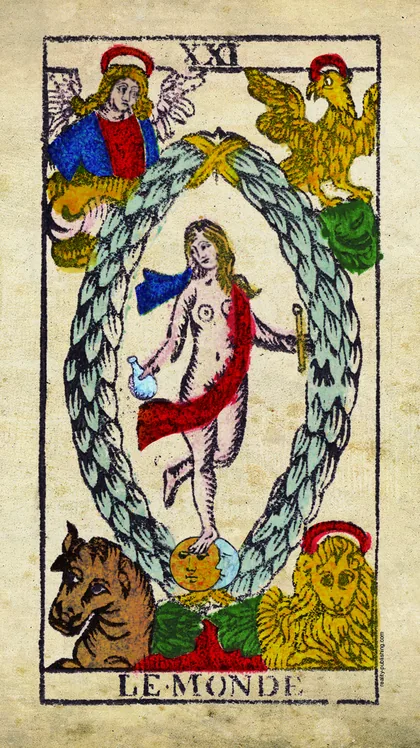
A nearly nude figure, one leg crossed, holds a wand and a vial inside an oval wreath of leaves; in the four corners, the eagle, the lion, the angel, and a brown animal.
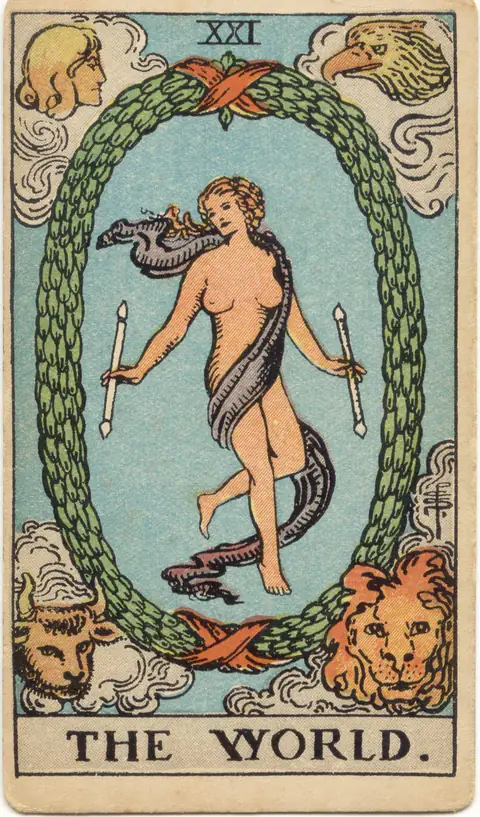
In the Marseille version, the figure wears a red scarf; the brown animal in the four corners is usually read as a bull. In the Rider-Waite deck, the dancing figure is wrapped in a scarf and holds a wand in each hand, at the center of a laurel wreath tied with red ribbons. The four corners are set in the clouds there: a human head, an eagle, a bull, a lion. In both drawings, the wreath surrounds the figure like a completed circle, and the four presences in the corners accompany it like the points of a complete frame of reference.
Oval wreath of leaves
A completed circle around the figure: a full cycle that contains everything it has passed through.
The red scarf (Marseille)
It wraps the figure without hiding it: a light link between movement and rest.
The wand and the vial (Marseille)
Two objects in hand: action and what you contain, held with ease.
The four corner figures
Angel, eagle, lion, and bull: the four Living Creatures of Ezekiel’s vision, which became the symbols of the four evangelists.
The crossed leg (Marseille)
A pose of dance or rest: fulfillment needs no stiffness.
The red ribbons (Rider-Waite)
They tie the wreath: what is complete stays connected, nothing is left floating.
Two decks
The World, Marseille and Rider-Waite
The same card in the two reference decks: Conver’s drawing, dated 1760, and Pamela Colman Smith’s scene, 1909.
Tarot de Marseille: Nicolas Conver, dated 1760, restored by the Tarot World Project, CC BY-SA 4.0 license, via Wikimedia Commons. Rider-Waite: drawings by Pamela Colman Smith, 1909, public domain, via Wikimedia Commons. Images resized and compressed by Versana; Marseille Minor Arcana diagrams and card back drawn by Versana.
The World: nuances and combinations
In love, depending on your situation
Two situations, two readings: in a current relationship, then in a period without one, and reversed.
In a current relationship
At the center of the wreath, the figure seems to dance: the card can describe a bond that stands firm, where you recognize yourselves in what you built. Taking the time to say so, to laugh about it, or to celebrate a milestone nourishes what follows without rushing it.
In a period without a relationship
A closed wreath surrounds the figure: outside any bond, the card makes you recognize that your life already has breadth, with its tastes, friendships, and projects. This fullness is not a renunciation; it may simply make a new bond freer.
Reversed
Reversed, the card leaves a circle open: you linger over a last detail, or you avoid concluding for fear of what would follow. Accepting that a chapter is good enough to close frees up room, in the bond and around it.
Depending on the position in a spread
The position changes the reading: 7 common positions, each upright then reversed.
The situation
The situation touches on fulfillment: a cycle is closing, the elements are coming together, and you can look at the whole journey, with a feeling of completeness.Reversed: The cycle comes close to its end without reaching it: a final gesture is slow in coming, and the whole holds together poorly.
What helps
What helps is what has already come to fruition: leaning on the road traveled, on solid gains, and on the overall view they offer.Reversed: Support exists but remains unfinished: what has been accomplished asks for one last gesture to become a solid base.
What holds you back
What holds you back is the difficulty of closing: you hesitate to turn the page, for fear of losing what completion has gathered.Reversed: The obstacle is that one last detail left hanging: as long as the cycle does not close, the whole remains in suspense.
Your way of being
You act with an overall view: you carry things through to the end, you gather what was scattered, and you give an impression of stable balance.Reversed: You stay at the threshold of completion: everything is almost done, but a last step is slow in coming, and the loop stays open.
What connects you
What connects you forms a complete whole: a stage crossed together, a balance found, and the shared feeling of having carried something through.Reversed: The bond remains unfinished: a last step is missing for the whole to close and for balance to settle in.
What is at stake
It is about accomplishing what was undertaken: your hopes find their complete form, and your fears concern mostly the aftermath, once the cycle is closed.Reversed: What is at stake is finishing what is almost finished: one last effort would be enough to close the cycle and steady the whole.
Where it can lead
A new cycle could open up: once the fulfillment is recognized, there would be room to start again from a stable and complete base.Reversed: An opening could come from finishing what remains: the cycle at last closed would free up room for what follows.
Which cards it reads well with
Six cards calculated by the combination rules: two that reinforce it, two that nuance it, two in friction. None is “bad.”
Numbered XXI in the Marseille deck and 21 in Waite’s, the World reduces to 3. Saturn and the letter Tav are also attributed to it.
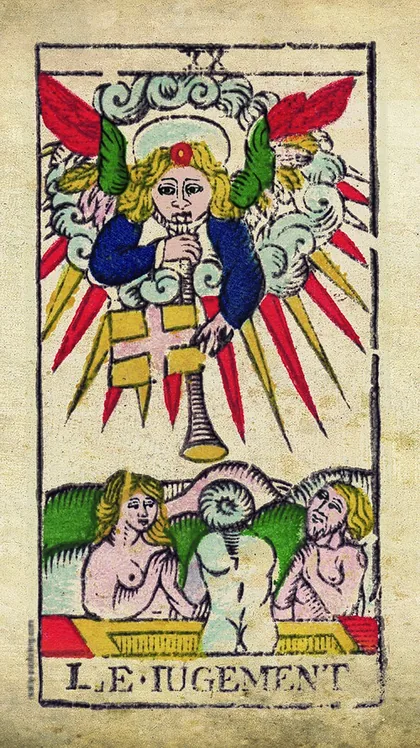
The four presences in the corners, angel, eagle, lion, and bull in the Marseille deck, are often read as a complete frame of reference around the central figure. In Waite’s deck, the human head is among the four, with the eagle, the bull, and the lion. The World, XXI, follows Judgement, XX: after the review, the card of fulfillment takes over. The wreath goes all the way around the figure, and each corner carries its presence: the image is read at a single glance, as a complete whole.
Tarot birth card and numerology
The World is also the tarot birth card for dates that add up to 21; its reduced number, 3, links it to numerology.
Numbers and names read on Conver’s cards and in Waite’s text; correspondences reported according to the Golden Dawn tradition, never as facts.
Number
XXI in the Marseille deck · XXI in Waite’s
Name in the Tarot de Marseille
Le Monde
Golden Dawn
Saturn, letter Tav
Hebrew letter
Tav ת
Planet
Saturn
Reduced number
3
Tendency (yes / no)
Rather favorable: Versana’s proposal, to be confirmed
Tone
Stability: Versana’s proposal, to be confirmed
Sources
Golden Dawn, Book T (The Tarot), published by Israel Regardie in The Golden Dawn
Nicolas Conver (1760), Tarot de Marseille restored by the Tarot World Project
A. E. Waite, The Pictorial Key to the Tarot (1910)
Sefer Yetzirah: three mother letters, seven doubles, twelve simples
Frequently asked questions about The World
What does the World mean in tarot?
The World is read as the fulfillment of a cycle: the figure centered in its wreath forms a whole, surrounded by four presences. Its tone is stability, and the card invites you to acknowledge the road traveled before opening what follows.
What does the World mean reversed?
Reversed, the World speaks of a cycle nearly complete that does not close: a last gesture, a decision, or an acknowledgment is missing. It is seen as blocked energy, which often loosens by naming what remains to be finished.
Which cards go well with the World?
The World links review to completion next to cards of sorting, and closes one cycle before another opens next to cards of departure. Neighboring cards and position always refine the reading. The calculated pairings above detail six.
The World in a yes or no reading?
If the question calls for a clear-cut answer, the World leans toward the favorable side, particularly if the question concerns an achievement. This tendency is nuanced by the wording used and the cards that accompany it.