Skip to content

The Hanged Man tarot card: meaning, upright and reversed

The Hanged Man is the card of the pause: accepting the wait and looking at the situation differently.

  • pause
  • another view
  • letting go
The essentials

The Hanged Man at a glance

For you

A time of stopping that cannot be forced, and that becomes useful once you accept looking at things differently.

A strength

Knowing how to stop without judging yourself, and drawing from a wait a fresh view of what seemed stuck.

Something to watch

Waiting can become a comfortable habit: by letting things come, you forget to decide.

Tone
Questioning
Yes or no
Nuanced
Read more

By Thomas Guilhot · updated

Upright

Upright, the Hanged Man is often read as a pause that cannot be commanded: a project waiting for an answer, a decision that depends on someone else, a situation in which pushing does no good.

The card does not say that everything is frozen; it notes that for now nothing can be forced.

Its lesson lies in the posture. Unable to move forward, the figure changes angle. Many readers see in it an invitation to turn the problem over: to ask what you have not yet looked at, what you would agree to let go of, what the wait allows you to understand. People sometimes speak of sacrifice; the word says above all that you give up one thing to gain another: time, perspective, accuracy.

In a spread, it slows down the neighboring cards. Near a card of drive, it asks you to check the timing before setting off; near a card of stability, it reminds you that a pause can also be a resource.

  • pause
  • another view
  • letting go

The Hanged Man in your life

In love

A relationship in suspension, where each person waits for a sign from the other rather than talking about what they wish.

It invites you to look at what this wait protects: the fear of a disappointment, the wish not to rush anything, or simple habit. For a person on their own, it can describe a time without meeting anyone, lived less as a lack than as a period for finding out what you are looking for.

At work

Files blocked by others: a validation that is slow in coming, a frozen budget, a promised position that does not arrive.

Rather than restarting endlessly, the card suggests using this time: preparing what comes next, learning, seeing the project from another angle. It can also signal that you are putting up too long with a position or project that no longer suits you, out of loyalty or caution.

With money

A sum tied up or an expense deferred, and the patience needed before deciding.

It gives no investment advice; it raises a question of rhythm. Waiting for a better opportunity is sometimes wise, sometimes a way of not facing a figure. The difference shows in what you do during the wait.

As a feeling, as an action

As a feeling

The impression of being suspended, of no longer having a grip, sometimes mixed with a strange calm, almost a relief.

As an action

Refrain from acting for a set time, and use it to observe differently what resists.

Reversed

The endured wait: you stay suspended without getting anything from it, or you struggle to get out before having understood.

In a yes or no reading

Nuanced

The Hanged Man calls for nuance: the outcome of the question depends on a delay or on another person, more than on your will alone.

Questions to ask yourself

  • What does this wait let you see that you did not see before?
  • What could you let go of, with no real loss, to get out of this impasse?
  • Seen from the other end, does the situation keep the same meaning?

A sentence to keep: “I take the time to look differently at what resists, without rushing to conclude.”

Yes or no tarot

What the card shows

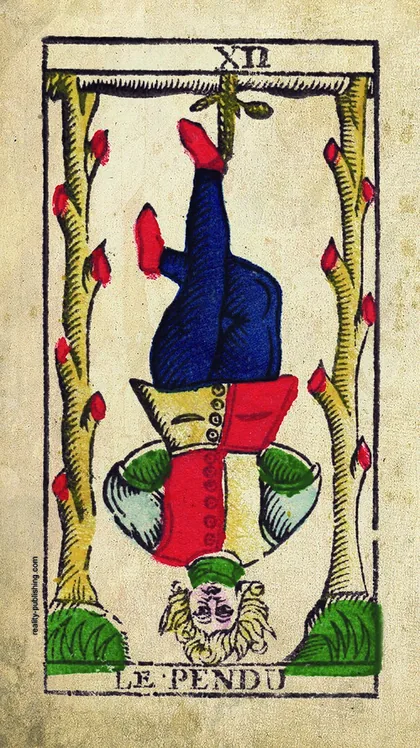
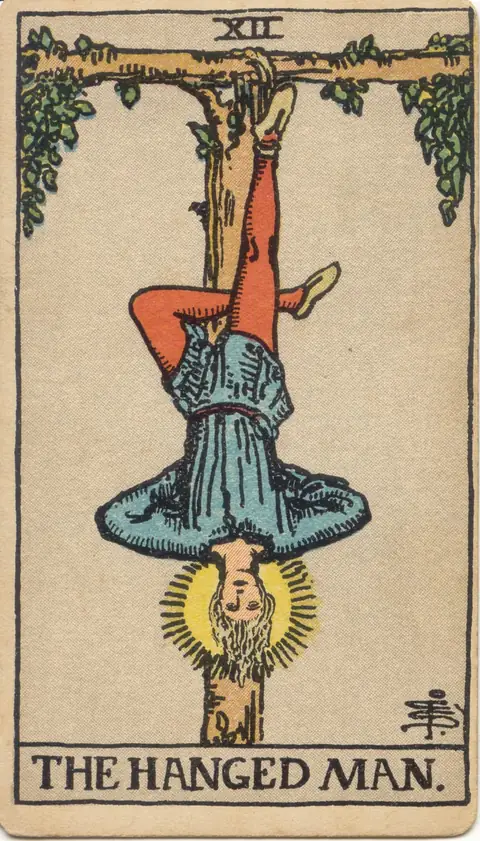
Hanging by one ankle from a beam, head toward the ground and arms hidden behind the back, the figure keeps a face in which nothing betrays fear.

In the Conver deck, the crossbar rests on two trees with cut branches painted red, six on each side. The free leg crosses behind the other and draws, with the body, a figure often compared to the number 4. The hair hangs down, the arms disappear behind the back: everything attached to the body obeys gravity, except the gaze.

Pamela Colman Smith takes up the posture on a T-shaped tree covered in leaves: the wood is alive. A halo surrounds the head. Waite refused to see a martyrdom in it and spoke of a life in suspension. The two decks agree on the essential: a body that is immobilized, a mind that is not.

Two decks

The Hanged Man, Marseille and Rider-Waite

The same card in the two reference decks: Conver’s drawing, dated 1760, and Pamela Colman Smith’s scene, 1909.

Tarot de Marseille · Conver, dated 1760The Hanged ManXII
Rider-Waite · London, 1909The Hanged ManXII
The Hanged Man: what changes from one deck to the other
AspectTarot de MarseilleRider-Waite
NameLe PenduThe Hanged Man
NumberXIIXII
ImageTwo trees with cut branches, painted red, hold the crossbar; the upside-down face looks straight ahead.A single T-shaped tree covered in leaves, and a halo around the head: the suspension becomes luminous.
ReversalOften not readCommonly read (reversed cards)

Tarot de Marseille: Nicolas Conver, dated 1760, restored by the Tarot World Project, CC BY-SA 4.0 license, via Wikimedia Commons. Rider-Waite: drawings by Pamela Colman Smith, 1909, public domain, via Wikimedia Commons. Images resized and compressed by Versana; Marseille Minor Arcana diagrams and card back drawn by Versana.

The Hanged Man: nuances and combinations

In love, depending on your situation

Two situations, two readings: in a current relationship, then in a period without one, and reversed.

Depending on the position in a spread

The position changes the reading: 7 common positions, each upright then reversed.

Which cards it reads well with

Six cards calculated by the combination rules: two that reinforce it, two that nuance it, two in friction. None is “bad.”

The history of the card

The drawing takes up a “defamatory painting” from Renaissance Italy: it showed, hanging by one ankle, a person a city wanted to dishonor.

Go further

How is it built?

Numbers and names read on Conver’s cards and in Waite’s text; correspondences reported according to the Golden Dawn tradition, never as facts.

Frequently asked questions about The Hanged Man

What does the Hanged Man mean in tarot?

The Hanged Man represents a time of stopping: a suspended situation that you do not move forward by force. The card shows a calm figure despite the posture; many readers find in it a chance to look differently, to give up an expectation in order to gain perspective. It is not a card of misfortune.

What does the Hanged Man mean reversed?

Reversed, the most common reading is of a wait that is endured rather than chosen: you stay suspended without getting anything from it, or you thrash about to get out too fast. Turned over, the card actually shows the figure standing; some readers see in it the moment to find your footing again.

Which cards go well with the Hanged Man?

The Hanged Man reads in contrast with the cards of drive, which it tempers, and with the cards of passage, whose movement it prepares. Near the cards of withdrawal, it strengthens the time of the pause. See the associations above.

The Hanged Man in a yes or no reading?

The Hanged Man does not settle things: its tendency is “to be nuanced.” It signals a question that depends on a delay, on another person, or on an outside condition. The useful question then becomes: what can I do while I wait?