Leaning against his seat or settled on a stone throne, the figure holds a scepter and a globe: the image speaks of power exercised with method. Many readers see in it order, responsibility, and the ability to decide.
Upright, the card invites you to structure. After the Magician’s drive and the Empress’s growth, it adds the form that allows things to last. Its number, four, evokes what stands on four supports. It can be read as the need for clear rules, a role held, commitments honored. It does not say that firmness is enough: listening remains what keeps authority alive, and a framework holds better when it is understood than when it is endured.
structure
authority
stability
The Emperor in your life
In love
A relationship that finds its stability in clear commitments, a reliable presence, and shared landmarks.
In matters of the heart, the Emperor evokes solidity: a commitment kept, shared landmarks, a reliable presence, steady from one day to the next whatever the moods. He invites you to say what each person expects, without imposing your own vision.
At work
A role of responsibility: organizing, deciding, giving a framework to a team or a project.
On the professional level, he speaks of responsibility, organization, and decision. A framework to set, a team to structure, a project to carry out with method. He invites you to keep your commitments as much as to have them respected.
With money
A calm, structured approach: establishing a framework, rules, and habits that last.
On the terrain of money, the card suggests a way of acting: putting things in order, setting rules, holding a framework over time. It looks at organization, never at an amount, and points to no purchase or investment.
As a feeling, as an action
As a feeling
A sense of solidity, the certainty of being able to lean on clear rules and on your own firmness.
As an action
Set clear rules, organize the steps, and keep to what was decided to the end.
Reversed
Authority that stiffens: wanting to control everything, deciding without consulting, confusing firmness with rigidity.
Main reading
Excess
In love
A relationship where one of the two sets the rules without discussing them.
At work
A hierarchy that crushes rather than organizes, instructions applied without flexibility or listening.
With money
Wanting to lock down every account and decision, at the risk of leaving nothing room to breathe.
A question
Where has my firmness turned into stiffness?
Readability
Readable reversed in both decks.
rigidity
control
stubbornness
In a yes or no reading
Rather favorable
The Emperor leans rather to the favorable side: the question moves forward if it rests on a clear framework and kept commitments.
Questions to ask yourself
What framework should I set so that this project holds over time?
Which rule in my life really holds, and which exists only on paper?
What do I expect from others, and have I already said it clearly?
A sentence to keep: “I set clear landmarks and I uphold them without crushing anyone.”
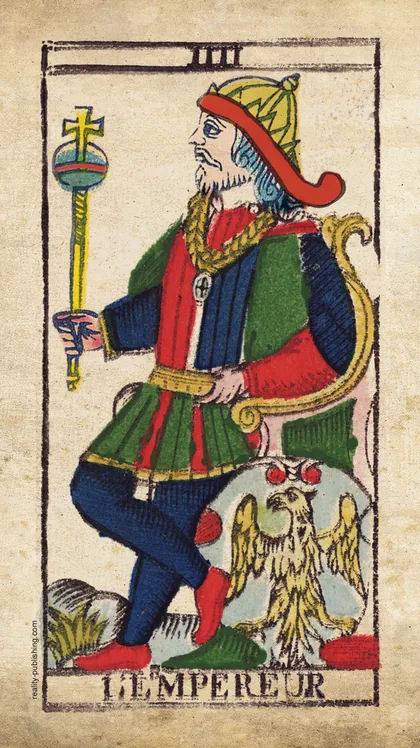
In profile, leaning back in a seat, legs crossed, the figure grips a scepter whose tip bears a globe and a cross; against the feet, a shield with an eagle.
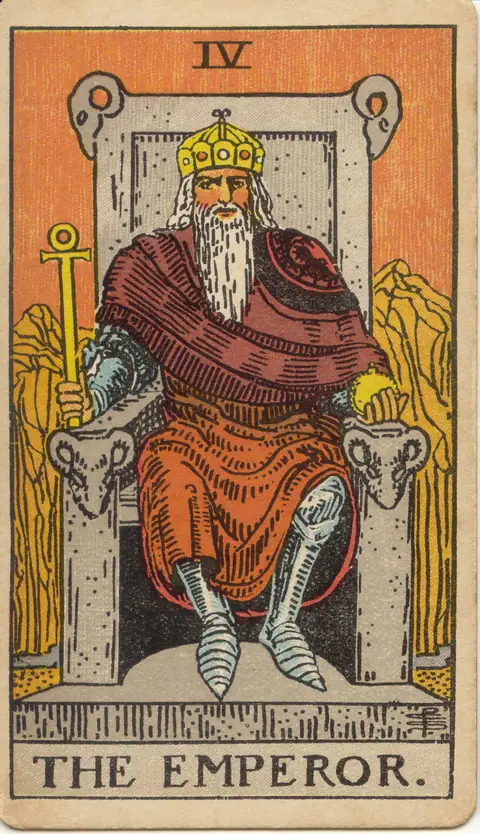
In the Marseille deck, a necklace and a helmet-like headdress go with a relaxed pose, legs crossed. The scepter ends in a globe and a cross, and the eagle shield rests against the feet. In Waite’s deck, the stone throne is decorated with carved rams, the Emperor is seen from the front, an ankh-shaped scepter and a globe in hand, armor under the red robe, in front of barren mountains under an orange sky. In both cases everything is stable and still: seat, stone, attributes of power, nothing moves.
The scepter topped with a globe (Marseille)
A power exercised over the material world: authority is held in the hand, not brandished.
The shield with an eagle (Marseille)
Arms set against the feet: a force that is available, kept in reserve to defend the frame.
The crossed legs (Marseille)
A settled, almost relaxed pose: a calm assurance, with no display.
The helmet-like headdress (Marseille)
A protected head, one that thinks before acting and does not get carried away.
Ram heads on the throne (Rider-Waite)
Aries, the sign that tradition links to the card: initiative and firmness.
The barren mountains (Rider-Waite)
A stripped-down setting: power is exercised on demanding terrain, where only what holds remains.
Two decks
The Emperor, Marseille and Rider-Waite
The same card in the two reference decks: Conver’s drawing, dated 1760, and Pamela Colman Smith’s scene, 1909.
The Emperor: what changes from one deck to the other
Aspect
Tarot de Marseille
Rider-Waite
Name
L’Empereur
The Emperor
Number
IIII
IV
Image
In the Marseille deck, the figure is in profile, legs crossed, leaning against his seat, wearing a kind of helmet, with a necklace and an eagle shield.
In Waite’s deck, the Emperor sits facing front; rams are carved on his stone throne, an ankh-shaped scepter in his hand, barren mountains behind.
Tarot de Marseille: Nicolas Conver, dated 1760, restored by the Tarot World Project, CC BY-SA 4.0 license, via Wikimedia Commons. Rider-Waite: drawings by Pamela Colman Smith, 1909, public domain, via Wikimedia Commons. Images resized and compressed by Versana; Marseille Minor Arcana diagrams and card back drawn by Versana.
The Emperor: nuances and combinations
In love, depending on your situation
Two situations, two readings: in a current relationship, then in a period without one, and reversed.
In a current relationship
A solid bond is recognized by its landmarks: who takes care of what, how you talk to each other when tension rises, what is upheld. The card invites you to lay down these foundations out loud, so that they are chosen together rather than endured.
In a period without a relationship
The stone throne is a reminder that a life without a relationship can have its structure: schedules, projects, clear limits. The card invites you to look at which conditions you want to set before making room for someone, and to put them simply.
Reversed
When the frame hardens, one decides and the other adapts in silence. The reversed card invites you to loosen a rule, to ask for the other’s point of view, and to check that security has not turned into distance.
Depending on the position in a spread
The position changes the reading: 7 common positions, each upright then reversed.
The situation
The context rests on stability: an established framework, a recognized authority, reference points that hold and give the situation its structure.Reversed: The framework stiffens: the context turns to control and rigidity, and the structure serves more to hold things in than to support them.
What helps
What helps is a solid framework: a clear organization, rules set once and for all, and an authority that reassures rather than pressures.Reversed: Help requires loosening the framework: keep the structure, but ease the control to let what is inside it breathe.
What holds you back
What holds you back is structure that has become too rigid: rules that no longer move, and a need to hold everything that freezes the situation.Reversed: The obstacle worsens: control is exercised down to the details, and rigidity closes the door to any adjustment.
Your way of being
A firm and steady way of being: holding your position, structuring, taking on responsibility with consistency and a sense of organization, without ever wavering.Reversed: A way of doing things that tenses up: authority becomes control, and firmness turns to stubbornness.
What connects you
Between two people, a bond that leans on solidity: commitments kept, shared reference points, a security built over time.Reversed: The bond is held too tightly: control and rigidity leave little room for flexibility.
What is at stake
What is at stake is holding a framework: building on solid ground, taking responsibility for what is laid down, and keeping a fair authority.Reversed: What is at stake is not letting authority stiffen: keeping firmness without sliding into control or rigidity.
Where it can lead
A solid structure could open up: a framework laid down with consistency would offer stable ground on which something lasting could be built.Reversed: A prospect would require loosening your grip: as long as control dominates, the structure would stay closed in on itself.
Which cards it reads well with
Six cards calculated by the combination rules: two that reinforce it, two that nuance it, two in friction. None is “bad.”
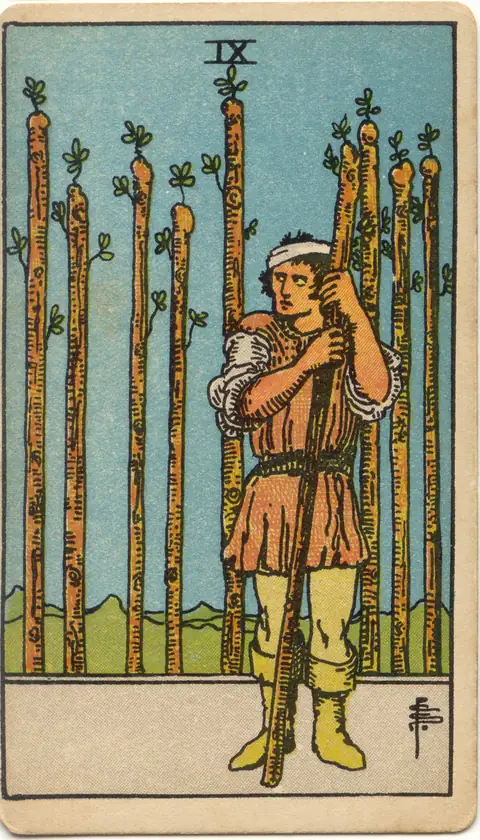
Cards that reinforce itNine of WandsNine of Wands: shared tone, stability, elements fire and fireRead the pair
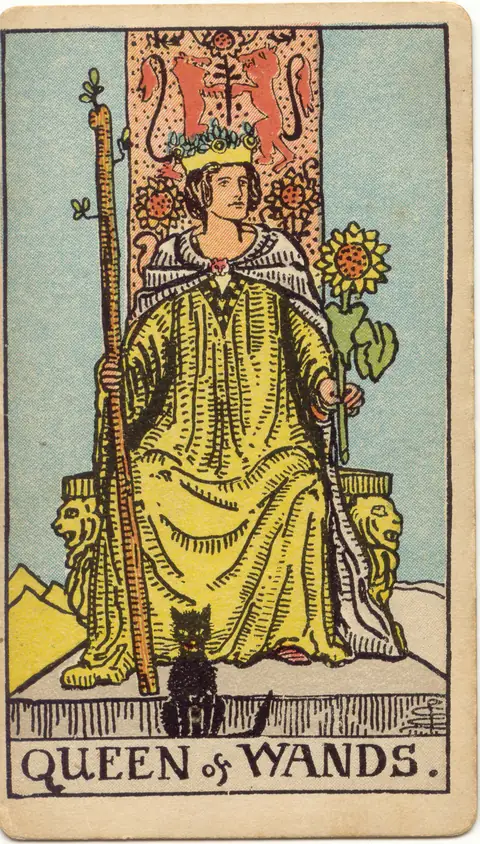
Cards that reinforce itQueen of WandsQueen of Wands: shared tone, stability, elements fire and fireRead the pair
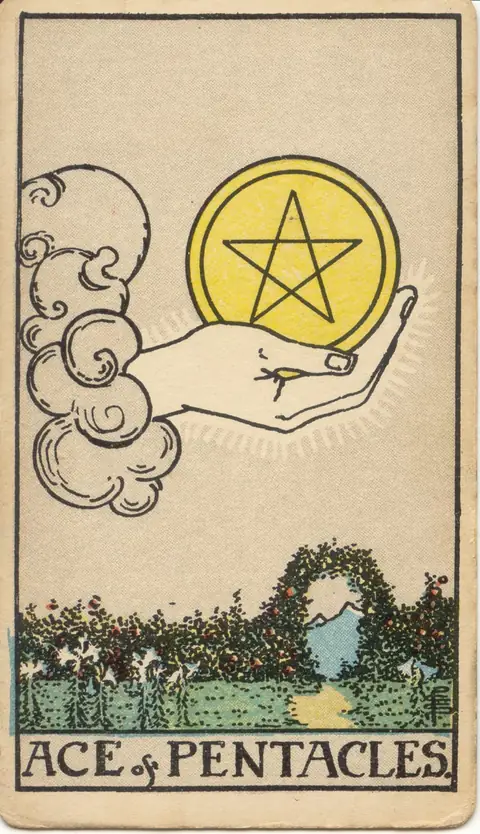
Cards that nuance itAce of PentaclesAce of Pentacles: tones stability and momentum, elements fire and earthRead the pair
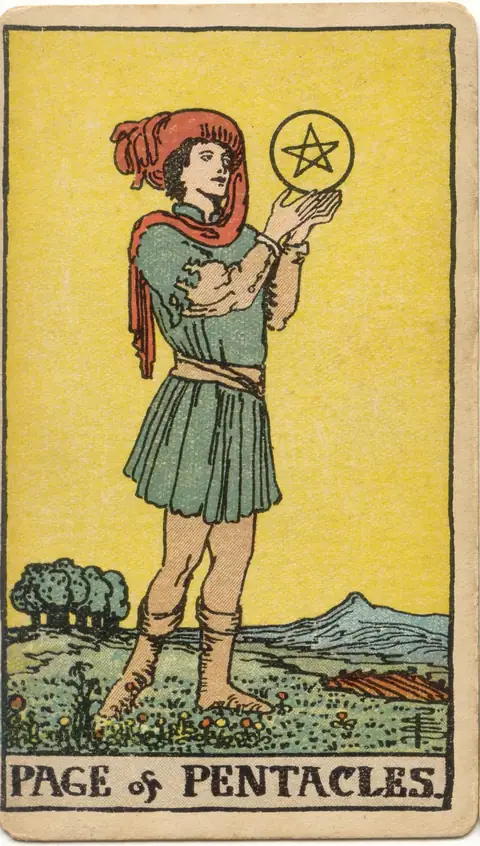
Cards that nuance itPage of PentaclesPage of Pentacles: tones stability and transition, elements fire and earthRead the pair
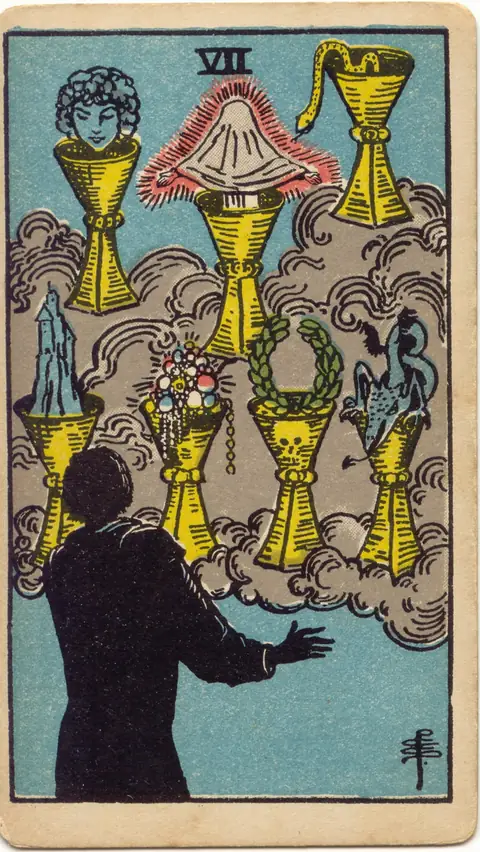
In frictionSeven of CupsSeven of Cups: tones stability and questioning, elements fire and waterRead the pair
Number IIII in the Marseille deck and 4 in Waite’s, the Emperor follows the Empress. Aries and the letter Heh are his reference points.
The name does not change between the Marseille deck and Waite’s (The Emperor), but the number is written IIII in the Marseille deck. Aries and the letter Heh characterize him on one side, whereas Crowley, in his own deck, places him at Aquarius with Tzaddi: the two tables answer each other without being confused. This disagreement is a reminder that these tables vary from author to author: they serve as reference points, never as proof on which to base a reading.
Tarot birth card and numerology
The Emperor is also the tarot birth card for dates that add up to 4; its reduced number, 4, links it to numerology.
Numbers and names read on Conver’s cards and in Waite’s text; correspondences reported according to the Golden Dawn tradition, never as facts.
Number
IIII in the Marseille deck · IV in Waite’s
Name in the Tarot de Marseille
L’Empereur
Golden Dawn
Aries, letter Heh
Hebrew letter
Heh ה
Sign
Aries
Variant (Crowley)
Aquarius, letter Tzaddi
Reduced number
4
Tendency (yes / no)
Rather favorable: Versana’s proposal, to be confirmed
Tone
Stability: Versana’s proposal, to be confirmed
Sources
Golden Dawn, Book T (The Tarot), published by Israel Regardie in The Golden Dawn
Nicolas Conver (1760), Tarot de Marseille restored by the Tarot World Project
A. E. Waite, The Pictorial Key to the Tarot (1910)
Sefer Yetzirah: three mother letters, seven doubles, twelve simples
Frequently asked questions about The Emperor
What does the Emperor mean in tarot?
The Emperor is read as framework, decision, and responsibility. His image shows a solid seat, a scepter, and a globe: power exercised with method. The card invites you to structure and keep your commitments.
What does the Emperor mean reversed?
Reversed, authority stiffens: wanting to control everything, deciding without consulting, confusing firmness with rigidity. The reading invites you to loosen what is held too tight, not to see a misfortune in it.
Which cards go well with the Emperor?
The Emperor is read near cards of starting, where the gesture finds a framework, near cards of silence, where the rule meets listening, and near cards of growth, where the form given can last. The neighbors clarify whether the framework is chosen or endured. Six cards above shed light on him.
The Emperor in a yes or no reading?
For a closed question, the Emperor leans rather to the favorable side when there is a clear framework and kept commitments. This tendency is not a verdict: the context and the neighboring cards count for more.