In love
Trust being rebuilt with care: tell protecting intimacy apart from shutting out the other.
Trust that has been rebuilt with care, or an intimacy you protect: the card helps tell useful caution from shutting out the other.
The Nine of Wands means perseverance: holding on a little longer, strengthened by hard-won experience.
Staying on your feet after a long journey, leaning on what has been built: vigilance protects, as long as it does not close you off.
It speaks of perseverance, of staying on your feet and keeping an eye open after an already long journey.
Wariness can harden into habit: by dint of keeping watch, you risk seeing danger where nothing is left.
By Thomas Guilhot · updated
The Nine of Wands speaks of what remains standing after the effort.
The fence behind the figure evokes what has been built, the sideways glance the vigilance that has set in. You hold on, close to the goal, with one last stage still to cross.
Its tone is stability. It suggests measuring the road already covered, keeping just enough caution to protect what has been gained, and telling caution apart from closing yourself off.
Trust being rebuilt with care: tell protecting intimacy apart from shutting out the other.
Trust that has been rebuilt with care, or an intimacy you protect: the card helps tell useful caution from shutting out the other.
A long project, close to the goal: keep your course and accept the help available for the last stage.
A long project, a final stage: keep your course without cutting yourself off from the help available, that is what the image whispers, close to the goal but not yet at the end.
Protecting what has been built, with caution, without seeing a danger in every new proposal.
Protecting what has been built, with caution: this is an attitude, not an indication of any management choice, only a way of holding on to what you have built, with moderation.
Constant attention, sometimes weariness, mixed with the pride of having stayed on your feet after a long journey.
Keep just enough caution to protect what you have gained, and let in what is not a threat.
Too much guard: vigilance turns into mistrust, and what was meant to protect ends up isolating.
Nuanced
Needs nuance: perseverance is there, but the wariness in the image calls for checking what is really still to be feared.
Questions to ask yourself
A sentence to keep: “I keep what I have built and let in what threatens nothing.”
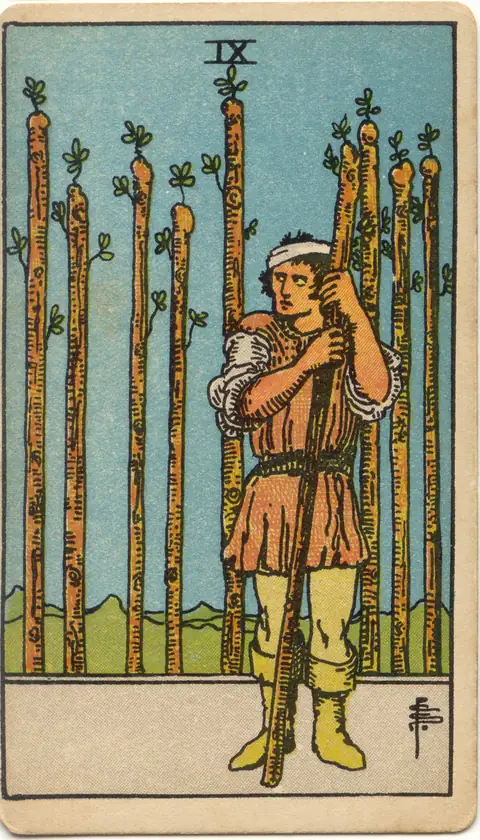
A figure with a bandaged head, leaning on a wand, glances sideways with wariness; eight wands standing behind them form a fence.
The sideways glance shows an attention that never switches off, even at rest. The wand serves as support more than as a weapon. Behind, the eight wands standing in a row form a fence: a barrier built over time. The scene reads as hard-won stability, held by vigilance, and the bandage is a reminder that the journey has left its marks.
The Tarot de Marseille repeats the suit’s pips; the Rider-Waite illustrates each card with a scene.
| Aspect | Tarot de Marseille | Rider-Waite |
|---|---|---|
| Name | Neuf de bâtons | Nine of Wands |
| Image | In the Marseille version, nine wands in sign-like patterns, with no figure and no drawn fence. | Rider-Waite adds a bandaged figure glancing sideways in front of eight standing wands: vigilance becomes a scene. |
| Reversal | Often not read | Commonly read (reversed cards) |
Tarot de Marseille: Nicolas Conver, dated 1760, restored by the Tarot World Project, CC BY-SA 4.0 license, via Wikimedia Commons. Rider-Waite: drawings by Pamela Colman Smith, 1909, public domain, via Wikimedia Commons. Images resized and compressed by Versana; Marseille Minor Arcana diagrams and card back drawn by Versana.
Two situations, two readings: in a current relationship, then in a period without one, and reversed.
The position changes the reading: 7 common positions, each upright then reversed.
Six cards calculated by the combination rules: two that reinforce it, two that nuance it, two in friction. None is “bad.”
Ninth of the Wands, between the Eight and the Ten. The Moon accompanies it, in the second decan of Sagittarius.
In the suit of fire, the nine comes after the Eight, where movement streaked freely, and just before the Ten, where the load is carried in the arms. You move from speed to endurance, then to responsibility. Many readers link the Moon to this attentive gaze, always slightly on alert.
The card carries the number 9: in numerology as in the suit, one stage of a progression from 1 to 10.
Suit and number read on the deck; decan and planet reported according to the Golden Dawn tradition, never as facts.
A vigilance born of experience: a figure leaning on their wand, eight wands standing behind them. The card evokes perseverance, the protection of what has been gained, and the last stage before the goal.
Reversed, the Nine speaks of excess: vigilance turning into mistrust. The card invites you to lower your guard and check what is still genuinely to be feared. Marseille readers rarely turn it upside down.
After the card of speed that precedes it, the Nine of Wands gives way to endurance; before the last card of the series, vigilance becomes a load to carry. Near the defense card, that one carries on. Nothing is settled outside your question. Six cards above shed light on it.
Needs nuance. Perseverance is visible, but the wariness of the image calls for checking what is still to be feared, in light of the question asked and the neighboring cards, which may correct it.