Skip to content

King of Swords tarot card: meaning and reversed

The King of Swords describes the authority of the mind: a fair, impartial thought faithful to its principles.

  • judgment
  • stability
  • consistency
The essentials

King of Swords at a glance

For you

Judging with constancy and keeping your word: the stability of a matured thought that arbitrates with method and stands by what it decides.

A strength

Judging with constancy, holding a considered position, and making decisions that everyone can understand.

Something to watch

Judgment can harden into a verdict, and rigor can become a way of no longer listening.

Way of acting
Leading
Yes or no
Nuanced
Read more

By Thomas Guilhot · updated

Upright

The King of Swords evokes a conduct made of constancy and reflection.

He invites you to base yourself on clear principles, to weigh the elements before concluding, then to hold your decision with consistency. Many readers see in him the reliable word of someone who knows what they are saying and why, and the art of arbitrating without being carried away. His stability is a support for others when it comes with listening. He can also be read as the culmination of the series: thought that has gone through learning, drive, and perspective, and now stands upright.

  • judgment
  • stability
  • consistency

King of Swords in your life

In love

A loyal word and clear commitments: keeping what you say, while leaving the other person their place.

In a relationship, the card evokes loyalty of word and clarity of commitments. Saying what you think and keeping to it gives a foundation; leaving room for the other person’s voice keeps firmness from becoming authority.

At work

Considered arbitration, a reasoned decision, and a framework set with consistency: expertise and rigor are recognized.

At work, he describes considered arbitration, a reasoned decision, the ability to set a framework and stick to it. Expertise and consistency are valued here, as is listening to opposing views.

With money

Clear rules and weighed choices, kept over the long term: a method rather than investment advice.

For money, the card argues for clear rules and weighed choices, kept over time. It describes a way of deciding with method, with no value as financial advice or forecast.

As a feeling

A quiet assurance, the certainty of knowing your position and being able to justify your choices calmly.

As an action

Set your criteria, weigh the elements one by one, and hold your decision while staying open to what would shed a different light on it.

Reversed

Judgment that hardens: rigor becomes rigidity, the decision freezes into a verdict, and listening wears thin.

In a yes or no reading

Nuanced

A “maybe”: the card pushes you to decide with method, but its firmness can hide a frozen judgment. Neighboring cards show whether the reasoning holds or deserves to be reopened.

Questions to ask yourself

  • What principles am I relying on, and am I ready to reexamine them?
  • Which rule that I defend deserves to be restated more gently?
  • What viewpoint different from mine did I listen to all the way through this week?

A sentence to keep: “I keep my word firmly, and I leave the other room to answer.”

Yes or no tarot

What the card depicts

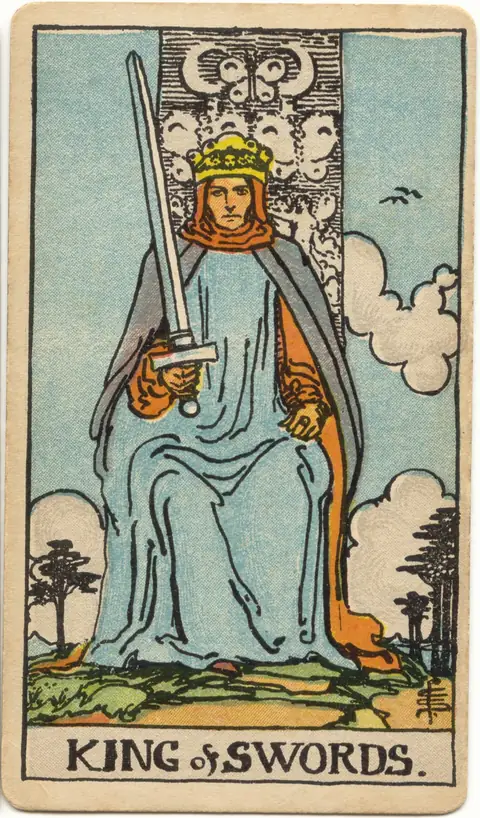
A crowned figure, facing forward on a throne decorated with butterflies and crescents, holds a straight sword and looks ahead. Around, clouds, cypresses, and birds.

Two decks

King of Swords, Marseille and Rider-Waite

The Tarot de Marseille repeats the suit’s pips; the Rider-Waite illustrates each card with a scene.

King of SwordsDiagram
Tarot de Marseille · pip diagramKing of Swords
Rider-Waite · London, 1909King of Swords
King of Swords: what changes from one deck to the other
AspectTarot de MarseilleRider-Waite
NameRoi d’épéesKing of Swords
ImageIn Marseille, it is the King’s place in the suit of Swords that carries the reading; the throne and cypresses of this version add a setting without changing the foundation.The Rider-Waite version places the King facing forward, sword straight, in a setting of cypresses and clouds: the image stresses the balance and constancy of judgment.
ReversalOften not readCommonly read (reversed cards)

Tarot de Marseille: Nicolas Conver, dated 1760, restored by the Tarot World Project, CC BY-SA 4.0 license, via Wikimedia Commons. Rider-Waite: drawings by Pamela Colman Smith, 1909, public domain, via Wikimedia Commons. Images resized and compressed by Versana; Marseille Minor Arcana diagrams and card back drawn by Versana.

King of Swords: nuances and combinations

In love, depending on your situation

Two situations, two readings: in a current relationship, then in a period without one, and reversed.

Depending on the position in a spread

The position changes the reading: 7 common positions, each upright then reversed.

Which cards it reads well with

Six cards calculated by the combination rules: two that reinforce it, two that nuance it, two in friction. None is “bad.”

The card’s place in the suit

Last of the four court figures of Swords, the King closes the series after the Queen: thought finds its steadiest form here.

How is it built?

Suit and number read on the deck; decan and planet reported according to the Golden Dawn tradition, never as facts.

Frequently asked questions about King of Swords

What does the King of Swords mean in tarot?

The King of Swords is read as matured judgment and a word kept. His keynote is stability: a clear, consistent thought that arbitrates with constancy. He describes a conduct founded on reflection and commitment, not a person.

What does the King of Swords mean reversed?

Reversed, the King warns against excess: judgment hardens, rigor becomes rigidity, and you stop listening. The card then invites you to reopen the file, hear the opposing view, and regain some flexibility.

Which cards go well with the King of Swords?

With other Swords, he reinforces the consistency and precision of ideas. Next to Cups, judgment is tempered by emotion; next to Pentacles, it is anchored in the concrete; next to Wands, it gives structure to the ardor of an undertaking.

The King of Swords in a yes or no reading?

Faced with a closed question, the King helps you decide with method, but his firmness can freeze the reasoning: the tendency stays toward nuance, depending on the neighboring cards and the flexibility you keep.