Skip to content

The Moon tarot card: meaning, upright and reversed

The Moon is the card of intuition and doubt: what you sense before you can name it.

  • intuition
  • doubt
  • withdrawal
The essentials

The Moon at a glance

For you

Doubt and intuition mingle: it is better to move slowly, listen to what can be sensed, and wait for the outlines to become clear.

A strength

It gives access to intuition and inner images: a fine attention to what can be sensed rather than what can be seen.

Something to watch

Beware of hasty conclusions: in doubt, a fear can take the shape of a fact. Give the outlines time to become clear.

Tone
Withdrawal
Yes or no
Nuanced
Read more

By Thomas Guilhot · updated

Upright

The Moon is the card of fertile doubt and intuition.

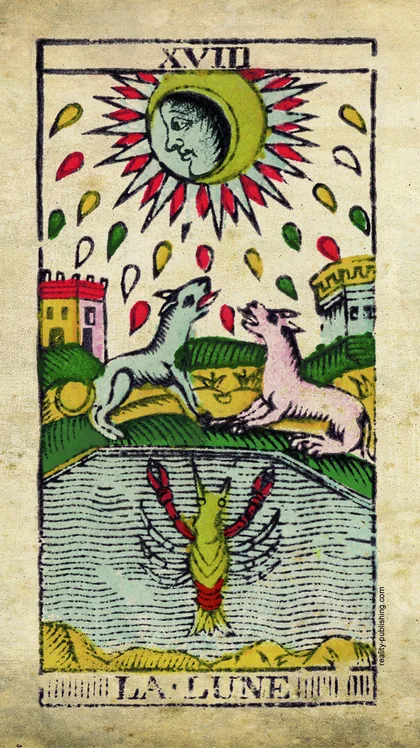
In Conver’s image, the light comes from a moon in profile, far from full clarity: the outlines stay uncertain, and two dogs bark at it. For many, it is a time when impressions, dreams, and fears take up more room than facts, and when it is better to slow down than to rush. The crayfish climbing out of the pool evokes what rises from the depths: old emotions, memories, and sensations that ask to be listened to without being taken for certainties. In a spread, it invites you to check what is true, to give yourself time, and to listen to your intuition without making it say more than it says. Its reduced number, 9, adds the idea of a cycle coming to a close, according to the common association. The Moon makes no forecast: it describes a moment of mist, which is crossed with patience.
  • intuition
  • doubt
  • withdrawal

The Moon in your life

In love

Silences and interpretations slip into the relationship; asking a simple question is better than guessing the answer.

In a relationship, the Moon can reveal raw sensitivities and misunderstandings that arise from what is left unsaid. Speaking simply, without accusing, helps separate what is felt from what is real. Alone, a person gains from listening to their impulses without rushing into them.

At work

The context lacks sharpness: check the information, avoid deciding in the fog, and trust your intuition with caution.

At work, the Moon signals incomplete information or unclear intentions. Taking time to check, asking for details, and noting your intuitions without imposing them lets you move forward on firmer ground. Projects that call for creativity also find rich material here.

With money

When the elements stay unclear, it is better to wait for clear markers than to decide on an impression; this is a cautious way of acting.

On the material side, the card invites caution more than boldness: rereading the figures, waiting until the elements are clear before committing. It is a way of acting, never financial advice or a forecast.

As a feeling, as an action

As a feeling

Heightened sensitivity, blurry impressions that come and go, and a need to retreat a little to see clearly.

As an action

Slow down, note your impressions without settling them, and postpone a decision as long as the situation stays unclear.

Reversed

The intensity eases: confusion gradually clears and fears subside, leaving room for a sharper view.

In a yes or no reading

Nuanced

The card stays nuanced: its uncertain light calls for checking before deciding. The tendency depends mostly on how clear the information you have is.

Questions to ask yourself

  • What is actually visible here, and what comes only from your impressions?
  • What impression could you check with someone before taking it for a fact?
  • What looks less like what you imagined in the light of day?

A sentence to keep: “I move forward carefully and separate what I feel from what I know.”

Yes or no tarot

What the card shows

Under a moon in profile that lets drops fall, two dogs raise their heads between two towers, while a crayfish climbs out of a pool in the foreground.

The moon occupies the top of the scene, in profile within a radiant disk, and its drops fall toward the ground like a slow rain. Below, the two dogs bark up at it, between the two towers that border the space. In the foreground, the crayfish, in its pool, belongs to another level of the image: lower down, closer to the water. The composition thus layers three levels: the moon, then the animals and towers, then the pool. It is often read as the difficulty of seeing clearly when the light comes from somewhere other than yourself, and as an invitation to move forward carefully, accepting that not everything is sharp yet.

Two decks

The Moon, Marseille and Rider-Waite

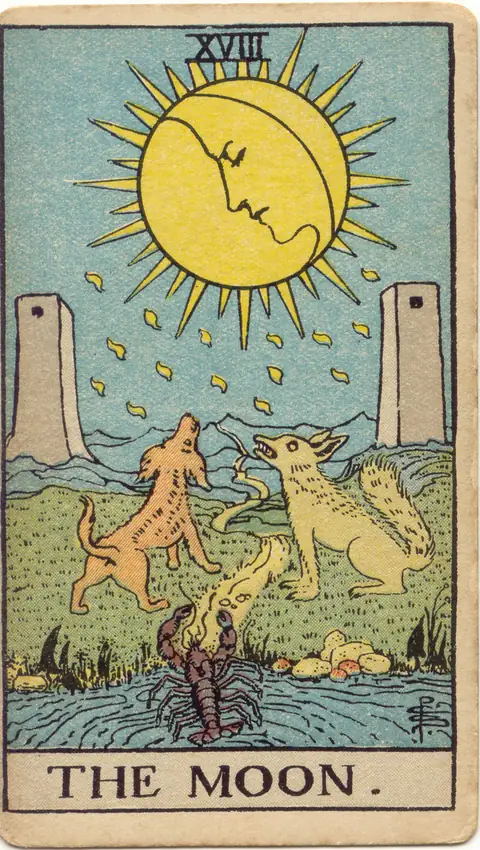
The same card in the two reference decks: Conver’s drawing, dated 1760, and Pamela Colman Smith’s scene, 1909.

Tarot de Marseille · Conver, dated 1760The MoonXVIII
Rider-Waite · London, 1909The MoonXVIII
The Moon: what changes from one deck to the other
AspectTarot de MarseilleRider-Waite
NameLa LuneThe Moon
NumberXVIIIXVIII
ImageIn the Marseille deck, two dogs bark at the moon, between two towers; the crayfish stays in its pool, in the foreground.In Waite’s deck, a dog and a wolf howl; the crayfish comes out of a pool and a path runs between two towers toward the mountains.
ReversalOften not readCommonly read (reversed cards)

Tarot de Marseille: Nicolas Conver, dated 1760, restored by the Tarot World Project, CC BY-SA 4.0 license, via Wikimedia Commons. Rider-Waite: drawings by Pamela Colman Smith, 1909, public domain, via Wikimedia Commons. Images resized and compressed by Versana; Marseille Minor Arcana diagrams and card back drawn by Versana.

The Moon: nuances and combinations

In love, depending on your situation

Two situations, two readings: in a current relationship, then in a period without one, and reversed.

Depending on the position in a spread

The position changes the reading: 7 common positions, each upright then reversed.

Which cards it reads well with

Six cards calculated by the combination rules: two that reinforce it, two that nuance it, two in friction. None is “bad.”

The history of the card

Numbered XVIII in the Marseille deck, the card is called The Moon in Waite’s, where it keeps the 18. Its number reduces to 9 (1 + 8).

Go further

  • PiscesThe sign the Golden Dawn assigns to this card
  • 18:18The hour that bears the card’s number
  • Dream dictionaryA card of the night, which modern readings link to dreams

How is it built?

Numbers and names read on Conver’s cards and in Waite’s text; correspondences reported according to the Golden Dawn tradition, never as facts.

Frequently asked questions about The Moon

What does the Moon mean in tarot?

The Moon speaks of doubt, intuition, and withdrawal: a period when impressions count as much as facts. It invites you to slow down, to check, and to listen to your feelings without taking them for certainties. The neighboring cards clarify its reach.

What does the Moon mean reversed?

Reversed, the Moon is read as an intensity easing: confusion clears and fears subside. The reading invites you to make the most of this regained clarity, while keeping your attention on details. It is a situation, not a verdict.

Which cards go well with the Moon?

The Moon softens its doubt with a little trust next to cards of hope, and lets clarity dispel what remained confused next to cards of light. These pairings depend on the question asked and on each card’s place. No verdict: see above.

The Moon in a yes or no reading?

For a closed question, the Moon stays nuanced: its uncertain light invites you to check before deciding. The tendency depends on the clarity of the information and on the neighboring cards; it does not replace a considered decision.