As a birth card, the Moon describes a sensitivity that picks up the mood before words do: the unease that hangs in a room, a colleague’s hesitation, a child’s apprehension.
These people have a rich inner life, a memory for dreams or images, and trouble deciding on bases that are too vague. They move forward by feel, sometimes slowly, but rarely off target.
You can recognize this theme in simple situations: sensing that a project does not fit without being able to say why, feeling the tension before the argument, hesitating over a choice that seems obvious to everyone else. The Moon gives no ready-made answer; it teaches you to live with a measure of uncertainty and to use it.
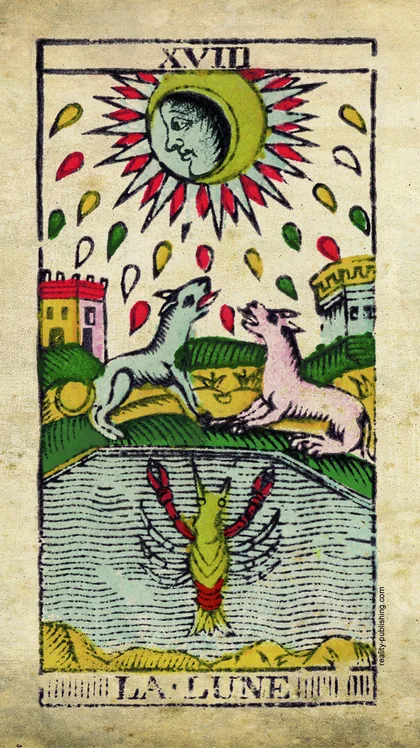
The Marseille Moon shows a celestial body with a strong profile, from which colored drops fall. Below, two dogs howl at the sky, framed by two towers, and a crayfish emerges from a pond. Nothing is sharp: the light is borrowed, shapes are only guessed at, and everyone interprets the landscape in their own way.
The Moon: strengths and points of attention
Its strengths
An imagination that feeds writing, drawing, music, or attention to detail.
An ability to listen without hurrying. Intuition, here, serves to ask good questions more than to deliver conclusions. A memory for atmospheres, valuable for understanding why a place, a team, or an evening worked well or badly. A listening ear that reassures hesitant people, because it does not push.
What needs attention
Delaying a decision because nothing is perfectly clear.
Taking for established fact an impression that has not been checked with the person concerned. Another difficulty is withdrawal: when everything seems hazy, you may pull back and let someone else decide for you, then feel regret.
The Moon in love, at work, and with money
In a relationship
This figure senses what the other feels before they even say it: a tiredness, a discomfort, a held-back joy.
This finesse creates a rare intimacy. Beware, though, of attributing intentions without checking them, or of keeping to itself an unease that a simple question would have dispelled.
At work
Jobs that decode weak signals suit it: creative work, listening, research, helping professions, monitoring.
The Moon spots early that a team is tensing up or that a client is hesitating. Written instructions and time to step back serve it better than decisions that must be made in a rush.
With money
The Moon manages its finances by feel, which gives good intuitions and a few gray areas.
A purchase can arise from a mood, a spending decision be put off by vague worry. Reviewing the accounts at a set time, with figures in front of you, turns these impressions into landmarks.
Portraits to recognize yourself in, not forecasts: the birth card says nothing about what will come.
The Moon: advice, number, and traditions
With The Moon: something to try this week
When a doubt occupies you, write down three verifiable facts before trusting the impression, then ask someone close whom you trust what they think.
Card 18 and the number 9
A birth card 18 reduces to 1 + 8 = 9.
The 9 brings openness and ideals: the Moon’s sensitivity gains perspective when it serves others, in the spirit of life path number 9. This kinship with 9 invites you to turn sensitivity outward: guiding, listening, advising give a clear use to what the Moon perceives on its own.
Your talent is to perceive a project before it is born, then give it substance. It appears when you describe a house to renovate and people already see it finished, when an invented story keeps a child spellbound, when you sense before anyone else that a project is going to fall short. This gift is used in writing and screenwriting, illustration, stage and film set decoration, psychological support, hypnosis and sophrology, and the creation of brands and visual worlds. To sharpen it, note your dreams and images each morning, practice an art form that starts from the imagination, and regularly complete a small project visualized all the way through, to teach your mind that it can build.
Your birth cards, according to tradition
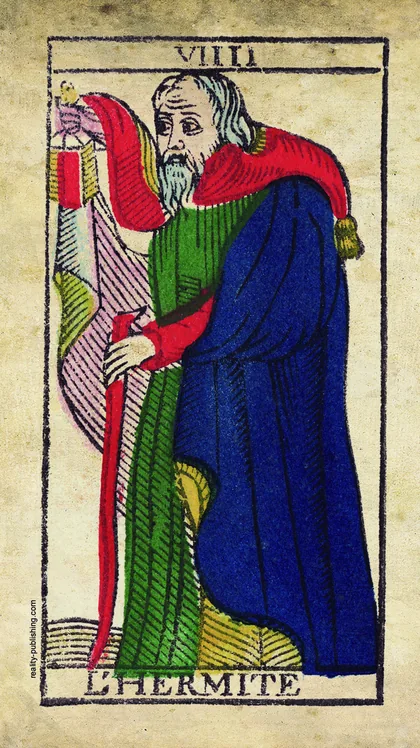
According to Angeles Arrien’s birth cards, taken up by Mary K. Greer, the Moon plays the role of personality and the Hermit (IX) that of the soul.
The pair joins nocturnal perception to the seeker’s lantern: impressions picked up in the haze find a patient light by which to be examined.
The Moon in two decks
The Moon of Conver (1760), card XVIII, places two dogs at the foot of two towers, while a crayfish occupies a pool in the foreground.
The Rider-Waite (1909), where it becomes “The Moon,” replaces one of the dogs with a wolf and traces a path that climbs between the two towers, toward the distance.
Day + month + year, reduced while the total is above 22 → 18.
With this method, birth card 18 no longer comes up for dates after 1978. For a later birth, it cannot be calculated; if it interests you, read it for the image, not for a match.
Is this really your birth card?
Your two birth cards
Personality cardXVIII · The Moon
Soul cardIX · The Hermit
1 + 8 = 9
A tradition passed on by Angeles Arrien and popularized by Mary K. Greer, an American author of books on tarot.
Frequently asked questions about The Moon
What does tarot birth card 18 mean?
Card 18 is The Moon, the card of imagination and hazy perceptions. It evokes a keen sensitivity, an intense relationship with dreams and moods, and trouble deciding when all is not clear. It is a theme for reading, never an imposed trait.
Which birth date gives birth card 18?
The total day + month + year must add up to 18: 4 + 5 + 1971 = 1980 → 18. It comes up only for births through 1978, then again from 2036 on; in between, it is impossible with this method of calculation.
Birth card 18 and life path number: what is the link?
Birth card 18 reduces to 9 (1 + 8). Life path number 9 puts ideals ahead of self-interest, and the image of the Moon answers it: sensitivity takes on meaning when it serves to understand others, rather than to worry alone.
Does The Moon announce a troubled period?
No. In a spread, tradition sometimes associates it with deception or confusion; as a birth card, the card announces nothing. It describes a way of perceiving the world, through nuances and feelings, and reminds us that an impression deserves to be checked before it becomes a conviction.
Illustrations: Nicolas Conver’s Tarot de Marseille, dated 1760, restored by Tarot World Project, CC BY-SA 4.0 license, via Wikimedia Commons — images resized and compressed by Versana.