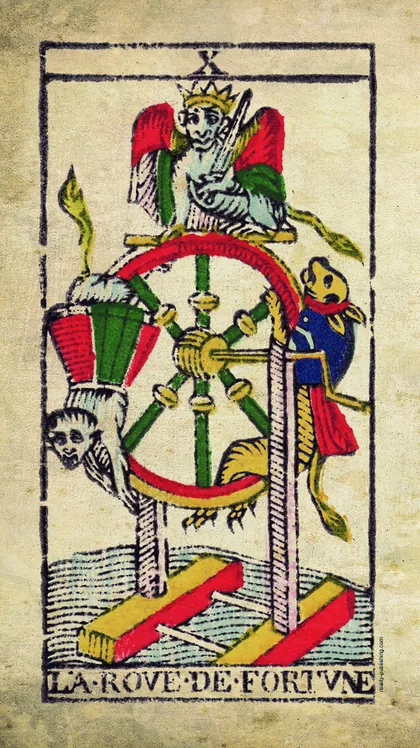
On the card, a large wheel with a crank sits at the center.
On the left, a small creature goes down, head first; on the right, another climbs back up; at the very top, a crowned figure sits calmly on a small platform. No one is settled for good. The image is not about luck but about movement.
What rises eventually falls, and the reverse: knowing where you stand in the turn helps you choose your moments. The most useful figure is the one at the top, who does not cling: it watches the wheel turn. Living under this card means learning not to confuse a phase with your whole life, or a low point with a verdict. Many paths of this kind tell of three or four successive careers, a move that restarted everything, a meeting that came just when nothing more was expected.
As a birth card, Wheel of Fortune points to an existence set by cycles: very active periods, periods when nothing seems to move, then a fresh start that nothing foretold. A person with this card readily changes direction after a few years, and is surprised to hear that they are “starting from zero” when, to them, they are following the same thread.
Wheel of Fortune: strengths and points of attention
Its strengths
A feel for the right moments, which you seize without calculating everything.
A taste for renewal, which lets you restart a stalled project. A certain detachment, which helps you get through a heavy period knowing it will pass. And a restarting energy: after a failure or a forced departure, you bounce back faster than your loved ones expect, often with a new project.
What needs attention
Conversely, you can wait for the wheel to turn on its own and let an opportunity slip by.
Before changing everything, ask yourself whether the phase is truly over, or just uncomfortable, which is not the same thing. Keep a thread, even a simple one, that links your periods.
Wheel of Fortune in love, at work, and with money
In a relationship
This figure lives love as a story in seasons: periods of closeness, others busier elsewhere, then reunions.
It brings movement, projects, and a wish to change scenery together. Its downside: wanting to restart everything when the other person would like to savor a steady moment.
At work
Paths under the Wheel rarely include just one profession.
This figure adapts quickly to a reorganization, takes over a file in progress, and senses when a market or a team changes course. It excels at launches and transitions; long routine without renewal gradually dims it.
With money
This figure’s finances follow its cycles: some periods are comfortable, others tighter.
It knows this and readily keeps a reserve to get through the lean stretches. It dares to redirect spending when the context changes. The trap: taking a good period for a lasting state and letting vigilance slip.
Portraits to recognize yourself in, not forecasts: the birth card says nothing about what will come.
Wheel of Fortune: advice, number, and traditions
With Wheel of Fortune: something to try this week
Draw your wheel: four periods from the past ten years.
Mark the one you are in, then what it is preparing for the next. Then talk about it with someone you trust.
Card 10 and the number 1
Arcana 10 reduces to 1 + 0 = 1: the first number, that of drive and initiative.
Each turn of the wheel then reads as a new beginning. For a life path, the idea is a road made of cycles, where you readily become a beginner again without minding, and where each start builds on what the last one taught.
Your talent is sensing when to act and placing yourself where opportunities pass. It shows when you apply the day before an unexpected hiring, when a project abandoned by others comes to life in your hands, when a chance conversation leads to a contract. It can also influence the path of those close to you, whom you steer toward the right door. It applies in commerce, real estate investment, tourism, recruiting, business development, and event organizing. To cultivate it, keep a notebook of signs and hunches and check them afterward, sometimes travel alone, and learn the basics of management to turn flair into lasting results.
Your birth cards, according to tradition
With Mary K. Greer’s method, a total of 10 pairs Wheel of Fortune, the personality card, with the Magician, the soul card: the turning cycle rests on someone who starts over.
The Wheel also appears in the trio for 19 (19 → 10 → 1). The Magician is never the first card with the calculation followed here.
Wheel of Fortune in two decks
In Conver (1760), card X shows a crank wheel gripped by three half-animal creatures; the one at the top wears a crown.
The 1909 Rider-Waite, Wheel of Fortune, transforms the scene: a sphinx sits on top, a serpent and Anubis flank the wheel, the letters TARO are inscribed on it, and four winged creatures read in the corners.
Day + month + year, reduced while the total is above 22 → 10.
Is this really your birth card?
Your two birth cards
Personality cardX · Wheel of Fortune
Soul cardI · The Magician
1 + 0 = 1
A tradition passed on by Angeles Arrien and popularized by Mary K. Greer, an American author of books on tarot.
Frequently asked questions about Wheel of Fortune
What does tarot birth card 10 mean?
Birth card 10 is Wheel of Fortune. The card shows a cycle where you go up, where you go down, where you start again. As a birth card, it invites you to read your life in periods rather than as one block, and not to take a phase for a destiny. It promises neither luck nor bad luck.
Which birth date gives tarot birth card 10?
November 27, 1979: 27 + 11 + 1979 = 2017, then 2 + 0 + 1 + 7 = 10. Other dates reach it in two reductions, like December 31, 1956: 1999, then 28, then 10. It is a frequent card, about one birth in fifteen since 1940.
Birth card 10 and life path 1: are they linked?
Yes, directly. The life path reduces the 10 to 1 + 0 = 1. Wheel of Fortune is thus the image of a 1 that keeps starting over: the initiative of this number is replayed at each turn. Two people with life path 1 do not necessarily have the same birth card: other totals also lead to 1, such as 19.
Does Wheel of Fortune mean ups and downs?
In a spread, it is often read as a turning point; as a birth card, the idea to keep is rather that every life has phases, and a way of finding your place in them: recognizing a rising moment in order to dare, a low moment in order to wait, without concluding that the situation will last forever.
Illustrations: Nicolas Conver’s Tarot de Marseille, dated 1760, restored by Tarot World Project, CC BY-SA 4.0 license, via Wikimedia Commons — images resized and compressed by Versana.