Upright, the Wheel of Fortune is often read as the observation of a movement: the situation is no longer quite what it was, and has not yet become what it will be.
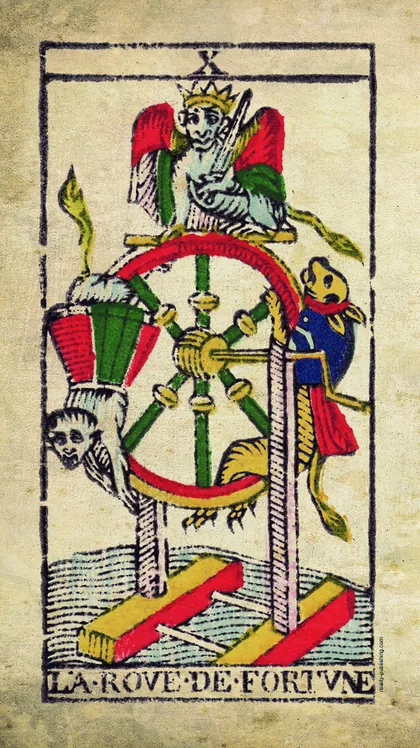
The drawing says it well. One figure rises, another descends, the sphinx stays on top with its sword. Nothing points to a winner.
For many readers, the card invites you to recognize a cycle: one period closes, another begins, and what worked yesterday may call for an adjustment. The card does not say that the change is happy. It says that it is taking place, and that how you go through it matters as much as the change itself.
In a spread, it sets in motion what surrounds it. In contact with a card of standstill, the blockage might loosen; facing a card of drive, it is better to check that the ground has really changed before launching into it.
cycle
change
movement
Wheel of Fortune in your life
In love
A relationship entering another phase: a rhythm that changes, roles that shift, a page that turns.
It invites you to look at the rhythm of the bond rather than its state: a relationship goes through seasons, and what changes is not always what is lost. With no current relationship, it can describe a period of renewal, in which the habits of meeting people shift.
At work
A position, a team, or a project in full rotation: places that change and an opportunity to seize with discernment.
The card evokes reorganizations, project cycles, and positions that are redistributed. It invites you to spot what is rising in your field and to adjust your position, rather than waiting for the movement to stop by itself.
With money
Income or spending that varies from one period to the next, and a rhythm to observe before deciding.
Here, money is a question of rhythm: broader periods, tighter ones. The card invites you to look at the curve rather than the day, and to tell what belongs to the cycle from what belongs to a choice.
As a feeling, as an action
As a feeling
The sense that things are getting under way, between curiosity about the change and a need to know where you stand.
As an action
Work out where on the wheel you are, then act in proportion to the movement rather than against it.
Reversed
The cycle that spins its wheels: the same situations come back because what keeps them turning has not changed.
Main reading
Energy blocked or turned inward
In love
Scenes that repeat from one relationship to the next, because no one has looked at what keeps bringing them back to the same point.
At work
A project going in circles: same meetings, same obstacles, and a movement that struggles to become progress.
With money
Spending or postponing habits that come back unchanged, until you decide to change a single point.
A question
What keeps coming back, and what could you change so that the cycle shifts?
Readability
Readable reversed in both decks.
cycle spinning its wheels
blocked energy
repetition
In a yes or no reading
Nuanced
The Wheel calls for nuance: the situation is turning, and the outcome depends on the moment you choose to act within that movement.
Questions to ask yourself
In the movement that is opening, where is the part that depends on you?
Where in the cycle would you place yourself, and how much depends on your own gesture?
What detail could you change to see whether the same scene plays out again?
A sentence to keep: “I look at where I stand in the cycle and I act at my own measure.”
A six-spoked wheel carries at its top a crowned, winged sphinx holding a sword. On the left, a creature tumbles down head first; on the right, another one climbs, clothed.
In the Conver deck, the wheel rests on a support and is turned by a crank: the movement is not natural, someone produces it. The sphinx, on a platform at the top, keeps the sword motionless while the two creatures trade places. One falls head down, the other climbs, clothed: the drawing shows the passage, not the result.
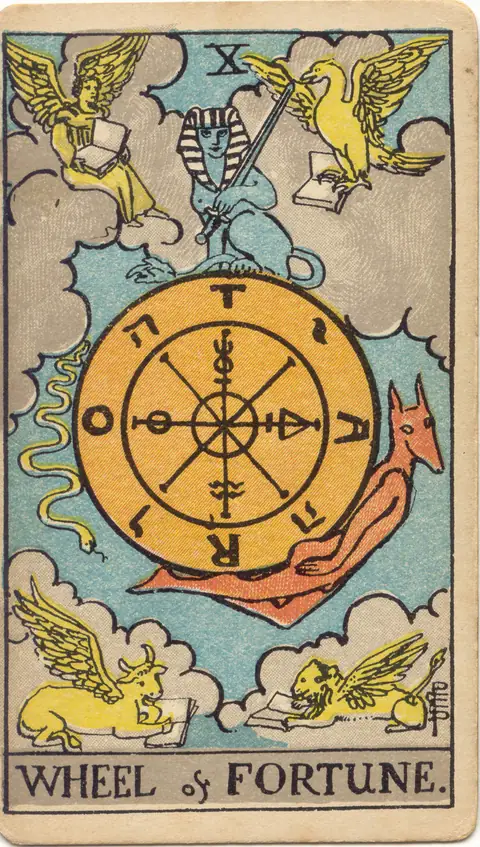
Waite’s deck replaces the crank with an orange wheel marked TARO and with Hebrew letters. A blue sphinx with a sword holds the top; a snake goes down on the left, a red figure with a jackal’s head goes up on the right. At the four corners, on clouds, a winged angel, eagle, bull, and lion read a book: around the movement, four presences seem still and attentive.
The six-spoked wheel (Marseille)
A cycle that turns without end: what is at the top does not stay fixed there.
The crank (Marseille)
Movement needs a hand that turns: the card recalls the part of human action in the cycle.
The sphinx with the sword
At the top, a motionless figure; Waite sees stability in the midst of movement.
Creature rising, creature falling
Fall and ascent at once: the wheel names no final winner or loser.
The letters on the wheel (Rider-Waite)
TARO and the Hebrew letters of the divine name, mingled around the circle: Waite reads Providence at work there.
The four winged figures (Rider-Waite)
Four winged beings on clouds, each holding a book: Waite links them to the Living Creatures of Ezekiel’s vision.
Two decks
Wheel of Fortune, Marseille and Rider-Waite
The same card in the two reference decks: Conver’s drawing, dated 1760, and Pamela Colman Smith’s scene, 1909.
Tarot de Marseille · Conver, dated 1760Wheel of FortuneXRider-Waite · London, 1909Wheel of FortuneX
Wheel of Fortune: what changes from one deck to the other
Aspect
Tarot de Marseille
Rider-Waite
Name
La Roue de Fortune
Wheel of Fortune
Number
X
X
Image
The wheel turns by crank on a support; one creature goes down head first and the other, clothed, climbs, beneath a winged sphinx.
The orange wheel carries TARO and Hebrew letters; a snake descends, a jackal-headed figure climbs, and four winged beings read at the corners.
Tarot de Marseille: Nicolas Conver, dated 1760, restored by the Tarot World Project, CC BY-SA 4.0 license, via Wikimedia Commons. Rider-Waite: drawings by Pamela Colman Smith, 1909, public domain, via Wikimedia Commons. Images resized and compressed by Versana; Marseille Minor Arcana diagrams and card back drawn by Versana.
Wheel of Fortune: nuances and combinations
In love, depending on your situation
Two situations, two readings: in a current relationship, then in a period without one, and reversed.
In a current relationship
A bond is made of highs and lows, and the wheel is a reminder that these positions trade places. The card invites you to see which season the relationship is going through, not to judge the whole on a single turn, and to turn the crank together.
In a period without a relationship
Someone rises, someone falls: without a relationship, the card speaks of a movement in which roles are redistributed. Habits, circles, wishes change places. It invites you to observe what moves in your daily life before deciding where to set your foot.
Reversed
When the wheel spins in place, the same evenings, the same quarrels, or the same attractions return under other faces. The reversed card invites you to spot the common point and change just one detail, to see what shifts.
Depending on the position in a spread
The position changes the reading: 7 common positions, each upright then reversed.
The situation
A cycle has just turned: what held the top place has moved, what was at the bottom is rising. The starting point reads as a passage, with no judgment of good or bad.Reversed: The cycle is spinning its wheels: you return to the same situations, the same gestures, as if the wheel were turning without getting anywhere.
What helps
Knowing that every cycle passes helps: watch the movement with patience and seize the moment when a small initiative can carry weight, rather than forcing the turn.Reversed: Support fades when you wait for the wheel to start again on its own: it is better to make a small gesture yourself to restart the movement.
What holds you back
The obstacle lies in how you read the moment: taking a change for a setback, or a rise for a permanent gain, keeps you from adjusting well.Reversed: A held-back movement blocks: everything turns inward, with no way out, and the same thoughts come back with each turn.
Your way of being
A flexible way of being in the face of change: you accept that things move, you adapt to the rhythm of the moment without trying to fix or control everything.Reversed: A resistance to movement: you cling to what is familiar, you delay the turn, and every adjustment seems to cost more than it brings.
What connects you
A bond that goes through phases: sometimes close, sometimes looser. What connects you reads as a cycle to live, not a straight line to hold at all costs.Reversed: The bond goes around in circles: the same discussions, the same misunderstandings coming back, and no one finds a way out of the circle.
What is at stake
It is about learning to deal with change: the hope of a rise, the fear of a fall, and the possibility of staying steady in the middle of the movement.Reversed: What is at stake is getting out of repetition: between the hope that everything moves and the fear that nothing changes, a first concrete step would restart the cycle.
Where it can lead
A new turn could open up: a phase that changes face and offers an unexpected hold, to be seized with flexibility rather than haste.Reversed: A prospect that is spinning its wheels: as long as the cycle turns idle, a single habit changed might be enough to set it going again.
Which cards it reads well with
Six cards calculated by the combination rules: two that reinforce it, two that nuance it, two in friction. None is “bad.”
Marseille numbers it X, Waite 10; the number reduces to 1. Jupiter and the Hebrew letter Kaph are associated with it.
X is a number of junction: ten is the end of a series that starts again at one. The card’s reduction to 1, 1 + 0, says the same thing differently: a closed cycle makes room for a new one. This is a numerology reading, not a fact of the drawing.
Apart from the number, no deck changes the card’s rank. Jupiter and Kaph give the card a vocabulary that many readers take up, without the drawing requiring it.
Tarot birth card and numerology
Wheel of Fortune is also the tarot birth card for dates that add up to 10; its reduced number, 1, links it to numerology.
Numbers and names read on Conver’s cards and in Waite’s text; correspondences reported according to the Golden Dawn tradition, never as facts.
Number
X in the Marseille deck · X in Waite’s
Name in the Tarot de Marseille
La Roue de Fortune
Golden Dawn
Jupiter, letter Kaph
Hebrew letter
Kaph כ
Planet
Jupiter
Reduced number
1
Tendency (yes / no)
Nuanced: Versana’s proposal, to be confirmed
Tone
Transition: Versana’s proposal, to be confirmed
Sources
Golden Dawn, Book T (The Tarot), published by Israel Regardie in The Golden Dawn
Nicolas Conver (1760), Tarot de Marseille restored by the Tarot World Project
A. E. Waite, The Pictorial Key to the Tarot (1910)
Sefer Yetzirah: three mother letters, seven doubles, twelve simples
Frequently asked questions about Wheel of Fortune
What does Wheel of Fortune mean in tarot?
The Wheel of Fortune represents a cycle in motion: one figure rises, another descends, and the sphinx keeps its sword at the top. Many readers see in it a change of phase, neither good nor bad in itself, that invites you to adjust how you act to the period you are going through.
What does Wheel of Fortune mean reversed?
Reversed, the Wheel is read mostly as a cycle that spins its wheels: the same situations come back because what keeps them turning has not changed. The movement is there, but it stays held back inside; the useful question becomes: what keeps repeating, and what could change?
Which cards go well with Wheel of Fortune?
With cards of standstill, the Wheel sets the situation moving; with cards of drive, it checks the timing. The cards paired with this page follow from the site’s rules, which issue no verdict.
Wheel of Fortune in a yes or no reading?
The Wheel keeps the answer in suspense: its tendency calls for nuance. The situation is turning, and the outcome depends on the moment you choose to act within that movement. The useful question becomes: where is the part that depends on me?