Skip to content

Four of Cups tarot card: meaning and reversed

The Four of Cups means weariness: a withdrawal into yourself that keeps you from seeing what is offered.

  • withdrawal
  • weariness
  • retreat
The essentials

Four of Cups at a glance

For you

A time of withdrawal: the gaze stays fixed on what is already there, and the offer that presents itself goes unnoticed.

A strength

A time of withdrawal that lets you take stock: the card invites you to look at what you already have before accepting something else.

Something to watch

A lowered gaze can let what is offered slip by: attention stays on what is in front of you, not on what is held out.

Tone
Withdrawal
Yes or no
Nuanced
Read more

By Thomas Guilhot · updated

Upright

The Four of Cups marks a pause in the momentum of the suit.

After the celebration of the three, the gaze turns inward: arms crossed, eyes fixed on what you already have, you step back.

It evokes a time of withdrawal, passing disinterest, or weariness, where nothing on offer really holds your attention.

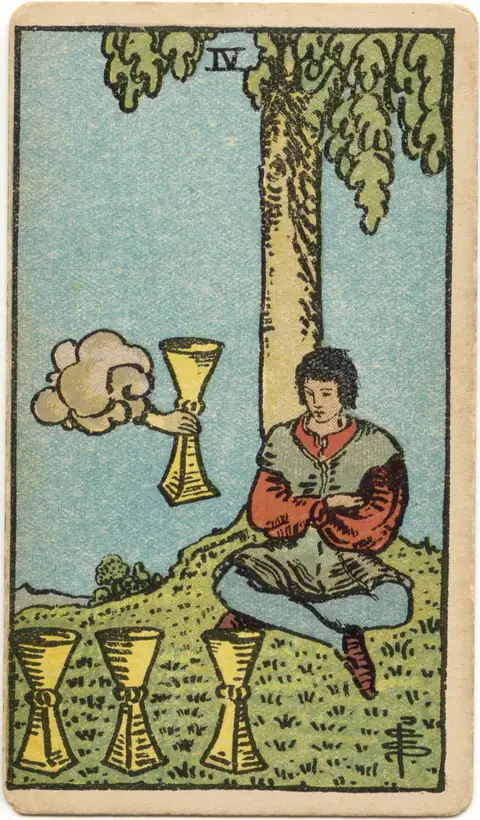
Its message lies in the hand coming out of the cloud: an offer exists, you just do not see it yet. It invites you to raise your eyes and ask whether the withdrawal protects or confines, without judging this time of pause.

  • withdrawal
  • weariness
  • retreat

Four of Cups in your life

In love

A feeling going dormant or an attention that goes unnoticed; raising your eyes might be enough to see it.

In close relationships, it describes a distance: a feeling going dormant, an attention offered that goes unnoticed. It invites you to raise your eyes before concluding there is nothing.

At work

A routine that no longer motivates, a proposal that goes unnoticed: the card invites a closer look.

In a team, it evokes weariness: a routine that no longer motivates, a proposal that goes unnoticed. Better to examine what is on offer before deciding that nothing is of interest.

With money

What is already secured fills the view; another option may exist, to be examined without rushing.

For money, the card speaks of what you already have in front of you: three cups plainly in view, a fourth to look at. It invites you to take stock without rushing at what presents itself.

As a feeling

A quiet weariness: nothing really tempts, and the gaze stays on what is already there.

As an action

Take a pause, then raise your eyes: look at what is offered to you before you decide.

Reversed

Weariness fades: you raise your eyes and finally notice what was offered.

In a yes or no reading

Nuanced

The tendency stays nuanced: an offer exists, but the gaze does not yet turn to it. Better to reread the question alongside the neighboring cards.

Questions to ask yourself

  • What is being offered to me right now that I am not really looking at?
  • Which detail of my emotional daily life have I stopped looking at?
  • Which small attention can I welcome this week, without making it a commitment?

A sentence to keep: “I take the time to look up before deciding that nothing is being offered to me.”

Yes or no tarot

What the card depicts

Under a tree, a seated figure, arms crossed, looks at three cups set before them; from a cloud, a hand holds out a fourth cup that their gaze does not meet.

Two decks

Four of Cups, Marseille and Rider-Waite

The Tarot de Marseille repeats the suit’s pips; the Rider-Waite illustrates each card with a scene.

IIIIFour of CupsDiagram
Tarot de Marseille · pip diagramFour of Cups
Rider-Waite · London, 1909Four of Cups
Four of Cups: what changes from one deck to the other
AspectTarot de MarseilleRider-Waite
NameQuatre de coupesFour of Cups
ImageIn the Tarot de Marseille, the Four of Cups remains a sign card without a scene: the tree and the crossed arms belong to Rider-Waite, and reversed it says little.Rider-Waite draws the withdrawal: a figure seated under a tree, arms crossed, and the hand emerging from a cloud with a fourth cup.
ReversalOften not readCommonly read (reversed cards)

Tarot de Marseille: Nicolas Conver, dated 1760, restored by the Tarot World Project, CC BY-SA 4.0 license, via Wikimedia Commons. Rider-Waite: drawings by Pamela Colman Smith, 1909, public domain, via Wikimedia Commons. Images resized and compressed by Versana; Marseille Minor Arcana diagrams and card back drawn by Versana.

Four of Cups: nuances and combinations

In love, depending on your situation

Two situations, two readings: in a current relationship, then in a period without one, and reversed.

Depending on the position in a spread

The position changes the reading: 7 common positions, each upright then reversed.

Which cards it reads well with

Six cards calculated by the combination rules: two that reinforce it, two that nuance it, two in friction. None is “bad.”

The card’s place in the suit

Fourth number of water, the four follows the celebration of the three and precedes the Five of Cups. The Moon, in the third decan of Cancer, is its reference point.

The card’s number

The card carries the number 4: in numerology as in the suit, one stage of a progression from 1 to 10.

Go further

  • Cancer 3rd decanThe decan the Golden Dawn assigns to this card
  • MelahelThe angel of the same decan, according to Lenain
  • HahiuiahThe angel of the same decan, according to Lenain

How is it built?

Suit and number read on the deck; decan and planet reported according to the Golden Dawn tradition, never as facts.

Frequently asked questions about Four of Cups

What does the Four of Cups mean in tarot?

The Four of Cups reads as a withdrawal: arms crossed, gaze on the three cups already there, a fourth offered that you do not yet see. It speaks of passing weariness and invites you to raise your eyes to what presents itself.

What does the Four of Cups mean reversed?

Reversed, the Four of Cups speaks of an intensity easing: weariness fades, you raise your eyes and finally notice what was offered. Withdrawal gives way to a more available gaze.

Which cards go well with the Four of Cups?

The Four of Cups follows the card of celebration, whose stance it reverses, and precedes the one that extends the withdrawal into regret. Near the series’ ace, it recalls that an offer can be there before it is received. See the pairings above.

The Four of Cups in a yes or no reading?

To a closed question, the Four of Cups answers with a tendency to qualify: an offer exists, but the gaze does not yet turn to it. It all depends on what the neighboring cards say about that offer.