Skip to content

Five of Swords tarot card: meaning and reversed

The Five of Swords embodies conflict: a victory that leaves a bitter taste and strained relationships.

  • conflict
  • bitter victory
  • power struggle
The essentials

Five of Swords at a glance

For you

A conflict leaves a bitter taste: having the last word has a price, and the blade invites you to ask what it is worth.

A strength

The clarity to see what a power struggle costs, and the possibility of choosing another way of being right.

Something to watch

Winning the argument can cost the relationship: tone, resentment, or the last word leave traces.

Tone
Questioning
Read more

By Thomas Guilhot · updated

Upright

The Five of Swords represents a conflict whose outcome leaves a bitter taste.

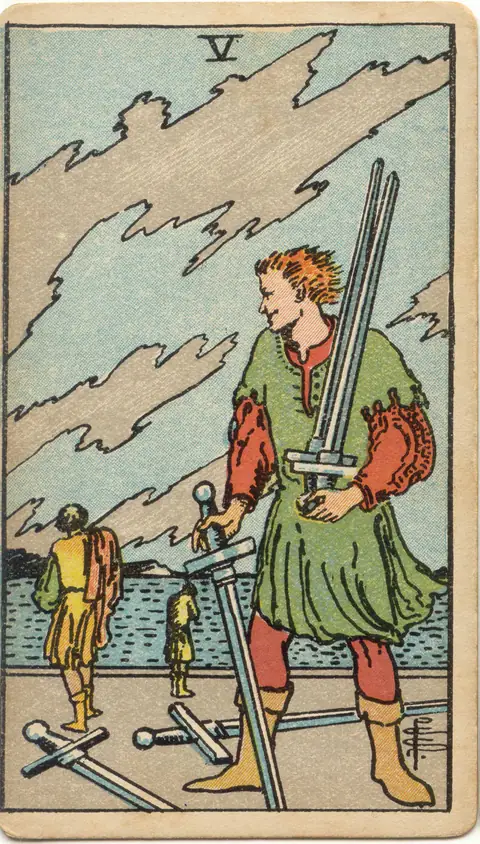
Someone has won, but the price is visible: figures walking away, an exchange that will not repair itself. The blade names no culprit; it shows a dynamic, the one in which you insist on being right.

It calls for questioning: what does this victory cost, and what is left of the relationship after it? Sometimes the blade suggests letting go of a fight not worth pursuing. It can also invite you to recognize a power struggle without being drawn into it.

The blade reads as a situation, never as a sentence.

  • conflict
  • bitter victory
  • power struggle

Five of Swords in your life

In love

An argument where each person wants to win can push you apart; setting down the stakes of being right for a moment reopens the chance to listen.

The Five of Swords looks at what an argument costs when each person wants the final word. Acknowledging your share, even a small one, or choosing not to answer a jab, can give the relationship some air.

At work

A rivalry or tense disagreement invites you to weigh what you really gain by insisting, and to look after your supports.

A team disagreement, a competition, or a tug-of-war of ideas: it pushes you to measure whether the stakes are worth the effort, and to preserve useful relationships rather than the last word.

With money

A dispute over a split or an amount benefits from being laid out calmly, facts in hand, without seeking advantage at all costs.

A stance, not financial advice: in a dispute over a split, rely on written facts, avoid escalation, and keep in mind what the discord costs.

As a feeling

A tension that lingers after the exchange, mixed with the wish to be right and the sense of having lost something.

As an action

Choose a fight to let go, or a sentence to take back, before the discussion damages the relationship further.

Reversed

The conflict dies down: the intensity eases, weapons are set down, and the wish to repair takes up a little more room.

In a yes or no reading

Rather reserved

The tendency is rather reserved: the Five of Swords shows a conflict that has its price. Better to refine your request and look at the neighboring cards before concluding.

Questions to ask yourself

  • What would this victory cost, and what could you let go?
  • Which part of this disagreement belongs to you, without anyone having to admit it first?
  • What would matter more to you than having the last word?

A sentence to keep: “I would rather find the bond again than win the argument.”

Yes or no tarot

What the card depicts

A person with a smirk gathers up swords; two others lie on the ground, while two figures walk away, heads down, toward the water.

Two decks

Five of Swords, Marseille and Rider-Waite

The Tarot de Marseille repeats the suit’s pips; the Rider-Waite illustrates each card with a scene.

VFive of SwordsDiagram
Tarot de Marseille · pip diagramFive of Swords
Rider-Waite · London, 1909Five of Swords
Five of Swords: what changes from one deck to the other
AspectTarot de MarseilleRider-Waite
NameCinq d’épéesFive of Swords
ImageIn the Marseille deck, the card stays a decor of patterns, with no conflict drawn.Rider-Waite shows a person gathering swords and two figures walking away toward the water, under torn clouds.
ReversalOften not readCommonly read (reversed cards)

Tarot de Marseille: Nicolas Conver, dated 1760, restored by the Tarot World Project, CC BY-SA 4.0 license, via Wikimedia Commons. Rider-Waite: drawings by Pamela Colman Smith, 1909, public domain, via Wikimedia Commons. Images resized and compressed by Versana; Marseille Minor Arcana diagrams and card back drawn by Versana.

Five of Swords: nuances and combinations

In love, depending on your situation

Two situations, two readings: in a current relationship, then in a period without one, and reversed.

Depending on the position in a spread

The position changes the reading: 7 common positions, each upright then reversed.

Which cards it reads well with

Six cards calculated by the combination rules: two that reinforce it, two that nuance it, two in friction. None is “bad.”

The card’s place in the suit

Fifth card of air, after the four and before the six. Venus is attached to it, in the first decan of Aquarius.

The card’s number

The card carries the number 5: in numerology as in the suit, one stage of a progression from 1 to 10.

Go further

  • Aquarius 1st decanThe decan the Golden Dawn assigns to this card
  • UmabelThe angel of the same decan, according to Lenain
  • Iah-helThe angel of the same decan, according to Lenain

How is it built?

Suit and number read on the deck; decan and planet reported according to the Golden Dawn tradition, never as facts.

Frequently asked questions about Five of Swords

What does the Five of Swords mean in tarot?

The Five of Swords represents a conflict whose outcome has a price: a bitter victory, a power struggle, figures walking away. It invites you to look at what you really gain by insisting, without naming a culprit.

What does the Five of Swords mean reversed?

Reversed, the card evokes a conflict dying down: the intensity eases and the wish to repair takes up more room. It is a reading of easing, which leaves the way open to a calmer exchange.

Which cards go well with the Five of Swords?

Next to the card of rest, a pause follows or precedes the tension. Near the card of sorrow, the pain accompanies the conflict. With a Cup, the bond seeks repair; with a Wand, momentum is put at the service of compromise. Six cards above shed light on it.

The Five of Swords in a yes or no reading?

The tendency is rather reserved: the Five of Swords signals a cost to face before going further. A wider spread, with its neighboring cards, helps measure its real weight.