Skip to content

Four of Swords tarot card: meaning and reversed

The Four of Swords represents rest: a necessary pause to regain strength and clear your head.

  • rest
  • withdrawal
  • lucid pause
The essentials

Four of Swords at a glance

For you

A time of withdrawal is needed to let thoughts settle; this retreat protects clarity before you resume.

A strength

The ability to withdraw for a while to catch your breath, let the noise die down, and regain clarity.

Something to watch

Rest can become a way of avoiding: a withdrawal that drags on cuts you off from others and makes you lose the thread.

Tone
Withdrawal
Yes or no
Nuanced
Read more

By Thomas Guilhot · updated

Upright

The Four of Swords is the card of the halt.

After the tension of sorrow and doubt, it shows a time when you set down your arms and withdraw to recover. This retreat looks less like an escape than like care taken of your own clarity, before returning to it.

In the image, everything is still, silent, and kept apart from noise. It invites you to choose a quiet place, a time without demands, a moment to let your thoughts settle.

It reads as a pause and is never interpreted literally: rest prepares what follows, without deciding it.

  • rest
  • withdrawal
  • lucid pause

Four of Swords in your life

In love

A time of gentle distance or shared silence can do good; saying that you are withdrawing avoids misunderstandings.

The blade speaks not of coldness but of breathing room. Saying clearly that you need a time of calm, and proposing a moment to reconnect, keeps the silence from being read as rejection.

At work

A pause in the rhythm, time to reflect before the next stage: withdrawal serves the quality of the work here.

A planned break, time off, a period without major decisions: the blade defends the right to slow down in order to resume better. It suggests not confusing rest with giving up.

With money

No hasty decision: letting a choice rest for a while lets you look at it afterward with more distance.

An attitude, not financial advice: not rushing, letting a choice rest, rereading the elements with a clear head, then deciding without pressure, at your own pace.

As a feeling

A need for silence and calm, like a long breath after a time of tension.

As an action

Plan a real pause, without screens or demands, and leave open questions waiting until calm returns.

Reversed

Blocked energy folds in on itself: rest is refused, agitation continues, and the weariness of thoughts builds up.

In a yes or no reading

Nuanced

The tendency stays to be nuanced: the Four of Swords invites you to wait and let things ripen rather than settle them. The neighboring cards can clarify the direction.

Questions to ask yourself

  • What time of silence do you need before you resume?
  • What time of calm could you ask for without it being taken as rejection?
  • When did the fatigue of thinking take over in recent times?

A sentence to keep: “I grant myself a frank pause, then return with rested eyes.”

Yes or no tarot

What the card depicts

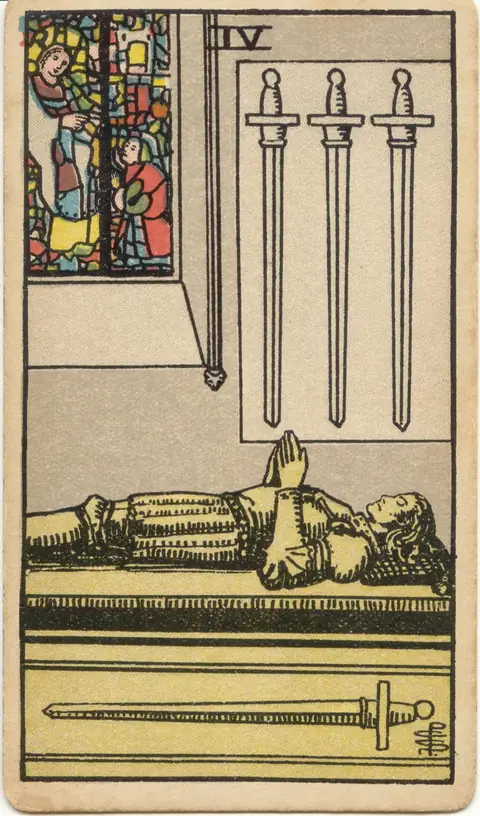
An armored figure, hands joined, lies on a tomb in a church; three swords hang on the wall and a fourth is carved along the tomb.

Two decks

Four of Swords, Marseille and Rider-Waite

The Tarot de Marseille repeats the suit’s pips; the Rider-Waite illustrates each card with a scene.

IIIIFour of SwordsDiagram
Tarot de Marseille · pip diagramFour of Swords
Rider-Waite · London, 1909Four of Swords
Four of Swords: what changes from one deck to the other
AspectTarot de MarseilleRider-Waite
NameQuatre d’épéesFour of Swords
ImageThe Marseille deck draws no scene: only the patterns of the suit appear.Rider-Waite places an armored figure lying in a church, with three swords on the wall, a fourth carved, and a stained-glass window.
ReversalOften not readCommonly read (reversed cards)

Tarot de Marseille: Nicolas Conver, dated 1760, restored by the Tarot World Project, CC BY-SA 4.0 license, via Wikimedia Commons. Rider-Waite: drawings by Pamela Colman Smith, 1909, public domain, via Wikimedia Commons. Images resized and compressed by Versana; Marseille Minor Arcana diagrams and card back drawn by Versana.

Four of Swords: nuances and combinations

In love, depending on your situation

Two situations, two readings: in a current relationship, then in a period without one, and reversed.

Depending on the position in a spread

The position changes the reading: 7 common positions, each upright then reversed.

Which cards it reads well with

Six cards calculated by the combination rules: two that reinforce it, two that nuance it, two in friction. None is “bad.”

The card’s place in the suit

Fourth card of air, placed between the three and the five. Jupiter accompanies it, in the third decan of Libra.

The card’s number

The card carries the number 4: in numerology as in the suit, one stage of a progression from 1 to 10.

Go further

  • Libra 3rd decanThe decan the Golden Dawn assigns to this card
  • HahahelThe angel of the same decan, according to Lenain
  • MikaelThe angel of the same decan, according to Lenain

How is it built?

Suit and number read on the deck; decan and planet reported according to the Golden Dawn tradition, never as facts.

Frequently asked questions about Four of Swords

What does the Four of Swords mean in tarot?

The Four of Swords represents rest, a chosen withdrawal, and the pause that gives clarity back. The image of a figure lying in a church reads as a halt, never as an end, and even less as an image to take literally.

What does the Four of Swords mean reversed?

Reversed, the card evokes refused rest: agitation continues, thoughts spin, and you cannot manage to stop. This reading invites you to ask what is preventing the pause.

Which cards go well with the Four of Swords?

With the card of sorrow, rest receives the pain. With the card of conflict, the pause comes before the confrontation. With a Cup, calm becomes inner; with a Wand, momentum waits to be found again. Details: the associations above.

The Four of Swords in a yes or no reading?

The tendency stays to be nuanced: the Four of Swords argues for waiting rather than settling. Depending on your request and the neighboring cards, it invites you to defer or to regain strength before deciding.