Skip to content

Seven of Swords tarot card: meaning and reversed

The Seven of Swords speaks of cunning: acting as a strategist, at the risk of sidestepping frankness.

  • strategy
  • discretion
  • questioning
The essentials

Seven of Swords at a glance

For you

A way of acting through cunning and strategy, which invites you to ask whether the direct route would not be fairer.

A strength

Knowing how to move forward with discernment, choosing what you take along and what you leave.

Something to watch

Thinking you are smarter than the situation, to the point of forgetting to say what really matters.

Tone
Questioning
Yes or no
Nuanced
Read more

By Thomas Guilhot · updated

Upright

Upright, the Seven of Swords is often read as a questioning: you look for the angle of approach, the strategy, the path that avoids a head-on clash.

In the realm of air, that of ideas, the mind calculates, schemes, doubts the direct route. The card pushes you to ask yourself: is this way of acting necessary, or would a frank word be enough? It describes a maneuver, not a judgment on the person carrying it out. In a spread, the neighboring card clarifies what is kept in reserve and what deserves to be said.

  • strategy
  • discretion
  • questioning

Seven of Swords in your life

In love

Half-truths set down out of caution, which would be better said than sidestepped.

A relationship may contain silences or half-truths set down out of caution. Asking what is left unsaid, on both sides, helps open the discussion without accusing anyone.

At work

A finesse-driven approach, prepared arguments, with the risk of replacing dialogue with maneuvering.

It can describe a context where you move forward with finesse: getting around an obstacle, preparing your arguments, keeping a card in hand. Make sure the maneuver does not replace dialogue.

With money

Cautious management, made of comparisons and waiting, safer when it stays simple.

It evokes a cautious way of managing money, sometimes from the sidelines: comparing, negotiating, waiting for the right moment. A simple rule is worth more than a complicated maneuver you no longer control.

As a feeling

A vigilance mixed with doubt, that of moving forward without revealing too much while looking behind you.

As an action

Check whether the goal can be reached openly before choosing a roundabout route.

Reversed

The strategy turns against you: the maneuver loses its effect and pushes you to return to more frankness.

In a yes or no reading

Nuanced

The card calls for nuance: it points to a roundabout path, which can serve you or turn against you depending on how frankly the question is asked.

Questions to ask yourself

  • What are you keeping to yourself, and what would you gain by saying it?
  • What information are you keeping in reserve, and to protect what exactly?
  • What would a complete version of what you think, said calmly, change?

A sentence to keep: “I prefer a whole word to a half-truth that protects me poorly.”

Yes or no tarot

What the card depicts

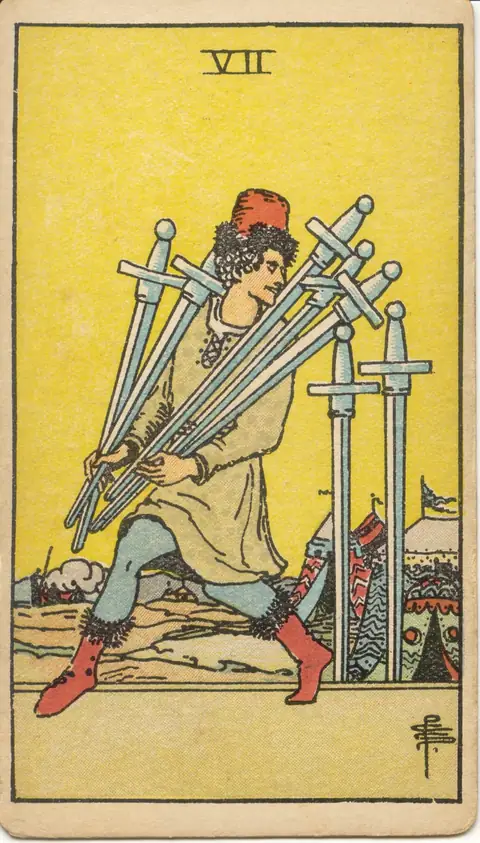
A figure tiptoes away carrying five swords, looking back over the shoulder; two swords remain planted, and the tents of a camp fill the background.

Two decks

Seven of Swords, Marseille and Rider-Waite

The Tarot de Marseille repeats the suit’s pips; the Rider-Waite illustrates each card with a scene.

VIISeven of SwordsDiagram
Tarot de Marseille · pip diagramSeven of Swords
Rider-Waite · London, 1909Seven of Swords
Seven of Swords: what changes from one deck to the other
AspectTarot de MarseilleRider-Waite
NameSept d’épéesSeven of Swords
ImageSeven swords arranged in a pattern, with no scene: in the Marseille deck, the meaning rests on the number seven and the suit of air.A figure on tiptoe, five swords carried off, two planted, and camp tents in the background.
ReversalOften not readCommonly read (reversed cards)

Tarot de Marseille: Nicolas Conver, dated 1760, restored by the Tarot World Project, CC BY-SA 4.0 license, via Wikimedia Commons. Rider-Waite: drawings by Pamela Colman Smith, 1909, public domain, via Wikimedia Commons. Images resized and compressed by Versana; Marseille Minor Arcana diagrams and card back drawn by Versana.

Seven of Swords: nuances and combinations

In love, depending on your situation

Two situations, two readings: in a current relationship, then in a period without one, and reversed.

Depending on the position in a spread

The position changes the reading: 7 common positions, each upright then reversed.

Which cards it reads well with

Six cards calculated by the combination rules: two that reinforce it, two that nuance it, two in friction. None is “bad.”

The card’s place in the suit

The seventh card of Swords, it follows the passage of the six and precedes the retreat of the eight: the mind, once under way, starts to calculate.

The card’s number

The card carries the number 7: in numerology as in the suit, one stage of a progression from 1 to 10.

Go further

  • Aquarius 3rd decanThe decan the Golden Dawn assigns to this card
  • DamabiahThe angel of the same decan, according to Lenain
  • ManakelThe angel of the same decan, according to Lenain

How is it built?

Suit and number read on the deck; decan and planet reported according to the Golden Dawn tradition, never as facts.

Frequently asked questions about Seven of Swords

What does the Seven of Swords mean in tarot?

The Seven of Swords represents cunning and strategy: an indirect way of acting, which invites you to ask whether the direct path is possible. The image shows a figure walking away with five swords, two remaining planted. The card describes a maneuver, not a fault.

What does the Seven of Swords mean reversed?

Reversed, it evokes blocked energy: the strategy turns against you, or the cunning loses its effect, which invites a return to more frankness. In the Marseille deck, the reversal of this card is barely noticeable.

Which cards go well with the Seven of Swords?

It is best read with a card of speech or clarity, which shows what can be said openly. The associated cards, higher up on the page, complete this reading without giving a verdict.

The Seven of Swords in a yes or no reading?

Its tendency calls for nuance: it describes a roundabout path, which can help or turn against you. It is better to rephrase the question: what am I not saying, and why?