In love
Setting a clear boundary and defending what matters, without turning every exchange into a tug-of-war.
Setting a clear boundary or defending what matters to you: the card invites this, without turning every exchange into a real tug-of-war.
The Seven of Wands means defense: holding your position against pressure, with courage and conviction.
Holding your place against what rises from below: a challenge is weathered standing up, without backing down.
It shows the ability to hold your ground and defend a choice, with an active stance rather than a retreat.
Holding on at all costs can become a reflex: defending everything sometimes makes it hard to tell what is truly worth keeping.
By Thomas Guilhot · updated
The Seven of Wands speaks of a position that has to be defended.
The wands rising from below stand for demands, criticism, or rivalries, and the figure on the height answers them with a frank gesture. An idea, a choice, or a place is being tested, and staying put takes courage.
Its reading centers on being challenged: the scene is an active defense, not a retreat. The card invites you to hold your course without stiffening, to choose your battles, and to accept that not everything is decided here.
Setting a clear boundary and defending what matters, without turning every exchange into a tug-of-war.
Setting a clear boundary or defending what matters to you: the card invites this, without turning every exchange into a real tug-of-war.
A contested idea or position: argue calmly and choose your battles rather than fighting them all.
A contested idea, a coveted position: you stand on high ground and argue calmly, choosing your battles rather than fighting them all head-on.
Defending what you have built, without being drawn into every discussion that opens.
Defending what you have built without being drawn into every discussion: a way of acting, never a management instruction, committing you to no specific choice.
The feeling of being called on from all sides, with the determination not to give up the ground gained.
Keep the wand in hand, sort out what deserves an answer, and let the rest pass without scattering yourself.
Blockage looms: overwhelmed by what keeps rising, you end up doubting your own position, turned in on itself.
Nuanced
Needs nuance: the position is tenable, but it takes effort and vigilance, and context weighs heavily on the answer.
Questions to ask yourself
A sentence to keep: “I hold my position calmly, without turning every exchange into a fight.”
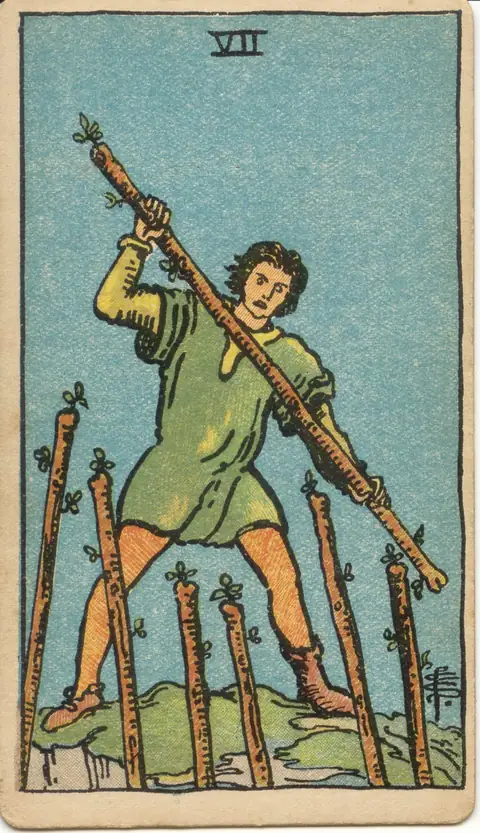
A figure standing on high ground uses a wand to fend off six wands raised toward them from below. Their two shoes do not match.
The high ground offers a favorable position, but the six wands rising from below leave no respite. The wand the figure holds is used here to push back, not to walk. The two different shoes add a puzzling detail: the defense is made with whatever means are at hand, without perfect preparation. The scene reads as a challenge that is faced rather than fled.
The Tarot de Marseille repeats the suit’s pips; the Rider-Waite illustrates each card with a scene.
| Aspect | Tarot de Marseille | Rider-Waite |
|---|---|---|
| Name | Sept de bâtons | Seven of Wands |
| Image | In the Tarot de Marseille, only seven wands, in sign-like patterns, with no high ground and no figure. | A scene of defense: on high ground, a figure in mismatched shoes fends off six wands raised toward them. |
| Reversal | Often not read | Commonly read (reversed cards) |
Tarot de Marseille: Nicolas Conver, dated 1760, restored by the Tarot World Project, CC BY-SA 4.0 license, via Wikimedia Commons. Rider-Waite: drawings by Pamela Colman Smith, 1909, public domain, via Wikimedia Commons. Images resized and compressed by Versana; Marseille Minor Arcana diagrams and card back drawn by Versana.
Two situations, two readings: in a current relationship, then in a period without one, and reversed.
The position changes the reading: 7 common positions, each upright then reversed.
Six cards calculated by the combination rules: two that reinforce it, two that nuance it, two in friction. None is “bad.”
Seventh card of the Wands, between the Six and the Eight. Mars, in the third decan of Leo, is its reference point.
In the suit of fire, the seven comes right after the Six, where a return is celebrated. Here, recognition gives way to a position to keep. The Eight, its next neighbor, shows wands thrown in mid-flight. Many readers link Mars to this image of a fight fought standing up.
The card carries the number 7: in numerology as in the suit, one stage of a progression from 1 to 10.
Suit and number read on the deck; decan and planet reported according to the Golden Dawn tradition, never as facts.
An active defense: a figure on high ground fends off six wands raised toward them. The card evokes a challenge that is faced and a position that is held, without backing down or digging in.
Reversed, the Seven speaks of blocked energy: you feel overwhelmed by demands, and the defense runs on empty. The card invites you to lighten what you are trying to protect. In the Tarot de Marseille, it is rarely read this way.
After the card of recognition that precedes it, the Seven of Wands makes it a position to hold; before the next card, defense gives way to movement; beside the one that follows, vigilance sets in. It all depends on what you are asking. The pairings section just above lists them.
Needs nuance. The position is tenable, but the card calls for effort and steadiness, and the answer varies with the question asked as well as with the neighboring cards. It becomes clearer mostly in context.