Skip to content

Judgement tarot card: meaning, upright and reversed

Judgement is the card of awakening: hearing a call, taking stock, and setting out again with new momentum.

  • call
  • review
  • awakening
The essentials

Judgement at a glance

For you

A call makes itself heard and invites you to take stock, to acknowledge the road traveled, and to choose what begins next.

A strength

A clear-eyed review: acknowledging what has been lived, drawing a lesson from it, and answering the call of a change of course.

Something to watch

Going back over the past again and again can become an inner trial: harshness toward yourself hides the call, which asks you to move on.

Tone
Transition
Read more

By Thomas Guilhot · updated

Upright

Upright, Judgement speaks of a call that awakens.

The angel blows its trumpet, and below the figures stand up: the card is often read as the moment you stop justifying yourself in order to hear what asks to change. Its number, XX, reduces to 2; the tone is that of a passage, a threshold you cross knowingly.

In a concrete situation, Judgement can accompany a long-considered decision, a fresh start, a reconciliation with your own path. It does not ask you to disown everything: it invites you to sort, to keep what truly matters, and to leave the rest behind. The moment favors clarity, the right word, and picking up a project set aside.

  • call
  • review
  • awakening

Judgement in your life

In love

Resuming a conversation left hanging, saying what matters, forgiving what can be forgiven, and choosing the bond consciously.

In a relationship, Judgement can invite you to resume a conversation left hanging, to say what matters, and to forgive what can be forgiven. It pushes toward a frankness without harshness, so that each person hears the other and chooses consciously what comes next for the bond.

At work

A review of your career, an evaluation, or a new course: the moment to put your gains into words and answer a professional call.

On the professional side, the card evokes a review of your career, an evaluation, the moment to acknowledge what you have gained and set a new course. It can help you present a project clearly or answer a call that falls outside the usual frame.

With money

Taking stock of your accounts without dramatizing, noticing your habits, and deciding what to keep.

For finances, Judgement suggests taking stock without dramatizing: rereading your accounts, noticing your habits, deciding what to keep. It is a way of facing things, which does not replace professional advice.

As a feeling, as an action

As a feeling

An inner awakening, between gravity and relief: what was blurry becomes sharp and asks for an answer.

As an action

Take stock, name what is finished, and follow up on what calls you, without waiting for a perfect moment.

Reversed

Reversed, the call stays unheard or turns against yourself: a review that is too harsh, blocked energy folded back on itself.

In a yes or no reading

Rather favorable

Judgement leans toward a favorable answer, especially when the question concerns a passage you own or a decision that has ripened; the wording of the question counts as much as the card.

Questions to ask yourself

  • What call am I hearing, and what is it asking of me?
  • Which part of my story can I reread with more kindness?
  • What has been calling me for a while that I keep putting off?

A sentence to keep: “I reread my story with kindness and answer what calls me.”

Yes or no tarot

What the card shows

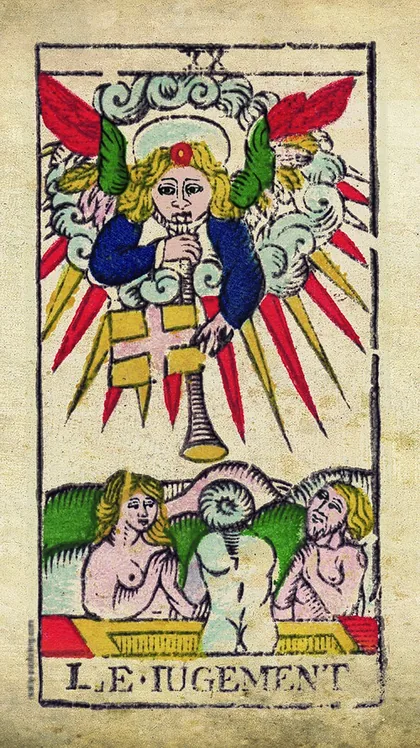
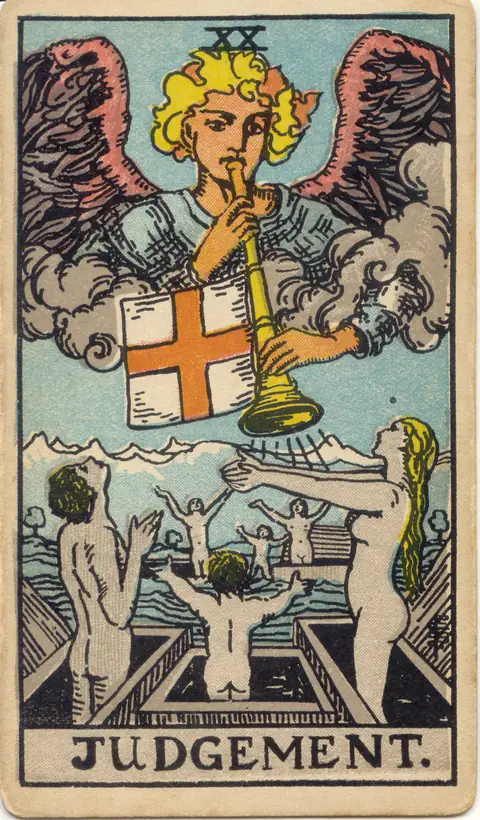
An angel in the clouds blows a trumpet hung with a cross banner, rays all around; below, a figure rises from the ground, seen from behind.

In the Marseille version, the figure rising from the ground stands between two others who join hands: the scene is read as a shared response to a call. In the Rider-Waite deck, the angel has wings and its trumpet carries a banner marked with a cross. Nude figures with gray skin rise in coffins floating on water, arms open, in front of snowy mountains. In both drawings, the sound comes from above and what is below stands up. The eye moves from the trumpet to the figures below, the way you move from a call to what it awakens.

Two decks

Judgement, Marseille and Rider-Waite

The same card in the two reference decks: Conver’s drawing, dated 1760, and Pamela Colman Smith’s scene, 1909.

Tarot de Marseille · Conver, dated 1760JudgementXX
Rider-Waite · London, 1909JudgementXX
Judgement: what changes from one deck to the other
AspectTarot de MarseilleRider-Waite
NameLe JugementJudgement
NumberXXXX
ImageIn the Marseille deck, the figure rising from the ground is seen from behind and stands between two others who join hands.In the Rider-Waite deck, nude figures with gray skin rise in coffins floating on water, arms open.
ReversalOften not readCommonly read (reversed cards)

Tarot de Marseille: Nicolas Conver, dated 1760, restored by the Tarot World Project, CC BY-SA 4.0 license, via Wikimedia Commons. Rider-Waite: drawings by Pamela Colman Smith, 1909, public domain, via Wikimedia Commons. Images resized and compressed by Versana; Marseille Minor Arcana diagrams and card back drawn by Versana.

Judgement: nuances and combinations

In love, depending on your situation

Two situations, two readings: in a current relationship, then in a period without one, and reversed.

Depending on the position in a spread

The position changes the reading: 7 common positions, each upright then reversed.

Which cards it reads well with

Six cards calculated by the combination rules: two that reinforce it, two that nuance it, two in friction. None is “bad.”

The history of the card

The Marseille deck numbers it XX, Waite’s 20; reduced, it gives 2. It corresponds to Fire and the letter Shin.

Go further

How is it built?

Numbers and names read on Conver’s cards and in Waite’s text; correspondences reported according to the Golden Dawn tradition, never as facts.

Frequently asked questions about Judgement

What does Judgement mean in tarot?

Judgement is read as a call and an awakening: taking stock of a path, acknowledging what has been lived, and answering a change of course. Its tone is that of passage, and its reading invites you to choose rather than endure.

What does Judgement mean reversed?

Reversed, the call is muffled: you do not hear it, or you judge yourself with a harshness that blocks momentum. The reading then puts forward blocked energy, which you can loosen by rereading your path with more leniency.

Which cards go well with Judgement?

Judgement links review to the completion of a cycle next to cards of fulfillment, and evokes a fresh start after a sorting next to cards of opening. Surrounded by heavier cards, it invites you to look at what weighs before deciding. See the pairings above.

Judgement in a yes or no reading?

Facing a closed question, Judgement leans toward the favorable side, especially if the question concerns a passage that has ripened. This tendency remains one reading among others: it depends on the wording and on the neighboring cards.