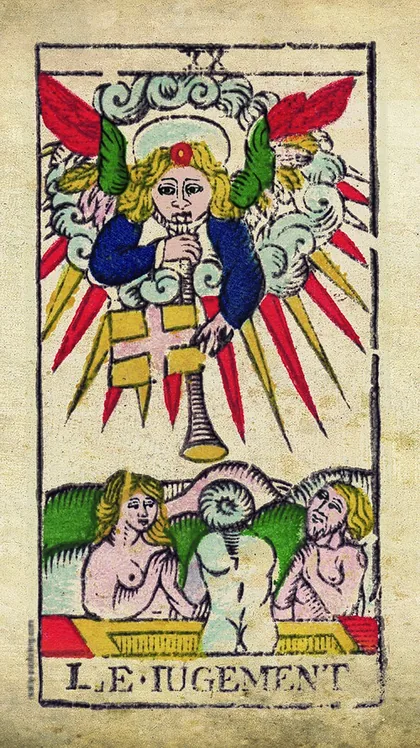
Judgement awakens the family’s memory: it helps you reread the family story and choose what to carry forward or repair.
family-line memory
family awakening
reconciliation
The essentials
Arcana 20 between parents and children at a glance
A strength
You have a sense of your family’s history. You know how to recover an anecdote, a name, a forgotten tradition, and bring it back to life over a meal. These stories give younger people a sense of belonging and the elders the joy of being listened to. You connect the generations through speech.
Something to watch
Family memory does not hold only gentle memories. Returning again and again to an old dispute, or waiting for an apology to arrive, can freeze relationships. Sorting what you keep from the shared history, then accepting that some episodes stay blurry, lets you move forward without giving up the truth.
With the 20 in this area, the relationship with the parents was often difficult: repeated quarrels, mutual grudges, the feeling of permanent judgment or of comparisons with a brother, a sister, a cousin.
With your parents
With the 20 in this area, the relationship with the parents was often difficult: repeated quarrels, mutual grudges, the feeling of permanent judgment or of comparisons with a brother, a sister, a cousin. This reproach eases when you place your parents back in their own story: what they received, what they missed. Questioning a grandparent, finding a photo of their youth, then forgiving without waiting for an apology often loosens the knot, even from a distance.
With your children
With the 20, you pass on a sense of family and history: the elders’ tales, holiday traditions, the pride of belonging to a lineage. The fitting stance is to offer a clear framework while letting the child build their own path, without asking them to repair what you did not manage. According to the method, the arrival of a child sometimes pushes you to draw closer to your own people and to give up a pride that isolates. The trap would be to hand down your family grudges, or to judge the child without listening.
On the line of the generations, Judgement speaks of a reckoning and an awakening. On the parents’ side, it evokes a relationship where words hurt, where grudges lasted, or on the contrary where a whole clan gathered around a single story. It brings to light the calls of the family line: what asks to be recognized, heard, soothed.
On the children’s side, the energy shows up as the wish to pass on a fair account. Telling where you come from, naming the figures who mattered, sharing the hardships that were gone through as well: these gestures give younger people living roots. They understand that they belong to a story, without having to repeat it exactly.
Finally, this line opens the way to reconciliation. Writing a letter, visiting an elder, suggesting a reunion meal: such gestures, even modest ones, wake dormant ties. Judgement does not ask you to judge anyone, but to answer the call of memory with an open heart.
Judgement in your life
In everyday life
While clearing out an attic with your children, you find a box of yellowed photos.
You spread them on the table and tell the stories: this portrait of a great-grandfather, that village festival, that wedding in the rain. The younger ones ask a thousand questions. That evening, you phone a distant cousin to suggest completing the album. He accepts gladly, and the two branches of the family begin exchanging rediscovered memories. A new bond is woven, patiently, around a story that is now shared.
What helps
What helps
Collect an elder’s story, in writing or recorded
Suggest a simple reunion to a relative you lost touch with
Keep a family notebook where everyone adds an anecdote
Judgement, parents and children: nuances
Where it sits in the matrix
These points: portrait, parents and children, parents and children (inner).
Portrait
The way people perceive you at first sight, your calling card. Active from birth.
Parents and children
What you received from your parents, and what flows from one generation to the next.
Parents and children (inner)
What you pass on to your children, or to the younger people you guide.
A symbolic reading of the Destiny Matrix: food for thought about yourself, never a verdict or an established fact.
The portrait is the starting point, then the center is added to it.
Fictional example, March 14, 1987: the portrait is 14 and the center 3. The transmission point adds the two, 17, the Star. The received inheritance point adds the portrait and this transmission: 14 and 17 make 31, then 3 and 1 make 4, the Emperor. The full line therefore reads 14, 4, 17, from the portrait toward the center.
Frequently asked questions: arcana 20 between parents and children
What does Judgement mean between parents and children?
It evokes family memory, the way a family line’s story is told and passed on. It can point to old tensions to soothe, or a tradition to keep alive. This line invites you to look at the inheritance clearly, then choose what you want to carry forward in your own home.
How do you reconcile with a parent with Judgement?
With a simple gesture and no reproach: a call, a letter, a meal. This energy favors reunions when everyone can tell their version without being interrupted. You do not need to resolve everything: a first sincere exchange often reopens the door, which later ones can widen at their own pace.
How do you talk about the past with children with Judgement?
With true stories suited to their age. Show photos, mention striking figures, and say what was hard too, without blaming anyone. Younger people like to understand where they come from. An honest account, calmly passed on, gives them firmer landmarks than silences or embellished versions.
Illustrations: Nicolas Conver’s Tarot de Marseille, dated 1760, restored by Tarot World Project, CC BY-SA 4.0 license, via Wikimedia Commons — images resized and compressed by Versana.