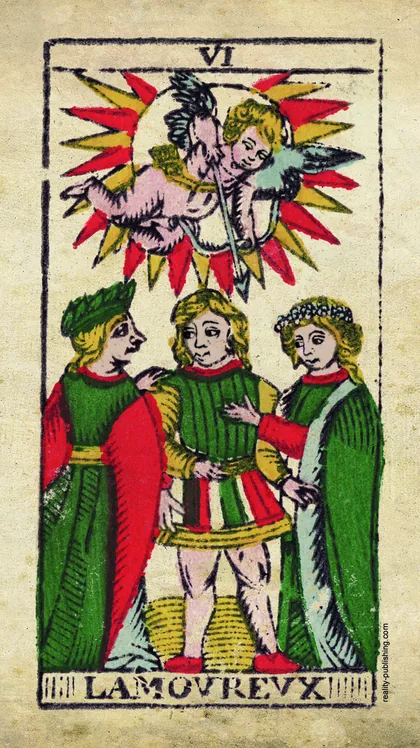
The Lovers put the bond at the center of your family: how each person feels chosen, loved, and free to choose in turn.
emotional bonds
feeling chosen
owned choices
The essentials
Arcana 6 between parents and children at a glance
A strength
You make everyone feel they matter. A word of attention, a moment set aside for one person alone, a celebration decorated with care: these gestures express affection without detours. The younger ones gain a precious confidence in their place in the family, and the elders the pleasure of being truly seen.
Something to watch
The wish to please everyone can make choices hard. Between two loyalties, two families, or two desires, you risk putting off a decision until you feel torn. Saying clearly what you want, even if it disappoints a little, often soothes more than prolonged hesitation.
With the 6 in this area, the child you were may have doubted being loved the way you hoped: very busy parents, not very demonstrative ones, or an affection that seemed to depend on grades and good behavior.
With your parents
With the 6 in this area, the child you were may have doubted being loved the way you hoped: very busy parents, not very demonstrative ones, or an affection that seemed to depend on grades and good behavior. This reproach eases when you admit that your parents loved with the means they had. Asking them about their own childhood, looking at an old photo together, or thanking them for a specific memory is sometimes enough to loosen the knot.
With your children
The 6 makes you pass on a taste for shared moments: holiday meals, the house decorated for birthdays, sweet notes slipped into a school bag. The fitting stance is to love the child for who they are, not for what they show: their report cards, their politeness in front of guests, or their adorable little face do not tell everything about them. Let them choose their clothes, activities, and friends, and show them by example that one can hesitate and then decide. The trap would be to dream of a perfect child and let them see your disappointment when they stray from it.
On this line, the Lovers question the way affection circulates. In your own childhood, the question of connection mattered a great deal: feeling loved like the others, finding your place between two people, understanding what was said or not said about tenderness. What often remains is a great sensitivity to the emotional atmosphere of a room.
With your children and the younger people around you, it is the shared moments that leave a mark: holiday meals, outings for two, little notes hidden in a schoolbag. They keep a taste for lovely things and for gestures that bring people closer.
Finally, this line invites you to learn to choose without fearing to lose a bond. Choosing a city to live in, a way of celebrating, a distance from certain relatives takes nothing away from affection. The Lovers remind you that to love is also to respect the other’s choices, and that each generation draws its own way of staying close.
The Lovers in your life
In everyday life
The end of the year approaches, and two branches of the family hope to host you the same evening.
Rather than promising both, you call each one, explain your choice, and suggest another date for the other. The voices relax right away. The next day, before a school outing, you slip a little note into a child’s bag, and on coming home they bring you a drawing made especially for you. You realize that affection grows through small, repeated attentions far more than through grand promises.
What helps
What helps
Set aside one-on-one time for each person you love
Announce a choice gently rather than delaying it
Tell your loved ones what you appreciate in them
The Lovers, parents and children: nuances
Where it sits in the matrix
These points: portrait, parents and children, parents and children (inner).
Portrait
The way people perceive you at first sight, your calling card. Active from birth.
Parents and children
What you received from your parents, and what flows from one generation to the next.
Parents and children (inner)
What you pass on to your children, or to the younger people you guide.
A symbolic reading of the Destiny Matrix: food for thought about yourself, never a verdict or an established fact.
The portrait is the starting point, then the center is added to it.
Fictional example, March 14, 1987: the portrait is 14 and the center 3. The transmission point adds the two, 17, the Star. The received inheritance point adds the portrait and this transmission: 14 and 17 make 31, then 3 and 1 make 4, the Emperor. The full line therefore reads 14, 4, 17, from the portrait toward the center.
Frequently asked questions: arcana 6 between parents and children
What do the Lovers mean in the parent-child line?
They point to the quality of the bonds between generations: feeling loved, chosen, and in your place. They can suggest a childhood where this feeling took time to settle, or great family warmth. This line invites you to cultivate the bonds you want to last, and to choose carefully those that matter.
How do you announce a choice that may disappoint with the Lovers?
With simple, affectionate words, before discomfort sets in. Make clear that your decision changes nothing about your attachment, suggest another way of getting together, and accept that disappointment, if it comes, can be expressed. Clarity protects the bond better than avoidance, and spares everyone long guesswork.
How do you make each child feel chosen with the Lovers?
By making individual moments, even brief ones. A walk for two, an activity they love, attention to their own tastes: each child needs to be seen as they are, not only as a member of a group. These moments nourish the feeling of having a lasting place and of being loved for who they are.
Illustrations: Nicolas Conver’s Tarot de Marseille, dated 1760, restored by Tarot World Project, CC BY-SA 4.0 license, via Wikimedia Commons — images resized and compressed by Versana.