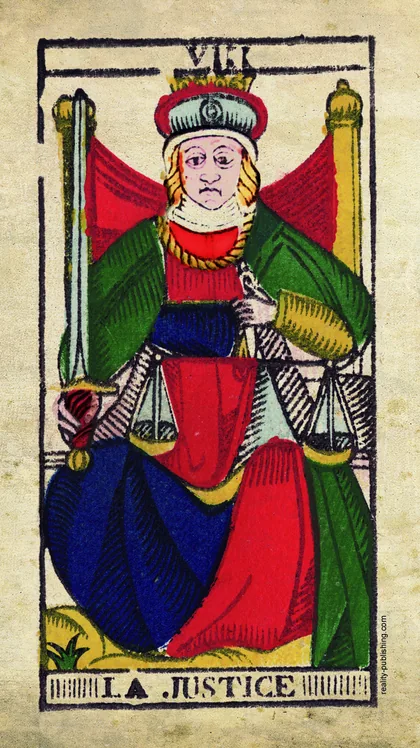
Between generations, Justice carries one shared concern: that each child receive their fair share, of attention as well as of rules.
family fairness
passed-on rules
peaceful sharing
The essentials
Arcana 8 between parents and children at a glance
A strength
You have a sense for family shares. An inheritance, help for an aging parent, the choice of the house that hosts the celebrations: you suggest solutions the siblings can accept. With the younger ones, this same fairness reassures deeply, because they know what they can expect and that the rule applies to everyone.
Something to watch
The family can become a scale that is watched without letup. Noting what the parents gave to this brother or that sister, comparing gifts, help, visits: the quest for fairness then stirs up resentment. Some inequalities cannot be repaired; acknowledging them, then leaving them behind, frees the whole lineage.
This parental 8 often signals an old grievance about fairness: a disproportionate punishment, a brother or sister who was always excused, a vacation promise never kept, rules that changed with the adults’ mood.
With your parents
This parental 8 often signals an old grievance about fairness: a disproportionate punishment, a brother or sister who was always excused, a vacation promise never kept, rules that changed with the adults’ mood. It eases when you stop putting your parents on trial in order to understand their own constraints, and when you stand as an adult before them: setting your limits calmly, without trying to obtain redress.
With your children
As a parent, the 8 passes on above all the value of a given word and respect for rules: schedules kept, promises honored, explanations rather than orders. The fitting stance is to be consistent: the same rule for all the children, a proportionate and explained sanction, apologies when you are wrong. According to the method, your child also teaches you not to fight a battle just to be right. The trap would be to turn the house into a courtroom, to judge every misstep, or to comment on their faults in front of other people.
On this line, Justice links what you received to what you pass on. On your parents’ side, she points to a family where the question of what is fair took up a lot of space: stated principles, accounts kept, sometimes an inheritance or a promise that left a taste of inequality. Even when childhood was happy, a sharp sensitivity remains to differences in attention between brothers and sisters.
On the children’s side, the energy turns toward passing on a framework. The most precious thing you leave them has less to do with the rules themselves than with how they are set up: explained, discussed, revised when they no longer serve. The young people you guide, your own or others, learn with you that a decision can be challenged without the bond being threatened.
Finally, this line invites you to look at the family’s material shares: a vacation home, furniture, a business. Settling them early, in writing and out loud, keeps one generation from inheriting the quarrels of the previous one. This is often where Justice does the greatest service to the whole lineage.
Justice in your life
In everyday life
One Sunday, the siblings get together to organize help for an aging parent: groceries, appointments, paperwork.
Tensions surface quickly, because everyone feels they do more. You take out a sheet of paper, note each person’s availability, suggest a rotation and a new check-in in three months. In the evening, with your own children, the same logic applies to sharing the game console or the front seat of the car: a clear rule, a turn for everyone, and far fewer arguments.
What helps
What helps
Write down important family agreements, even among relatives who trust each other
Acknowledge to your children a rule you set badly
Grant the previous generation the right to have been imperfect
Justice, parents and children: nuances
Where it sits in the matrix
These points: portrait, parents and children, parents and children (inner).
Portrait
The way people perceive you at first sight, your calling card. Active from birth.
Parents and children
What you received from your parents, and what flows from one generation to the next.
Parents and children (inner)
What you pass on to your children, or to the younger people you guide.
A symbolic reading of the Destiny Matrix: food for thought about yourself, never a verdict or an established fact.
The portrait is the starting point, then the center is added to it.
Fictional example, March 14, 1987: the portrait is 14 and the center 3. The transmission point adds the two, 17, the Star. The received inheritance point adds the portrait and this transmission: 14 and 17 make 31, then 3 and 1 make 4, the Emperor. The full line therefore reads 14, 4, 17, from the portrait toward the center.
Frequently asked questions: arcana 8 between parents and children
Does Justice in the parent-child line mean a strict childhood?
Not necessarily. She signals a childhood where fairness mattered, happily or painfully: rules that were very present, or on the contrary a lack of rules that left a sense of injustice. Some families were simply attached to principles. What matters is the mark left in you, and what you decide to do with it.
How do you talk about inheritance in the family with Justice on this line?
Early, calmly, and in front of everyone concerned. This energy tolerates discreet arrangements poorly, since they later feed suspicion. A family meeting, a notary, a written document make it possible to set out each person’s intentions. The goal is not perfect equality, but a division understood and accepted by everyone.
What should you pass on first to your children with Justice?
Keeping your word, and knowing how to admit a mistake. A child who sees their parents keep their promises and apologize when they are wrong learns that justice is not a power struggle. This lesson is worth more than a thousand rules: it will serve them in their friendships, their work, and their own family choices.
Illustrations: Nicolas Conver’s Tarot de Marseille, dated 1760, restored by Tarot World Project, CC BY-SA 4.0 license, via Wikimedia Commons — images resized and compressed by Versana.