Skip to content

Justice tarot card: meaning, upright and reversed

Justice is the card of fairness: seeing things as they are and deciding with integrity.

  • discernment
  • balance
  • coherence
The essentials

Justice at a glance

For you

A moment of discernment: the card invites you to weigh the facts calmly, then to decide with clarity and coherence.

A strength

A gaze that weighs before deciding, a clear word, and an agreement between your decisions and your way of living.

Something to watch

The decision can stay suspended: by weighing every pan, you delay the moment of deciding.

Tone
Questioning
Yes or no
Nuanced
Read more

By Thomas Guilhot · updated

Upright

Justice passes for the card of discernment: a moment when you need to look at the facts calmly, measure what each option implies, then decide with clarity.

The raised sword evokes the clarity of speech, the scale the attention given to both sides of a situation. Many readers also see in it the idea of coherence: what you choose answers for what you have done, and what you have done shapes what you will choose next. Questioning gives it its tone: the card does not decide in your place, it invites you to examine your criteria. Over the course of a spread, it can suggest gathering the elements of a file, saying things clearly, or repairing what had been left shaky. The question it asks: what would be fair here, for you as for others?

  • discernment
  • balance
  • coherence

Justice in your life

In love

A need for balance between giving and receiving; a frank conversation could put things back on the table.

In a relationship, Justice can evoke a need for balance between giving and receiving, or a frank conversation that puts things back on the table. It pushes you to say what seems fair to you, and to listen to the answer.

At work

A contract, a common rule, or an evaluation to carry out with method; check the facts before deciding.

At work, the card points to a contract, a common rule, an evaluation to carry out with method. It can ask you to check the facts before deciding, then to formulate a decision that is clear, reasoned, and owned.

With money

A rigorous way of acting: keeping your accounts, honoring an agreement, sharing fairly what must be shared.

On the resources side, Justice describes a rigorous way of acting: keeping your accounts, honoring an agreement, sharing fairly. The image speaks of rigor rather than figures: check that each pan of the scale is properly filled.

As a feeling, as an action

As a feeling

A need for clarity and fairness, the feeling of having to measure before acting, sometimes the gravity of a decision to be made.

As an action

Gather the facts, listen to both sides, then formulate a clear decision that you could explain out loud.

Reversed

Reversed, Justice leaves the decision suspended: a balance that does not come about, put off from day to day.

In a yes or no reading

Nuanced

An answer to qualify, here: everything rests on the facts weighed and on the decision you own, more than on the image.

Questions to ask yourself

  • What would be fair here, for you as for others?
  • What would you say if you had to explain your decision out loud in front of the other person?
  • Which disagreement would gain from being examined calmly, with facts rather than impressions?

A sentence to keep: “I weigh what is fair for each person, then I say clearly what I decide.”

Yes or no tarot

What the card shows

A figure seated facing front, wearing a crown and a cap, a raised sword in one hand and a scale in the other; behind, the uprights of the throne.

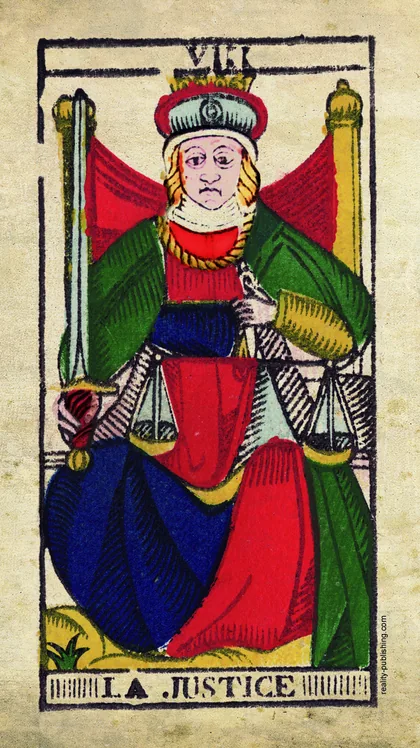
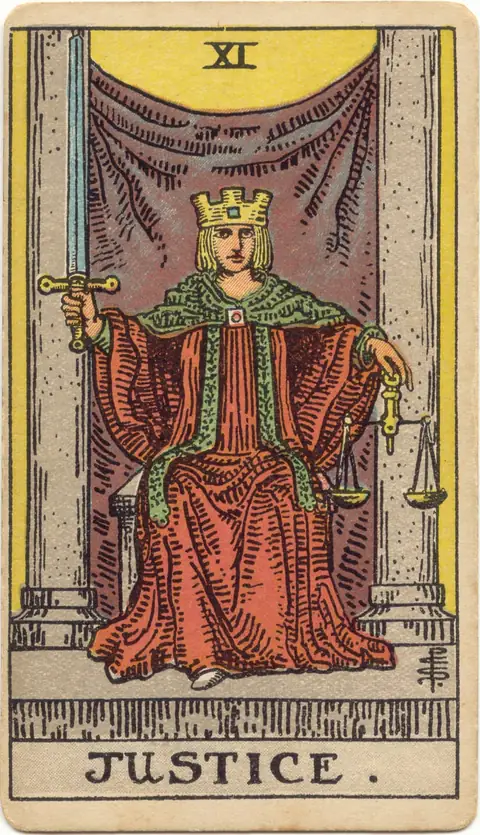
In the Marseille deck, the drawing is plain and frontal: the figure sits facing the viewer, the sword pointing upward, the scale hanging from the other hand, the uprights of the throne forming a frame behind. Nothing moves; everything invites a pause. In Waite’s deck, the card takes the number XI. The crowned figure sits between two pillars, in front of a purple veil; the sword stands straight, the scale hangs from the other hand, and a white foot peeks out under the red robe. Both versions place side by side a blade that cuts and a scale that weighs: two gestures that complete each other, and that the reading asks you to hold together.

Two decks

Justice, Marseille and Rider-Waite

The same card in the two reference decks: Conver’s drawing, dated 1760, and Pamela Colman Smith’s scene, 1909.

Tarot de Marseille · Conver, dated 1760JusticeVIII
Rider-Waite · London, 1909JusticeXI
Justice: what changes from one deck to the other
AspectTarot de MarseilleRider-Waite
NameLa JusticeJustice
NumberVIIIXI
ImageNumbered VIII, Justice sits facing front, sword raised and scale in hand, between the uprights of her throne.Waite places her at XI and gives the VIII to Strength; in front of a purple veil, a white foot peeks out from the robe.
ReversalOften not readCommonly read (reversed cards)

Tarot de Marseille: Nicolas Conver, dated 1760, restored by the Tarot World Project, CC BY-SA 4.0 license, via Wikimedia Commons. Rider-Waite: drawings by Pamela Colman Smith, 1909, public domain, via Wikimedia Commons. Images resized and compressed by Versana; Marseille Minor Arcana diagrams and card back drawn by Versana.

Justice: nuances and combinations

In love, depending on your situation

Two situations, two readings: in a current relationship, then in a period without one, and reversed.

Depending on the position in a spread

The position changes the reading: 7 common positions, each upright then reversed.

Which cards it reads well with

Six cards calculated by the combination rules: two that reinforce it, two that nuance it, two in friction. None is “bad.”

The history of the card

Justice is the eighth card in the Marseille deck and the eleventh in Waite’s: its place changes, but the image of the scale remains.

Go further

  • LibraThe sign the Golden Dawn assigns to this card
  • 08:08The hour that bears the card’s number

How is it built?

Numbers and names read on Conver’s cards and in Waite’s text; correspondences reported according to the Golden Dawn tradition, never as facts.

Frequently asked questions about Justice

What does Justice mean in tarot?

Justice stands for discernment, balance, and a weighed decision. It evokes an agreement between actions and choices, and invites you to examine your criteria, without predicting a verdict.

What does Justice mean reversed?

Reversed, Justice is often read as a suspended decision, a balance that does not come about. The reading invites you to spot what holds the decision back: a missing fact, a vague criterion, or the fear of deciding.

Which cards go well with Justice?

Justice goes with cards of drive, to give a heading to what moves forward, with cards of choice, to weigh a decision calmly, or with cards of rule, to base it on a text. The neighboring cards refine the reading. The associations above show it.

Justice in a yes or no reading?

If a clear-cut answer is expected, Justice stays to be qualified: everything depends on what is weighed and on what you decide. Above all, the card invites you to clarify the question before trying to answer it.