The Chariot is often read as the card of drive: a project getting started, a desire to act taking shape, a heading you choose to hold.
Many readers see in it the image of mastery obtained without reins, through the sole direction given to different forces. In a spread, it can invite you to decide on a destination, then to bring your resources, wishes, and constraints into line so that they pull the same way. The chariot is covered and solid: the card evokes the protection of a well-built framework as much as speed. The tendency is rather favorable, with no guarantee: everything depends on the steering, and the card is a reminder that you only hold a team by looking ahead. The useful question is simple: where do you want to go, and what in you pulls elsewhere?
drive
direction
mastery
The Chariot in your life
In love
A shared drive, a project for two getting started; check that you are pulling in the same direction.
In a relationship, the Chariot can evoke a shared drive, a project for two getting started, or a wish to move forward together. It also invites you to check that you are pulling in the same direction as the person who matters to you.
At work
A project getting started, a mission carried out with method; set a clear heading before speeding up and divide up the roles.
On the professional side, it is read as a project getting started, a mission carried out with method, a team that has to be coordinated. It can push you to set a clear heading before speeding up, and to divide up what each person drives.
With money
A determined way of acting: a clear goal, means devoted to it, a direction that stays readable.
On the resources side, the Chariot describes a determined way of acting: giving yourself a goal, devoting means to it, and sticking with it. The card puts no figure on anything; above all it asks you to keep a readable heading.
As a feeling, as an action
As a feeling
Determination and the wish to move forward, with sometimes the tension of holding opposing drives together.
As an action
Choose a precise destination, line up your means with it, then move forward in stages rather than committing everything at once.
Reversed
Reversed, the Chariot shows a drive without direction: excess speed and scattering replace the heading.
Main reading
Excess
In love
A drive that is too fast or two wishes that pull each their own way; slow down to agree on the direction.
At work
Too many projects run at the same time, efforts scattered; choosing one priority would help you get back on course.
With money
Means spread across several directions at once; narrowing down to one goal could make the whole more readable.
A question
Which direction do you really hold, and where do your efforts go in all directions?
Readability
Readable reversed in both decks.
scattering
drive without heading
excess
In a yes or no reading
Rather favorable
The Chariot leans rather to the favorable side, provided a heading is held and the drive does not scatter.
Questions to ask yourself
Toward what goal do you want to steer your drive, and what pulls elsewhere?
Which forces within you are pulling in different directions right now?
What concrete step would bring your momentum closer to a precise goal?
A sentence to keep: “I choose a course and I align my forces to hold it.”
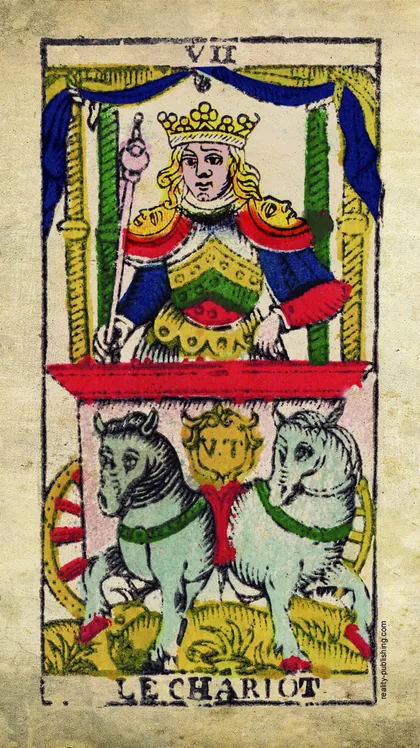
A crowned figure, standing in a canopied chariot carried by four pillars, scepter in hand, shoulder pads with faces; two horses pull in two diverging directions.
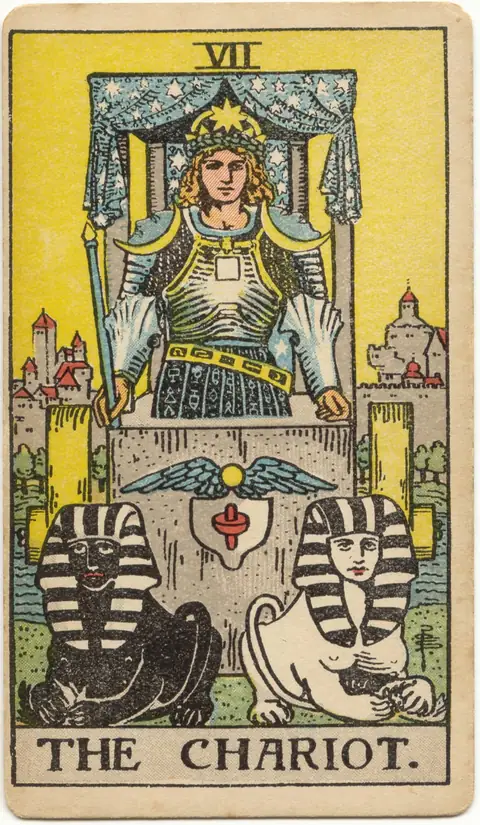
In the Marseille deck, the chariot looks like a small covered stage: a canopy on four pillars, a body bearing the letters V.T., a crowned figure holding a scepter whose shoulder pads show faces. The two horses do not look the same way, and that detail gives the card its tension. In Waite’s deck, the driver wears armor and a starry crown, holds a wand under a canopy scattered with stars, and the chariot is drawn by two sphinxes, one black and one white, without reins; a winged disc decorates the body and a city can be made out behind. In both versions, the question is the same: who leads, and how do you make two forces move forward together?
The canopy on four columns (Marseille)
A covered, held space: four supports that give momentum a stable frame.
The faces on the shoulder pads (Marseille)
Faces on the shoulders. For his own card, Waite says the shoulders would carry the Urim and Thummim, oracle objects from the Bible.
The two diverging horses (Marseille)
Two forces pulled toward opposite directions: the challenge is to make them move together.
The letters V.T. (Marseille)
Two initials on the body of the chariot. Another Tarot de Marseille bears those of its maker there (F.T., Tourcaty); these remain unexplained.
The black and white sphinxes (Rider-Waite)
One black sphinx, one white sphinx, with no visible reins; Waite sees in the card a triumph of the mind more than of force.
The winged disk (Rider-Waite)
A disk with wings adorns the front of the chariot’s body.
Two decks
The Chariot, Marseille and Rider-Waite
The same card in the two reference decks: Conver’s drawing, dated 1760, and Pamela Colman Smith’s scene, 1909.
Tarot de Marseille: Nicolas Conver, dated 1760, restored by the Tarot World Project, CC BY-SA 4.0 license, via Wikimedia Commons. Rider-Waite: drawings by Pamela Colman Smith, 1909, public domain, via Wikimedia Commons. Images resized and compressed by Versana; Marseille Minor Arcana diagrams and card back drawn by Versana.
The Chariot: nuances and combinations
In love, depending on your situation
Two situations, two readings: in a current relationship, then in a period without one, and reversed.
In a current relationship
Two people moving toward the same goal make a bond in motion: moving in together, traveling, carrying out a project. The card invites you to match your rhythm before the road, since horses pulling apart slow down the whole chariot.
In a period without a relationship
The chariot covered by a canopy gives an image of mastery: you know where you are going and what you want. The card invites you to keep moving without rushing to find someone, and to keep the direction of your own journey.
Reversed
When speed replaces direction, each runs their own way and the bond follows as best it can. The reversed card invites you to stop, compare each person’s route, and choose a course to hold together.
Depending on the position in a spread
The position changes the reading: 7 common positions, each upright then reversed.
The situation
The context is in motion: a will to progress, a momentum that carries the situation along and asks you to keep hold of the reins with clarity.Reversed: The momentum lacks direction: the context heads off in several ways at once, and effort is scattered.
What helps
What helps is momentum well driven: a clear will, a steady course, and a force directed at a single goal, right up to the arrival.Reversed: Help comes through a direction regained: taking back the reins of a movement that is scattering, and choosing a heading.
What holds you back
What holds you back is the urge to move forward on every front at once: two impulses pull each their own way, and the movement wears itself out instead of carrying you.Reversed: The obstacle hardens: by wanting to hold the reins so tightly, you no longer move forward at all.
Your way of being
A determined and conquering attitude: moving forward, holding the course, leading things with will, without being diverted from your path, whatever the resistance.Reversed: A way of pushing ahead without direction: plenty of momentum, but pulled two ways, and a scattering that wears you down.
What connects you
Between two people, a bond that moves forward: a common goal, coordinated efforts, a shared movement that gives the relationship momentum.Reversed: The bond scatters: each pulls their own way, and the shared momentum no longer finds a common heading.
What is at stake
What is at stake is holding the course: carrying a momentum through to the end with consistency, keeping command of everything that pulls forward.Reversed: What is at stake is gathering what is scattering: giving momentum a direction before it runs out.
Where it can lead
A movement could open up: with a clear heading and determination, the situation would pick up speed and gain coherence.Reversed: A prospect would exist if momentum found a direction; scattered, it could wear out long before getting anywhere.
Which cards it reads well with
Six cards calculated by the combination rules: two that reinforce it, two that nuance it, two in friction. None is “bad.”
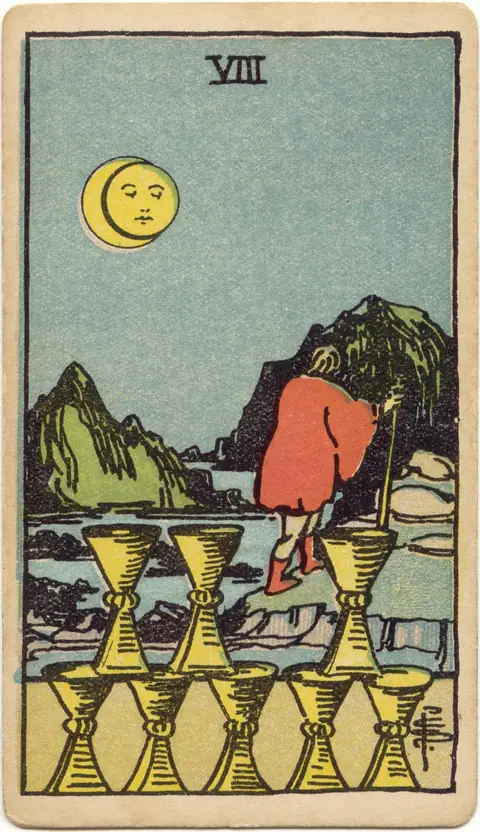
Cards that reinforce itEight of CupsEight of Cups: tones momentum and transition, elements water and waterRead the pair
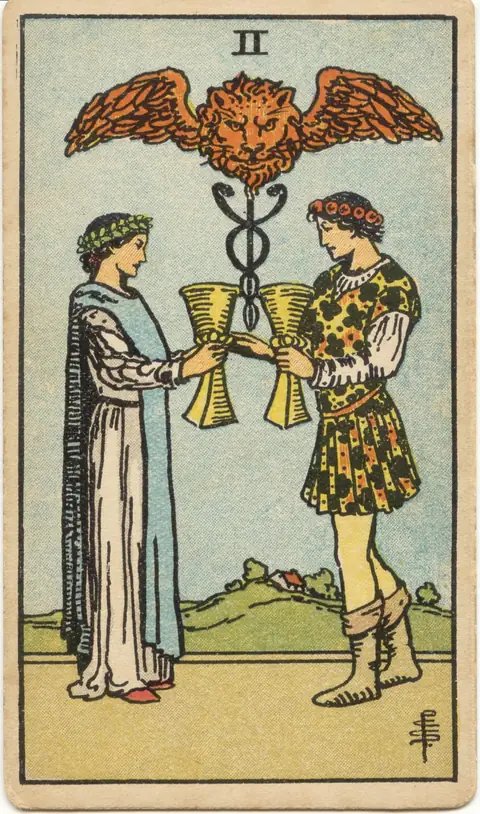
Cards that reinforce itTwo of CupsTwo of Cups: shared tone, momentum, elements water and waterRead the pair
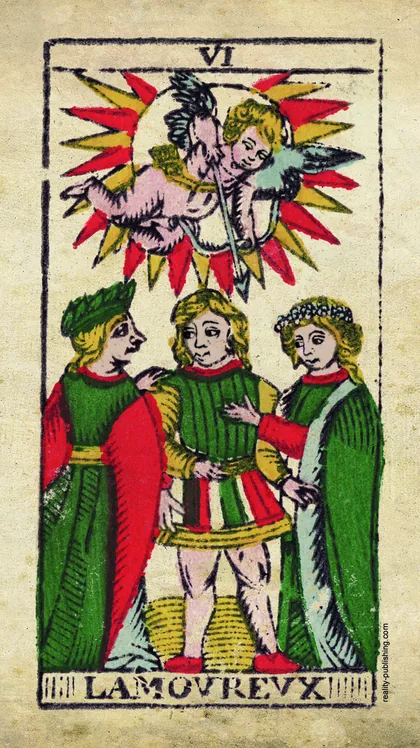
The Chariot is the seventh card of the Major Arcana: after the choice of the Lovers, the drive that arises from a decision made.
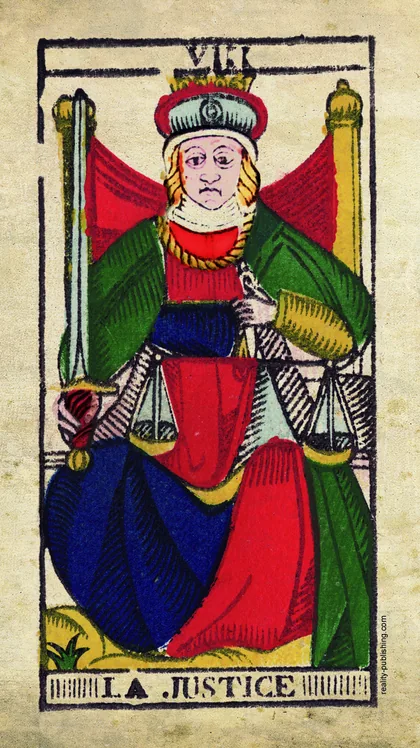
Numbered VII, the card follows the Lovers and precedes Justice in the Marseille deck, Strength in Waite’s, which swap places between VIII and XI. The Chariot is the first card of frank movement: after the framework of the Hierophant and the choice of the Lovers, something sets out. The number 7 stays 7 after reduction. The Marseille deck and Waite’s number it the same way, and each version keeps the image of a team of two forces, horses on one side, sphinxes on the other.
Tarot birth card and numerology
The Chariot is also the tarot birth card for dates that add up to 7; its reduced number, 7, links it to numerology.
Numbers and names read on Conver’s cards and in Waite’s text; correspondences reported according to the Golden Dawn tradition, never as facts.
Number
VII in the Marseille deck · VII in Waite’s
Name in the Tarot de Marseille
Le Chariot
Golden Dawn
Cancer, letter Cheth
Hebrew letter
Cheth ח
Sign
Cancer
Reduced number
7
Tendency (yes / no)
Rather favorable: Versana’s proposal, to be confirmed
Tone
Momentum: Versana’s proposal, to be confirmed
Sources
Golden Dawn, Book T (The Tarot), published by Israel Regardie in The Golden Dawn
Nicolas Conver (1760), Tarot de Marseille restored by the Tarot World Project
A. E. Waite, The Pictorial Key to the Tarot (1910)
Sefer Yetzirah: three mother letters, seven doubles, twelve simples
Frequently asked questions about The Chariot
What does the Chariot mean in tarot?
The Chariot stands for drive, steering, and a heading held. Many readers see in it a will that sets out and brings together different forces. It invites you to choose a direction, without promising anything about the outcome.
What does the Chariot mean reversed?
Reversed, the Chariot is often read as a drive without direction: the two animals pull each their own way, hence a scattering. The reading invites you to take the reins again by first clarifying the heading to hold.
Which cards go well with the Chariot?
The Chariot teams up with cards of choice, for the drive that follows a decision, with cards of balance, to temper speed, or with cards of structure, to support a project. The question asked refines the reading. No verdict: see above.
The Chariot in a yes or no reading?
For someone who expects a verdict, the Chariot leans rather to the favorable: a drive is possible. It remains conditional on a heading held, so the reading invites you to clarify the direction before launching.