Skip to content

The Tower tarot card: meaning, upright and reversed

The Tower is the card of upheaval: what was badly built gives way and lets fresh air in.

  • shake
  • liberation
  • reset
The essentials

The Tower at a glance

For you

A structure gives way all at once: what held out of habit falls, and space frees up to build on sounder foundations.

A strength

It says what the structure could no longer hold and frees up room for a sounder construction.

Something to watch

Its image grips you, but it describes a situation tipping over, never a misfortune written in advance.

Tone
Transition
Read more

By Thomas Guilhot · updated

Upright

Upright, the Tower is read as the moment when a structure gives way: a certainty, a plan, an organization, a self-image that held only out of habit.

The shake seems brutal, but many readers also see a liberation in it, because what collapses was often already fragile. The crown tipping over is a reminder that what dominated can be set down. The card invites you not to rebuild identically, but to look at what, in the old building, served only as a façade. It speaks of passage: a before and an after, with a moment of floating between the two. For a question that counts on keeping a plan in place, the tendency becomes cautious; for a situation that precisely needed to move, it softens. After the shake, space becomes available, and the gaze reaches farther than before, up to what was waiting behind the façade.
  • shake
  • liberation
  • reset

The Tower in your life

In love

A truth spoken or a framework giving way resets the bond; the card invites you to see what really held.

In a relationship, the card can evoke a sudden reset: a truth spoken, a habit that gives way, a framework that shifts. It invites you to look at what really held, before rebuilding anything together.

At work

An organization or a project is abruptly reorganized; the card invites you to rebuild on sounder foundations.

In professional activity, an organization, a project, or a position may be reorganized abruptly. The card invites you to spot what really held and then build, with others or on your own, on sounder foundations.

With money

A plan shifts or a certainty crumbles; the card invites you to start again from what is concrete and verifiable.

On the side of personal finances, the card evokes a plan that shifts, a budget to review, or a certainty that crumbles. It invites you to start again from what is concrete, without this being numerical advice.

As a feeling, as an action

As a feeling

A shock followed by a strange lightening, as if a pressure held for a long time had finally eased.

As an action

Do not rebuild identically: spot what really held and rebuild from that alone.

Reversed

Blocked energy, folded in on itself: the change is delayed, and a contained crisis smolders without yet bursting.

In a yes or no reading

Rather reserved

Cautious tendency when the question assumes nothing moves, since the card shows a framework giving way; more open if a change was expected.

Questions to ask yourself

  • What was held up by habit rather than by solidity?
  • What truth was hard to look at, and what does it change for you?
  • What would you choose to keep in order to rebuild more honestly, even something very small?

A sentence to keep: “I look calmly at what is collapsing and keep what truly holds.”

Yes or no tarot

What the card shows

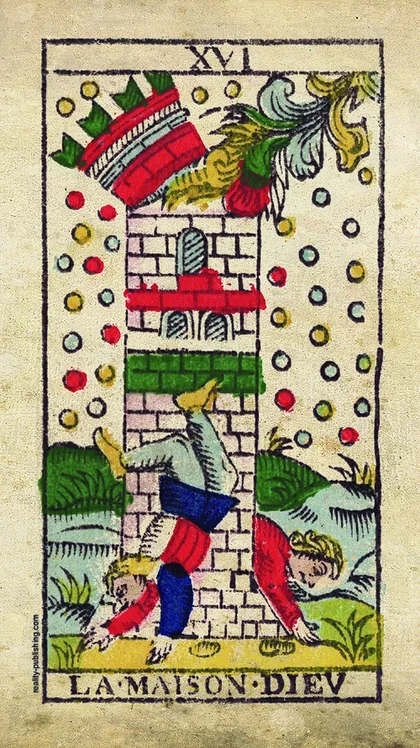
On the Marseille card, the crenellated top of a tower is carried away by a burst of flames or feathers coming from the corner. Colored balls fall from the sky.

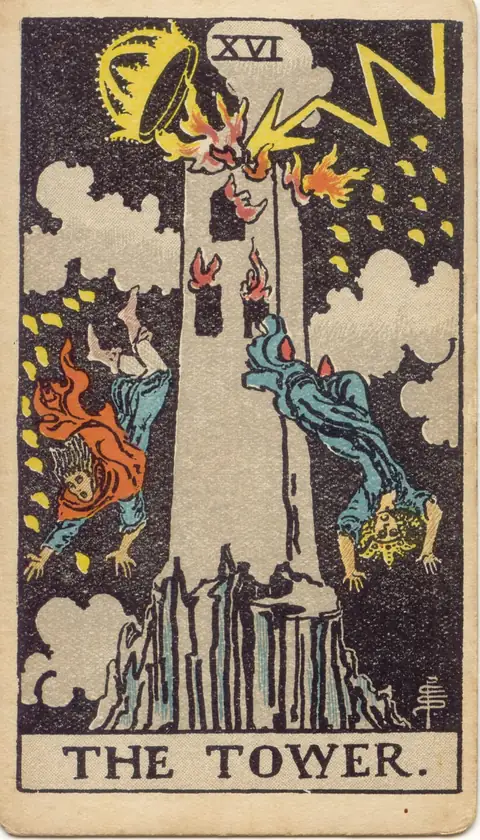
Two figures fall, one head down in front of the tower’s door. The colored balls give the scene an almost festive feel, as if the sky were letting go of what it held. Nothing points to a specific cause: the image does not tell why, only the moment. In the Rider-Waite, The Tower is a tower on a rocky peak struck by lightning, its crown tipping over, flames coming out of the windows. Two figures fall headfirst, drops of fire in a black sky. In both versions, the essential element is the same: a structure that seemed solid gives way all at once, and the top of the tower, symbol of what dominated, no longer holds.

Two decks

The Tower, Marseille and Rider-Waite

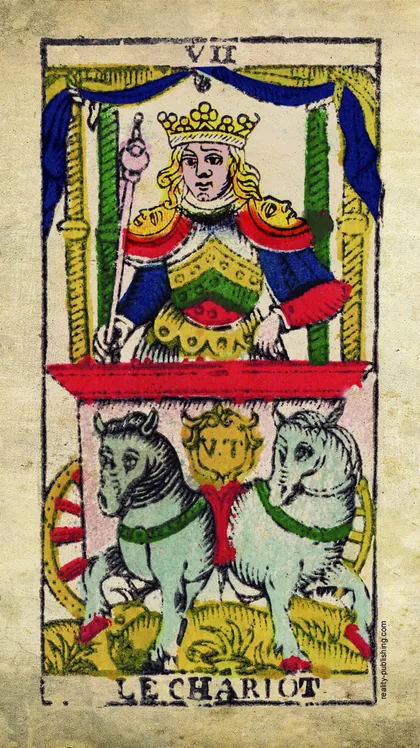
The same card in the two reference decks: Conver’s drawing, dated 1760, and Pamela Colman Smith’s scene, 1909.

Tarot de Marseille · Conver, dated 1760The TowerXVI
Rider-Waite · London, 1909The TowerXVI
The Tower: what changes from one deck to the other
AspectTarot de MarseilleRider-Waite
NameLa Maison DieuThe Tower
NumberXVIXVI
ImageIn the Marseille deck, the burst of flames or feathers and the colored balls give the shake an almost festive look.The Rider-Waite shows the lightning, the crown tipping over, flames at the windows, and a black sky.
ReversalOften not readCommonly read (reversed cards)

Tarot de Marseille: Nicolas Conver, dated 1760, restored by the Tarot World Project, CC BY-SA 4.0 license, via Wikimedia Commons. Rider-Waite: drawings by Pamela Colman Smith, 1909, public domain, via Wikimedia Commons. Images resized and compressed by Versana; Marseille Minor Arcana diagrams and card back drawn by Versana.

The Tower: nuances and combinations

In love, depending on your situation

Two situations, two readings: in a current relationship, then in a period without one, and reversed.

Depending on the position in a spread

The position changes the reading: 7 common positions, each upright then reversed.

Which cards it reads well with

Six cards calculated by the combination rules: two that reinforce it, two that nuance it, two in friction. None is “bad.”

The history of the card

Sixteenth Major Arcana, the Tower carries the number XVI in the Marseille deck, 16 in Waite’s, and the reduced number 7, that of the quest and of questioning.

Go further

  • MarsThe planet the Golden Dawn assigns to this card
  • 16:16The hour that bears the card’s number

How is it built?

Numbers and names read on Conver’s cards and in Waite’s text; correspondences reported according to the Golden Dawn tradition, never as facts.

Frequently asked questions about The Tower

What does the Tower mean in tarot?

The Tower, card XVI, shows a tower whose top is carried away. It speaks of structures giving way, certainties falling, and liberation after the shake. It is read as a situation tipping over, never as an event announced in advance.

What does the Tower mean reversed?

Reversed, the Tower is read as a held-back energy, turned inward: the change is delayed, the contained crisis smolders. Tension rises without bursting, and the spread suggests watching what is ripening.

Which cards go well with the Tower?

The Tower is read after a realization, when the shake arrives; next to a card of measure, the rebuilding happens by touches; near a card of hope, a space opens afterward; near a card of passage, the transformation is deep. See the calculation above.

The Tower in a yes or no reading?

For a question that counts on a stable framework, the answer leans toward caution. For a situation that was due to change, the shake becomes rather a liberation, and the tendency softens.