Nothing is in order yet: the objects are spread out, the figure is standing, and attention goes to the gesture that is about to follow. Many readers see in it the drive of someone who gets moving with the means of the moment, without waiting for all the conditions to be met.
Upright, the card invites initiative, skill, and the word that sets things in motion. It suggests that competence is discovered by acting: you try, you show, you correct. It can also be read as a reminder that several tools are already there, provided you look at them. Its number, one, speaks of a single start, of a first step rather than ten.
initiative
skill
beginning
The Magician in your life
In love
A relationship that opens through initiative: a message, an invitation, a first step that does not wait for certainty.
In matters of the heart, the Magician is read as a gesture of opening: writing, proposing, introducing yourself with your means. It invites clarity of intentions, because the same skill that attracts can also muddy the trail. It speaks of a beginning more than of an established commitment.
At work
A project to launch with the available resources: the skill of presenting, trying, showing what you know how to do.
On the professional level, the card evokes a launch: an idea to show, a skill to put into practice, a first try rather than a complete plan. It favors versatility, demonstration, and contact. It invites you to choose among the available tools instead of taking them all out.
With money
Using what you already own in an inventive way: a know-how, a small trial, rather than a big stake.
On the money side, the card describes a gesture rather than a figure: starting with what you already have, a know-how or a small trial, and seeing what comes of it. No amount, no investment is read in it.
As a feeling, as an action
As a feeling
The impression of holding, within reach, everything you need to begin, even if nothing is yet put away or assured.
As an action
Choose a simple first move, make it today, and adjust afterward according to what it reveals.
Reversed
Skill pushed too far: the restlessness that multiplies gestures, or the know-how that slides into manipulating the other person.
Main reading
Excess
In love
Brilliant words that charm without committing, or a bond in which one person stages more than they share.
At work
Too many leads open at once, or a presentation so polished that it lets you guess little substance.
With money
Chaining together little schemes and shiny promises, while the table shows what is really there.
A question
Does my know-how still serve the project, or only the effect produced?
Readability
Readable reversed in both decks.
restlessness
cunning
scattering
In a yes or no reading
Rather favorable
The tendency is rather favorable: the Magician pushes you to try, and the answer becomes clearer above all once a first move is made.
Questions to ask yourself
What first move can I make right now with what I have?
What resource do I already have at hand without having shown it yet?
What, in the way I present things, would gain from being said more simply?
A sentence to keep: “I put on the table what I have, and I begin with that.”
Behind a table loaded with mismatched objects, a young figure in a big hat raises a wand in one hand and shows a coin with the other, as at the first instant of a trick.
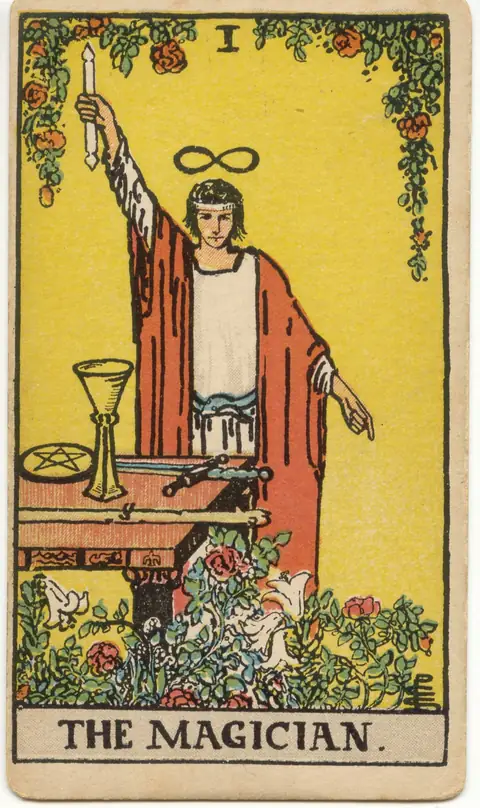
On the table, with three visible legs, a cup, dice, coins, knives, and a bag are mixed together: nothing is put away, everything is within reach. The brim of the big hat forms a sideways eight. A small sprout comes out of the ground between the figure’s feet, like the beginning of something alive. In the Rider-Waite version, the Magician raises a wand toward the sky and points to the ground with his other hand, a gesture that seems to link above and below. A sideways eight floats above his head, a snake biting its tail serves as his belt, and the table carries the four suits: cup, pentacle, sword, wand. Roses and lilies bloom in the foreground and in an arbor.
The sideways figure eight of the hat (Marseille)
Many readers see a sign of infinity there: possibilities that remain open.
The table and its objects
Cup, dice, coins, knives, bag: all the resources are there, and nothing has been put away yet.
The small sprout (Marseille)
The beginning of something alive: what is starting asks to be cultivated, not only shown.
Raised wand, pointing hand (Rider-Waite)
One hand toward the sky, the other toward the ground: Waite sees what descends from above to below, grace and light.
The serpent belt (Rider-Waite)
The serpent swallowing its tail, a common symbol of eternity, which Waite links to a fulfillment of the spirit.
The four suits (Rider-Waite)
Cup, pentacle, sword, wand: for Waite, the elements of natural life, arranged at the will of the one who handles them.
Two decks
The Magician, Marseille and Rider-Waite
The same card in the two reference decks: Conver’s drawing, dated 1760, and Pamela Colman Smith’s scene, 1909.
The Magician: what changes from one deck to the other
Aspect
Tarot de Marseille
Rider-Waite
Name
Le Bateleur
The Magician
Number
I
I
Image
In the Marseille deck, the figure wears a big hat whose brim forms a sideways eight, with a small sprout at the feet and a table with three visible legs.
In Waite’s deck, the Magician raises a wand, points to the ground, and stands under a sideways eight, in front of the four suits laid on the table.
Tarot de Marseille: Nicolas Conver, dated 1760, restored by the Tarot World Project, CC BY-SA 4.0 license, via Wikimedia Commons. Rider-Waite: drawings by Pamela Colman Smith, 1909, public domain, via Wikimedia Commons. Images resized and compressed by Versana; Marseille Minor Arcana diagrams and card back drawn by Versana.
The Magician: nuances and combinations
In love, depending on your situation
Two situations, two readings: in a current relationship, then in a period without one, and reversed.
In a current relationship
An established relationship can find its playfulness again when one of you brings out their tools: a surprise, an invented attention, a new way of saying things to each other. The card invites you to offer the other one of your skills, without turning it into a performance.
In a period without a relationship
Table set: the card speaks of a period when you can present yourself with your talents, your curiosities, your humor. It invites you to let others see what you carry with you rather than wait for everything to be perfectly in place.
Reversed
When the tricks follow one another, the other may no longer know what is sincere. The reversed card invites you to set down the objects on the table and simply say what you want, with no effect or detour.
Depending on the position in a spread
The position changes the reading: 7 common positions, each upright then reversed.
The situation
The context bears the mark of a beginning: a situation where momentum is present, where a first gesture is possible, and where skill shows itself rather than hiding.Reversed: Skill goes astray: a lot of agitation, gestures multiplying, and the context gives the impression of many effects with little substance.
What helps
What helps is taking action: a first attempt, even a clumsy one, is worth more than a perfect plan; momentum is built by practicing it.Reversed: Help turns into agitation: too many attempts at once, and scattered skill supports nothing in particular.
What holds you back
What holds you back is the temptation to multiply beginnings: momentum scatters into brilliant gestures, and nothing is carried far enough to last.Reversed: The obstacle comes from an excess of skill: too much cunning, too much showing off, and the sincerity of the gesture disappears.
Your way of being
A way of acting that takes the initiative: trying, showing your talent, setting things in motion without waiting for everything around you to be ready.Reversed: Know-how can slide into manipulation: skill pushed too far, with a gesture that seeks effect more than rightness.
What connects you
Between two people, a beginning: one of the two dares to take the first step, the conversation opens, and the bond gains momentum simply by trying.Reversed: The bond suffers from skill that is overworked: well-turned words that serve to obtain more than to connect, and trust feels the strain.
What is at stake
What is at stake is knowing how to begin: turning a wish into a concrete gesture before hesitation closes the door, and daring to show your know-how.Reversed: What is at stake becomes how you use your skill: staying true, instead of pushing it as far as showmanship or manipulation.
Where it can lead
A beginning could open up: a first attempt would be enough to set things in motion, and the momentum present here would invite you not to wait any longer.Reversed: A prospect would exist, but spoiled by agitation: it would call for slowing down, choosing a single gesture, and making it with accuracy.
Which cards it reads well with
Six cards calculated by the combination rules: two that reinforce it, two that nuance it, two in friction. None is “bad.”
Number I in the Marseille deck and 1 in Waite’s, the Magician opens the series of the Major Arcana. Mercury and the letter Beth are two of its reference points.
Le Bateleur (the Juggler) is the name of arcana I in the Tarot de Marseille; decks in the English-language tradition, including Waite’s, speak of the Magician. The number is the same, one, and it reduces to itself. The Marseille name evokes a person showing their objects before an audience, whereas Waite’s puts the emphasis on the power to make things happen. The Hebrew letter Beth and the planet Mercury serve mostly as reference points for comparing decks with one another: they change nothing about the drawing.
Tarot birth card and numerology
The Magician is also the tarot birth card for dates that add up to 1; its reduced number, 1, links it to numerology.
Numbers and names read on Conver’s cards and in Waite’s text; correspondences reported according to the Golden Dawn tradition, never as facts.
Number
I in the Marseille deck · I in Waite’s
Name in the Tarot de Marseille
Le Bateleur
Golden Dawn
Mercury, letter Beth
Hebrew letter
Beth ב
Planet
Mercury
Reduced number
1
Tendency (yes / no)
Rather favorable: Versana’s proposal, to be confirmed
Tone
Momentum: Versana’s proposal, to be confirmed
Sources
Golden Dawn, Book T (The Tarot), published by Israel Regardie in The Golden Dawn
Nicolas Conver (1760), Tarot de Marseille restored by the Tarot World Project
A. E. Waite, The Pictorial Key to the Tarot (1910)
Sefer Yetzirah: three mother letters, seven doubles, twelve simples
Frequently asked questions about The Magician
What does the Magician mean in tarot?
The Magician is read as the drive of the beginning: initiative, skill, the word that sets things moving. Its image shows a table filled with objects and a gesture ready to go. The card invites you to try with the means of the moment rather than wait for perfect conditions.
What does the Magician mean reversed?
Reversed, the card warns against excess skill: a restlessness that multiplies gestures, or a know-how that slides toward manipulation. The main reading is not a misfortune, but an invitation to check that the effect produced still serves the project.
Which cards go well with the Magician?
No association is imposed on the Magician. Next to a card of withdrawal and study, its drive meets reflection; next to a card of growth, the beginning becomes a project; next to a card of structure, the gesture looks for a form. See the associations above.
The Magician in a yes or no reading?
For a closed question, the Magician’s tendency is rather favorable, especially if a concrete first step is possible. It remains a tendency, not a verdict: the context of the question and the neighboring cards matter more than the card alone.