The Hierophant is often read as the card of the received framework: a rule, a school, a family, a shared habit that gives landmarks.
Many readers see in it the figure of transmission, the one that explains why things are done a certain way before proposing to do them differently. It can suggest seeking advice from someone who knows the subject, or becoming yourself, for a time, the person who explains. It is read with nuance, however: a framework reassures when it fits, and weighs when it no longer does. The question it asks is simple: where does this advice come from, and what in what it says really speaks to you?
transmission
landmarks
advice
The Hierophant in your life
In love
Shared values and a clear commitment can matter; check that the rules of the couple are also your own.
In matters of the heart, the Hierophant can evoke shared landmarks: common values, a stated commitment, a family tradition. He is also read as an invitation to ask which rules you follow out of habit rather than by choice.
At work
Handed-down knowledge, training, or a mentor can help; the procedure is reread in the light of its usefulness.
At work, the card points to training, handed-down know-how, an organization with its own customs. It can invite you to look for a mentor, or to check that the procedure still serves what it was meant to serve.
With money
A cautious way of acting, based on proven practices; compare several opinions before relying on a single one.
On the resources side, the Hierophant describes a cautious way of acting, based on proven practices. It is a posture, not a figure-based instruction: comparing several opinions before relying on a single one, even a respected one.
As a feeling, as an action
As a feeling
A need for landmarks, the wish to listen to a voice that knows or to pass on in your turn.
As an action
Ask a knowledgeable person for advice, then sort out what suits you from what you follow out of habit.
Reversed
Reversed, the card is often read as a rule applied without listening, a conformity that takes the place of judgment.
Main reading
Excess
In love
A framework too strict in the couple, or outside expectations that take precedence over what you feel.
At work
A procedure followed because it exists, an authority’s opinion accepted without discussion; a fresh look could help.
With money
Advice followed without examination because its source seems authoritative; better to cross-check it.
A question
Which rule do you follow without knowing anymore what it is for?
Readability
Readable reversed in both decks.
excess of rules
conformity
rigidity
In a yes or no reading
Nuanced
The card leans toward an answer to qualify: everything depends on the person giving advice and the framework in which the question is asked.
Questions to ask yourself
Which advice you received deserves to be kept, and which do you follow out of habit?
Which family tradition or habit do you want to keep the best of?
Who handed down your ideas about being a couple, and do they still suit you?
A sentence to keep: “I keep what was handed to me that is right, and I choose the rest.”
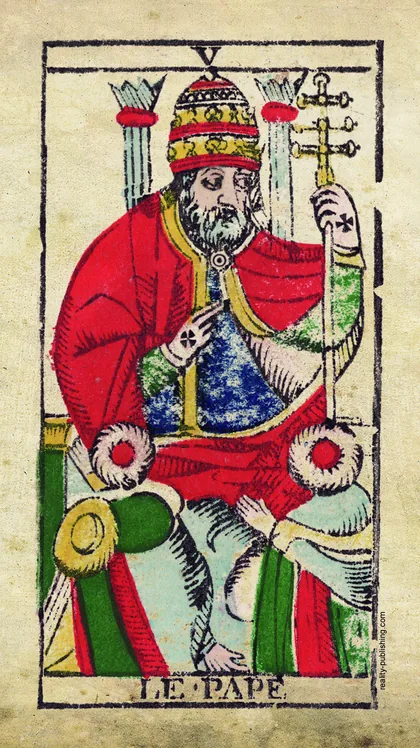
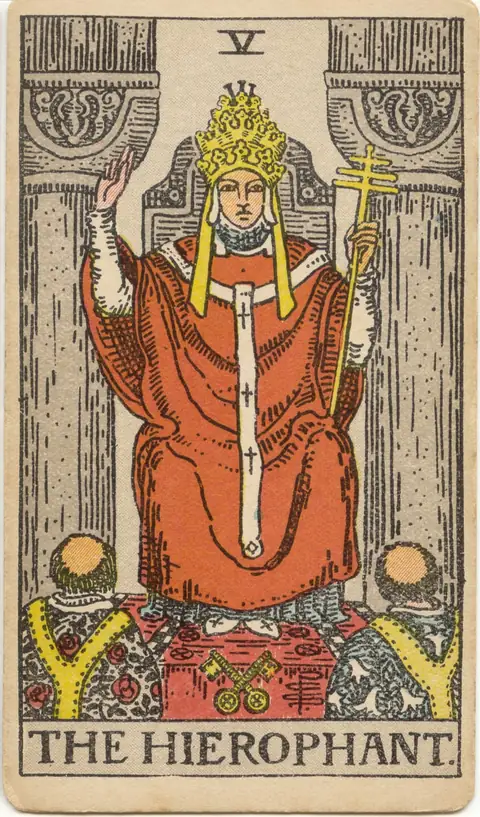
A seated figure between two pillars, wearing a three-tiered crown, a triple-barred cross in one hand; the other, gloved and marked with a cross, blesses. Two small tonsured figures, seen from behind, in the foreground.
In the Marseille deck, the scene is frontal and almost symmetrical: the figure sits between two pillars, and the number three comes back twice, in the crown and in the cross. The gloved hand, marked with a cross, is the one that blesses; it is addressed to the two small tonsured figures, turned toward this word as toward a teaching. In Waite’s deck, the Hierophant keeps the two pillars and the gesture of blessing, but two crossed keys appear at his feet, and the two figures kneel before him. In both versions, the image shows a word descending toward those who listen: a transmission, more than a conversation.
The two pillars
A symmetrical frame: speech rests on shared, lasting landmarks.
The three-crowned tiara (Marseille)
The number three returns in the headdress as in the cross: the popes’ tiara, a sign of religious authority.
The triple-barred cross
Three crossbars stacked: the spiritual or moral authority the figure represents.
The gloved hand giving a blessing (Marseille)
A gesture of transmission: knowledge passes from one person to others.
The two tonsured figures seen from behind
The students facing the teacher: teaching is received, but each remains free in what they keep from it.
The two crossed keys (Rider-Waite)
Two crossed keys at the foot of the throne, an emblem of the keys of Saint Peter: the power to open and to close.
Two decks
The Hierophant, Marseille and Rider-Waite
The same card in the two reference decks: Conver’s drawing, dated 1760, and Pamela Colman Smith’s scene, 1909.
Tarot de Marseille: Nicolas Conver, dated 1760, restored by the Tarot World Project, CC BY-SA 4.0 license, via Wikimedia Commons. Rider-Waite: drawings by Pamela Colman Smith, 1909, public domain, via Wikimedia Commons. Images resized and compressed by Versana; Marseille Minor Arcana diagrams and card back drawn by Versana.
The Hierophant: nuances and combinations
In love, depending on your situation
Two situations, two readings: in a current relationship, then in a period without one, and reversed.
In a current relationship
Shared values, a common ritual, a way of celebrating or coming back together: the card highlights what makes tradition in the bond. It invites you to check that these landmarks come from the two of you and not only from the people around you.
In a period without a relationship
Two figures listen, seen from behind: the card speaks of a period of learning, when advice, models, and other people’s stories shape your idea of the bond. It invites you to sort out what truly speaks to you in these teachings.
Reversed
When custom takes precedence over listening, the bond is set by what is done rather than what is lived. The card invites you to ask a simple question: does this habit still serve us?
Depending on the position in a spread
The position changes the reading: 7 common positions, each upright then reversed.
The situation
The context rests on a shared rule: a transmitted framework, established customs, and received knowledge that give the situation its stability.Reversed: The rule is applied without listening: the context leans toward conformity, and what has been received is no longer questioned.
What helps
What helps is received advice: a trusted person or tradition whose experience sheds light on the situation, as long as you examine its source.Reversed: Help requires questioning the rule: listen to the advice, then check whether it truly suits you, rather than following it to the letter.
What holds you back
What holds you back is the weight of the rule: the habit of doing as it has always been done, to the point of stifling any personal initiative.Reversed: The obstacle grows: the rule applied without listening turns the framework into conformity, and no one questions it.
Your way of being
A way of being attached to reference points: passing on, respecting what has been learned, relying on a common rule with seriousness and consistency.Reversed: A way of being that shuts itself inside the rule: applying without listening, following custom out of habit rather than choice.
What connects you
Between two people, a bond founded on common values: shared customs, a trust that rests on a common and lasting heritage.Reversed: The bond bends to convention: you do what is expected, at the expense of what each person truly feels.
What is at stake
What is at stake is choosing what to lean on: received knowledge, a rule, advice, whose value depends on who gives it.Reversed: What is at stake is getting out of conformity: examining the rule you follow, and deciding whether it still serves.
Where it can lead
A transmitted framework could open up: a teaching, advice, or a shared rule would offer lasting support, to be examined with discernment before following it.Reversed: A possibility would remain closed as long as the rule is followed without listening; a freer look could reopen it.
Which cards it reads well with
Six cards calculated by the combination rules: two that reinforce it, two that nuance it, two in friction. None is “bad.”
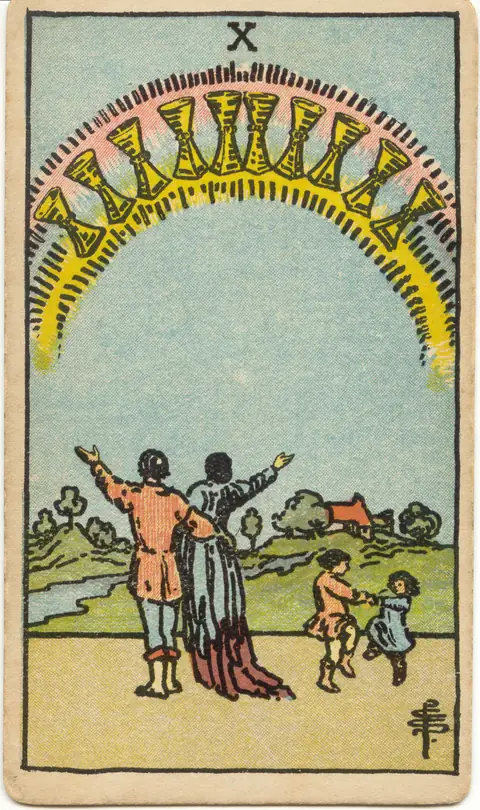
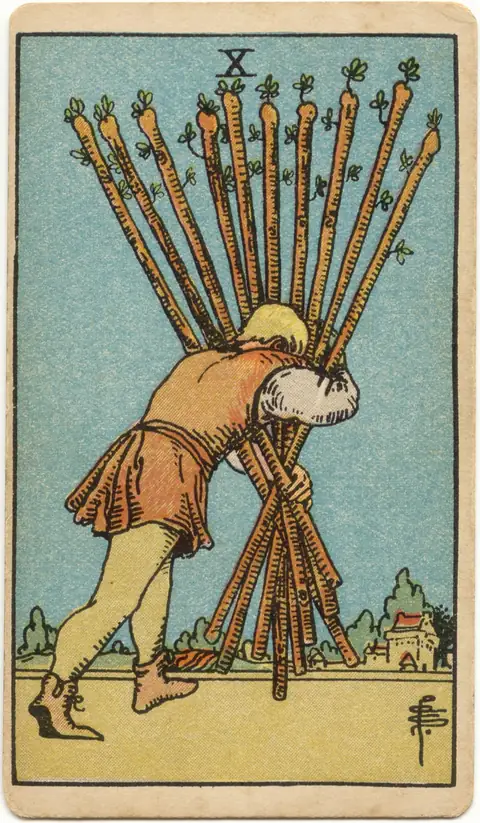
Cards that reinforce itTen of CupsTen of Cups: shared tone, stability, elements earth and waterRead the pair
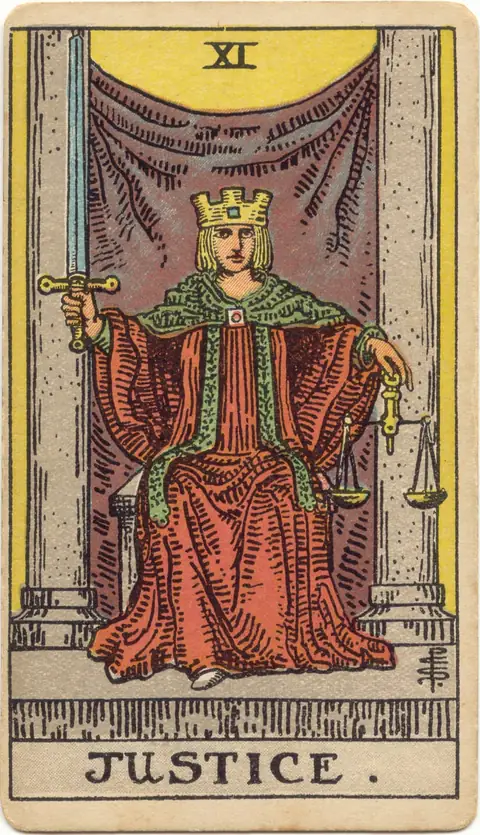
In frictionJusticeJustice: tones stability and questioning, elements earth and airRead the pair
The history of the card
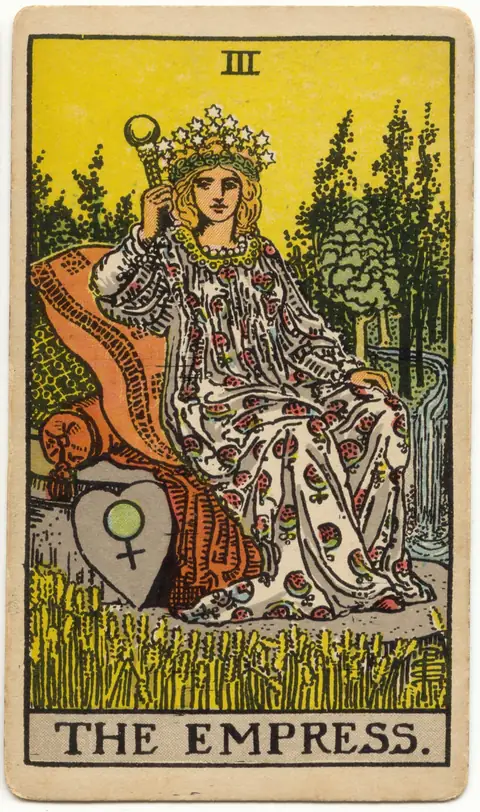
The Hierophant is the fifth card of the Major Arcana, after the Empress and the Emperor: a first step away from personal power, toward a shared framework.
In the sequence of the Major Arcana, card V comes after two figures of power, the Empress and the Emperor. It shifts the gaze: authority no longer rests on the force or decision of one person, but on what passes from one person to another. The name varies from deck to deck: the Pope (Le Pape) in the Marseille tradition, the Hierophant in Waite’s, where it keeps the same number. Reduced, the number 5 stays 5. The card precedes the Lovers, which will ask for a personal choice: after the received rule, the decision you make yourself.
Tarot birth card and numerology
The Hierophant is also the tarot birth card for dates that add up to 5; its reduced number, 5, links it to numerology.
Numbers and names read on Conver’s cards and in Waite’s text; correspondences reported according to the Golden Dawn tradition, never as facts.
Number
V in the Marseille deck · V in Waite’s
Name in the Tarot de Marseille
Le Pape
Golden Dawn
Taurus, letter Vav
Hebrew letter
Vav ו
Sign
Taurus
Reduced number
5
Tendency (yes / no)
Nuanced: Versana’s proposal, to be confirmed
Tone
Stability: Versana’s proposal, to be confirmed
Sources
Golden Dawn, Book T (The Tarot), published by Israel Regardie in The Golden Dawn
Nicolas Conver (1760), Tarot de Marseille restored by the Tarot World Project
A. E. Waite, The Pictorial Key to the Tarot (1910)
Sefer Yetzirah: three mother letters, seven doubles, twelve simples
Frequently asked questions about The Hierophant
What does the Hierophant mean in tarot?
The Hierophant stands for the received framework, transmission, and advice. Many readers see in it a teaching, a tradition, or a shared rule. The card invites you to listen, then to sort, without predicting anything.
What does the Hierophant mean reversed?
Reversed, the Hierophant is often read as a rule applied without listening, or a conformity that smothers. The reading remains an invitation to examine what you are asked to follow, and to bring a share of choice to it.
Which cards go well with the Hierophant?
The Hierophant is readily read with cards of structure, to speak of a framework well kept, with cards of choice, to set the rule against personal choice, or with cards of gentleness, to soften authority. The meaning becomes clearer according to the question. See, above, the six associations calculated for this card.
The Hierophant in a yes or no reading?
Faced with a question that expects a verdict, the Hierophant stays to be qualified: everything depends on the advice received and on who gives it. It is better to clarify the question than to decide too quickly.