As a birth card, the card speaks of the relationship to transmission.
You read a person who explains willingly, who has landmarks to lean on and shares them effortlessly: an elder who trains newcomers, a parent who tells family stories, a colleague people ask as soon as a point gets complicated.
The Hierophant also evokes loyalty to recognized frameworks: a tradition, a trade, values you received and pass on in turn. He gives meaning to ceremonies, to simple rituals, to those moments when people gather around something shared.
The image invites you to tell apart what you chose to pass on from what you repeat out of habit. A teacher who never questions themselves ends up reciting. A good guide also knows how to become a student.
Think of who taught you something important, a trade, a recipe, a gesture, and of what you have taught someone else in turn. That is the chain this card tells of, where everyone is by turns student and master.
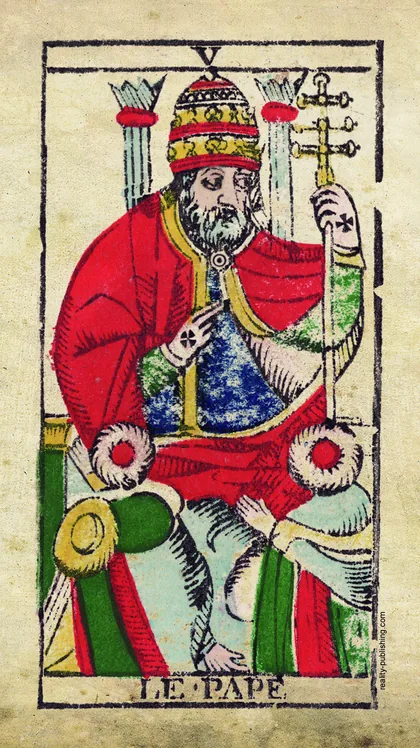
The Hierophant (Le Pape, “the Pope” in the Marseille deck) is enthroned between two pillars. He wears the three-tiered tiara, raises two fingers in blessing, and holds a long cross with three crossbars. At his feet, two figures turned toward him listen, heads raised. The scene is one of teaching: someone knows, others learn.
The Hierophant: strengths and points of attention
Its strengths
He helps create links between generations and give a framework to disoriented people.
He also keeps the memory of stories, know-how, and values. In a family or a company, he recalls why things are done, and he makes changes easier to accept.
What needs attention
The same figure can lean so hard on custom that it refuses anything new, or become preachy, hand out advice nobody asked for, or judge harshly those who take another path.
Transmission then becomes a sermon that no one listens to anymore.
The Hierophant in love, at work, and with money
In a relationship
Commitments spoken before others and rituals that last matter to this figure: a birthday celebrated every year, a family recipe handed down.
It provides landmarks. The risk is lecturing the loved one, or clinging to a way of living as a couple that the other does not share.
At work
Trainer, teacher, tutor, go-to person people consult: the Hierophant thrives in the trades of transmission.
He explains with patience, knows the house rules, and welcomes newcomers. Changing method makes him less comfortable, especially when the new way of doing things comes from someone younger than him.
With money
The Hierophant manages his money according to received principles: you do not spend what you do not have, you set aside for your own.
He likes to fund what has meaning, an association, studies, an estate to pass on. His choices rest on habit more than on comparison, at the risk of missing a better option.
Portraits to recognize yourself in, not forecasts: the birth card says nothing about what will come.
The Hierophant: advice, number, and traditions
With The Hierophant: something to try this week
Take a gesture from your trade or your kitchen that you have mastered: show it to someone rather than explaining it in writing.
You will see what this sharing teaches you too.
Card 5 and the number 5
Number 5 in numerology stands for freedom and an appetite for discovery.
The link with the Hierophant surprises at first, then makes sense: a life path number 5 likes to tell others about their finds, and this card gives this taste a form of transmission. Where the 5 explores, the Hierophant retains: each feeds the other in a single life.
Your talent is making knowledge accessible and lasting. It shows when a colleague finally understands a piece of software thanks to your diagram, when a nephew passes a competitive exam after your revision sessions, when a team adopts a procedure you wrote. It finds its place in teaching, adult training, workplace mentoring, writing guides and manuals, public speaking, and religious or philosophical guidance. To develop it, practice explaining a difficult notion in three sentences, speak up in an association or a club, and test your knowledge against different schools of thought: a ferryman gains in value when he has read several masters.
Your birth cards, according to tradition
The Hierophant, in the birth card tradition that Mary K. Greer made famous, belongs to the soul cards.
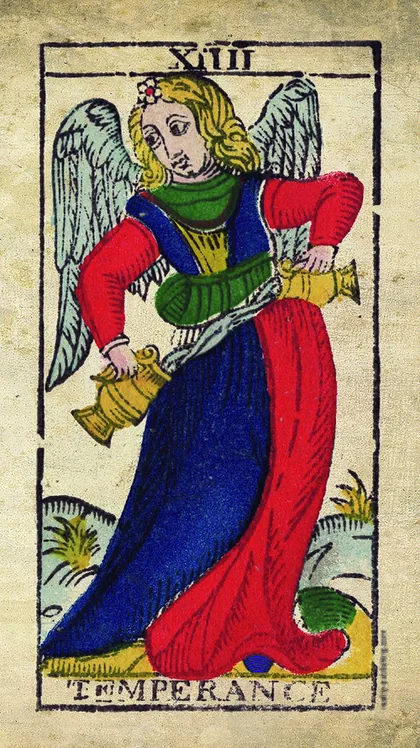
With this calculation, he goes with only one total, 14, Temperance: behind the figure who pours from one vessel to another stands the one who passes on. Patient measuring then finds a meaning to share.
The Hierophant in two decks
The Hierophant of the Conver deck, dated 1760, towers over two tonsured figures, tiny at the foot of his throne.
Waite renames him “The Hierophant,” and Pamela Colman Smith draws two crossed keys at his feet, with two monks before him. The number V, for its part, stays the same from one deck to the other, and the scene keeps its air of teaching.
Day + month + year, reduced while the total is above 22 → 5.
Is this really your birth card?
The Hierophant, soul card
Total 14XIV · Temperance
Soul cardV · The Hierophant
1 + 4 = 5
A tradition passed on by Angeles Arrien and popularized by Mary K. Greer, an American author of books on tarot.
Frequently asked questions about The Hierophant
What does tarot birth card 5 mean?
The Hierophant evokes teaching, transmission, and attachment to received landmarks. As a birth card, he describes someone who guides, explains, and connects others to what lasts. The tiara and the triple-barred cross mark his role as a guide.
Which date gives birth card 5?
A date whose total reduces to 5, directly or by way of 23. October 5, 1979 gives 1994, then 23 (1 + 9 + 9 + 4), then 5. Many dates lead there: it is a frequent card.
Card 5 and life path number 5: what is the link?
Life path number 5 likes movement, whereas the Hierophant is seated. The agreement lies in curiosity: one explores, the other shares what they have understood. The two readings complement more than oppose each other. Life path number 5 reads in this card what it will do with everything it has seen.
Is the Hierophant a religious figure?
By his costume, yes, but in a birth card what you keep is mostly the role of guide: someone who teaches and passes on. No belief is required to read this image. The Tarot de Marseille borrows many costumes from the period of its creation, which explains this appearance.
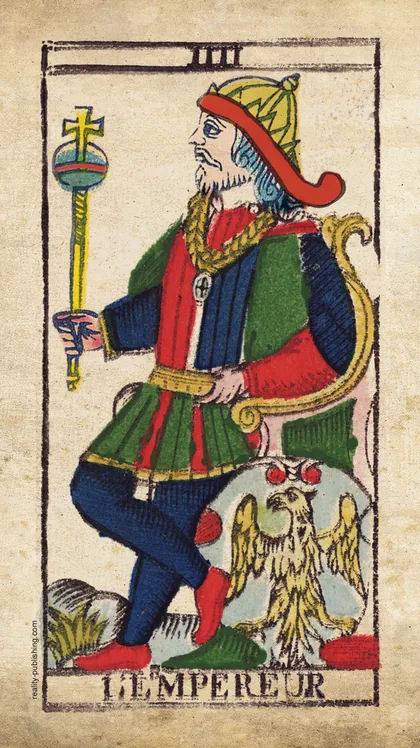
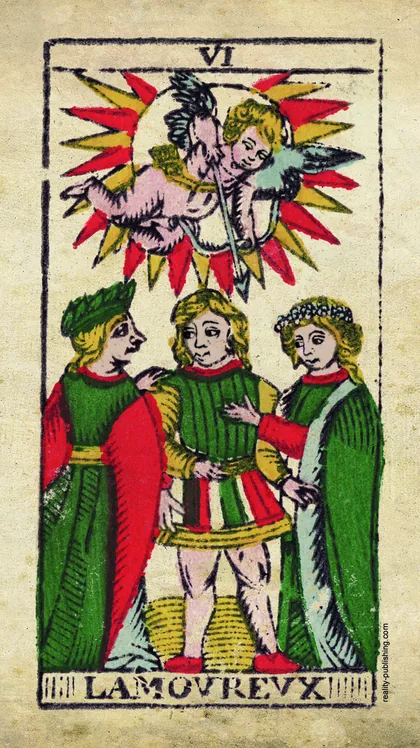
Illustrations: Nicolas Conver’s Tarot de Marseille, dated 1760, restored by Tarot World Project, CC BY-SA 4.0 license, via Wikimedia Commons — images resized and compressed by Versana.