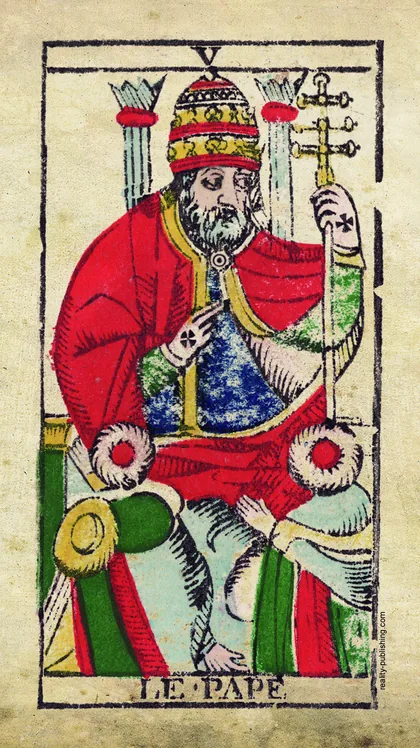
For the Hierophant, passing on comes naturally: you make knowledge accessible, connect generations, and leave others with lasting landmarks.
art of teaching
sense of tradition
teaching skill
The essentials
Arcana 5 in the talent at a glance
A strength
Knowledge you have acquired becomes limpid in your hands: you make it clear for someone else. You find the example that speaks, the order that helps, and the pace that leaves time to absorb. People ask you to train, explain, or guide, because your way of teaching builds confidence and a wish to learn.
Something to watch
Passing on can slide into lecturing. When you know how to explain, you are tempted to correct, to remind people of the right way to do things, and to cling to what has always been done. The talent is refined by listening: a rule is worth something only if the other person can make it their own.
Your talent is making knowledge accessible and lasting.
It shows when a colleague finally understands a piece of software thanks to your diagram, when a nephew passes a competitive exam after your revision sessions, when a team adopts a procedure you wrote. It finds its place in teaching, adult training, workplace mentoring, writing guides and manuals, public speaking, and religious or philosophical guidance. To develop it, practice explaining a difficult notion in three sentences, speak up in an association or a club, and test your knowledge against different schools of thought: a ferryman gains in value when he has read several masters.
This gift shows itself in situations where someone hands you a question. A neighbor stuck on a form, a cousin preparing for an exam, an intern lost in the first few weeks: you take the time to rephrase, to draw a diagram, to repeat it another way. Explaining does not wear you out, it feeds you.
The position modulates this talent. At the top of the diamond, the Hierophant resembles a calling to teach or to pass things along, a trust in what can be handed down. On the inner points, he acts discreetly: advice given at the table, know-how shown to a loved one. On the father’s side, the reading sees elders who kept traditions, trades, or convictions; on the mother’s side, figures of oral transmission: recipes, stories, gestures learned by imitation.
This gift grows when it stays alive. Updating your knowledge, accepting that a student brings something new, connecting the old and the new: this is what makes transmission an inheritance and not a habit.
The Hierophant in your life
In everyday life
A colleague joins the team and does not understand the management software.
You take twenty minutes, draw a diagram of the three essential screens, and hand over the controls. The next day, he is moving ahead on his own. At home, the scene repeats itself with the kids, the homework, the family recipe you are asked to write down before it gets lost. Your patience makes you someone people gladly come back to. Little by little, you are also asked to train newcomers, and you find real satisfaction in it.
What helps
What helps
Write down a know-how that no one else masters
Ask a question before explaining, so you start from what the other person knows
Stay curious about what younger people bring that is new
The Hierophant, talent: nuances
Where it sits in the matrix
These points: received talent, expressed talent, inner talent, paternal ancestral line (spirit), father’s talent (inner), father’s talent, maternal ancestral line (spirit), mother’s talent (inner), mother’s talent.
Received talent
What comes easily to you, your link with what is greater than you. Takes its place around age 20.
Expressed talent
The form your talent takes in everyday life.
Inner talent
The source of your talent, the most inward one.
Paternal ancestral line (spirit)
What the father’s side passes on in talents and values. Around age 10.
Father’s talent (inner)
The talent of the paternal line, closest to you.
Father’s talent
The talent of the paternal line as it is passed on.
Maternal ancestral line (spirit)
What the mother’s side passes on in talents and values. Around age 30.
Mother’s talent (inner)
The talent of the maternal line, closest to you.
Mother’s talent
The talent of the maternal line as it is passed on.
A symbolic reading of the Destiny Matrix: food for thought about yourself, never a verdict or an established fact.
The received talent is simply the number of the month in the year, with no reduction at all.
For an imaginary birth on March 14, 1987, March gives 3, the Empress. The expressed talent adds the center, here 3, making 6; the inner talent adds that 6 to the month, making 9. On the father’s side, the corner is the portrait plus the talent, 14 and 3, making 17; add the ancestral power, 6, to get 23, reduced to 5, then 17 and 5 make 22. On the mother’s side, the corner is the talent plus the material point, making 10; then 10 and 6 give 16, and 10 and 16 give 26, reduced to 8.
Frequently asked questions: arcana 5 in the talent
Does the Hierophant in talent mean you have to teach?
Not necessarily. The gift can be exercised at school as well as in a company, a sports club, an association, or a family. It concerns anything that can be passed on: a gesture, a method, a value. What matters is being able to share it in a lasting way. This gift also lives in the small everyday transmissions, with no title and no podium.
How do you avoid lecturing with this talent?
By starting with listening to what the person already knows and what they are looking for. Suggest rather than impose, leave room for attempts, and accept mistakes. Successful transmission resembles accompaniment: the person leaves with a skill of their own, not just with your answers. It also makes teaching more enjoyable, because the exchange becomes mutual.
What does the Hierophant mean when it comes from a family line?
It suggests values, a trade, or traditions already carried by elders. This inheritance comes to you, and you keep it alive in your own way. A heavy family rule can also slip in: the talent turns it into a transmission you choose. You can thus keep what is precious to you and leave aside what does not suit you.
Illustrations: Nicolas Conver’s Tarot de Marseille, dated 1760, restored by Tarot World Project, CC BY-SA 4.0 license, via Wikimedia Commons — images resized and compressed by Versana.