As a birth card, the card speaks of a desire to move forward and hold together what pulls in opposite directions.
You see someone who has a course, who manages to reconcile opposing forces, wants and duties, work and home, and who makes progress all the same. Victory lies not in speed but in driving.
The image also speaks of autonomy: the driver is alone on his chariot, he does not wait for others to decide for him. You can sometimes spot it in a fondness for cars, trips, or travel, but mostly in a way of approaching goals: you set a destination and you go there.
The Chariot poses a question: who holds the reins, you or what presses you? Stepping back to choose where you are going is often worth more than speeding up.
Think of a trip where several obligations crossed, a move, an exam, a child to pick up : you probably carried it off by holding opposing demands together. That skill is the Chariot’s.
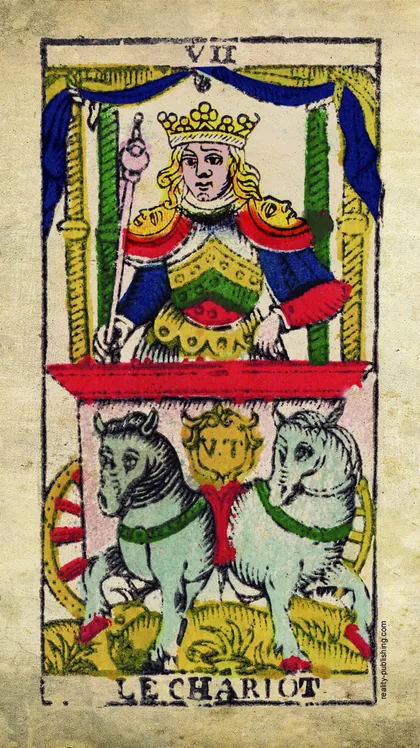
The Chariot (Le Chariot) shows a young driver standing under a canopy with four columns. He wears a crown and holds a scepter. In front of the chariot, two horses, one turned right, the other left, seem to pull each their own way. He has no visible reins: his direction comes from his will.
The Chariot: strengths and points of attention
Its strengths
He helps handle several things at once and keep a cool head in the storm.
After a setback, he gets back up quickly and takes the road again without resentment, drawing the lesson from the incident. In a complex project, he keeps the goal in mind when others get lost in the details.
What needs attention
Mastery can also turn into stiffness, when every slip is felt as a failure: not admitting you took the wrong direction, chasing a success that does not suit you.
Easing off then becomes part of driving.
The Chariot in love, at work, and with money
In a relationship
Independent, this figure wants to move forward as a pair without losing its own road.
It proposes plans, organizes departures, pulls the other into its rhythm. People admire it for its determination. Its downside is running the relationship like a trip, forgetting to ask where the other wants to go.
At work
Numerical targets, travel, projects to steer: the Chariot likes roles where you move forward and measure the distance covered.
He keeps several files going at once and stays calm under pressure. Waiting periods, with no clear course, make him impatient and push him to create movement.
With money
Money serves the Chariot to gain autonomy: a vehicle, a personal project, a margin to decide alone.
He negotiates with assurance and sets precise savings goals. The downside is quick spending when he wants to go fast, and discomfort asking for advice.
Portraits to recognize yourself in, not forecasts: the birth card says nothing about what will come.
The Chariot: advice, number, and traditions
With The Chariot: something to try this week
Name the direction you want to hold this year, then one thing to give up that makes it possible.
This choice will make the rest of the journey lighter.
Card 7 and the number 7
Number 7 in numerology revolves around patient observation and the need to understand.
The Chariot offers its active side: a person with life path number 7 may recognize themselves in it through the desire to understand, then to go where their reflection leads. The 7 precedes action with reflection, and the Chariot gives it the road: a complementary pair.
Your talent is to set things in motion and carry them through to the goal. It shows when a project bogged down for months restarts the week you arrive, when a discouraged team finds its rhythm again, when a complicated trip goes off without a hitch because you planned everything. It is exercised in project management, team leadership, sports coaching, organizing trips and expeditions, logistics, and starting a business. To cultivate it, keep a goals notebook reviewed every Sunday, take responsibility for a volunteer project, practice an endurance sport that teaches you to pace your effort, and train in delegation.
Your birth cards, according to tradition
Mary K. Greer, who made birth cards known, places the Chariot only on the soul side.
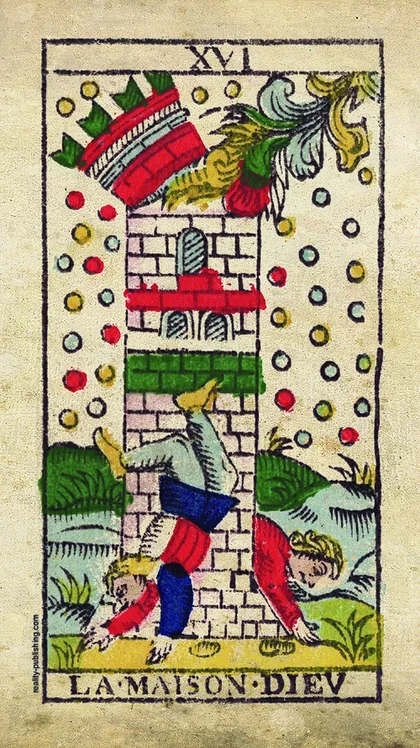
With the day, month, and year formula, he goes with only one total, 16, the Tower (La Maison Dieu in Marseille). The pair shows the tower struck by flame and, behind it, the driver keeping his course.
The Chariot in two decks
The Chariot of Conver drives, crown on head, a chariot drawn by two horses.
In 1909, the English version published by Rider keeps the name, “The Chariot,” and the number VII, but changes the team: two sphinxes, one black, one white, replace the horses. The idea of opposing forces to be led together runs through both images.
Day + month + year, reduced while the total is above 22 → 7.
Is this really your birth card?
The Chariot, soul card
Total 16XVI · The Tower
Soul cardVII · The Chariot
1 + 6 = 7
A tradition passed on by Angeles Arrien and popularized by Mary K. Greer, an American author of books on tarot.
Frequently asked questions about The Chariot
What does tarot birth card 7 mean?
The Chariot symbolizes moving forward, mastery, and will. Taken as a birth card, it shows someone who has a course and knows how to reconcile opposing forces to reach it. The crown, the canopy, and the two horses are its emblems.
Which date gives birth card 7?
The total must be 7, or 25, which is then reduced to 7. February 5, 1980 gives 1987, then 25 (1 + 9 + 8 + 7), then 7. Many dates fit, which makes it a common card.
Card 7 and life path number 7: what is the link?
Life path number 7 conducts an inner inquiry, the Chariot an outer conquest. The link lies in the will to understand where you are going. Both meet in the idea of holding your own direction. Life path number 7 likes to stop and reflect, though, which the Chariot rarely does.
Why do the Chariot’s horses go in two directions?
They stand for the opposing forces the driver must hold together: desires and duties, drive and caution. The Chariot’s success comes not from their agreement, but from how he guides them. The Rider-Waite replaces these horses with two sphinxes of opposite colors.
Illustrations: Nicolas Conver’s Tarot de Marseille, dated 1760, restored by Tarot World Project, CC BY-SA 4.0 license, via Wikimedia Commons — images resized and compressed by Versana.