Among the twenty-two figures of the Marseille tarot, only one carries no name: the thirteenth.
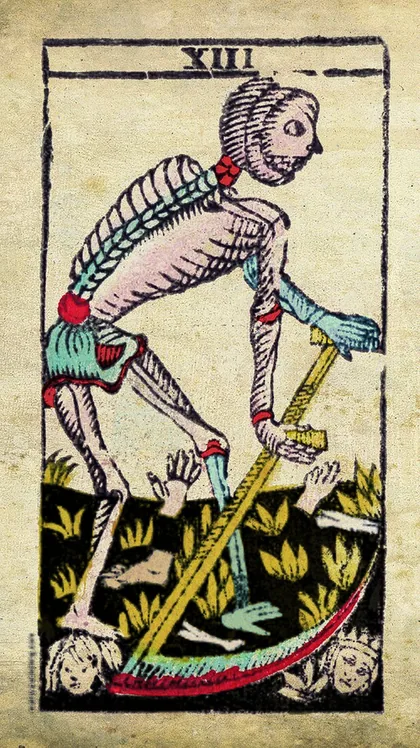
It shows a gaunt silhouette armed with a scythe, advancing across dark ground from which hands and heads emerge. The most striking detail lies elsewhere, though: shoots are already springing from this turned earth. The card shows the cutting and the regrowth in the same scene. The absence of a name matters too. It leaves each person to name what they are going through.
People with this card recognize themselves when they tell of a change of course that first felt like relief, then like the obvious thing. The difficulty, often, is saying goodbye to what was useful but no longer is: a habit, a role, a friendship that quietly faded. The movement happens in stages, calmly, with the feeling of clearing ground rather than losing everything.
Under this card, you find a person whose life moves by transformations: a chapter is closed, a room is emptied, a job or a city is left, and they set off lighter than they came. This card says nothing alarming: it speaks of the end of cycles lived without drama, of what we leave behind to make room.
Death: strengths and points of attention
Its strengths
A sense of sorting: you spot what clutters, in a calendar as in an organization.
Calm in the face of changes that others dread. And trust in the new, which helps loved ones through a delicate passage. Finally, a lightness that makes people want to follow you when everything has to be redone, a move as much as a reorganization.
What needs attention
A deep change does good, but the habit of renewing everything can keep you from building anything lasting.
It also happens that you decide to let something go without truly managing to detach. Before deciding, distinguish what is finished from what is simply hard to get through. A notebook of the things you kept helps you remember them.
Death in love, at work, and with money
In a relationship
This figure does not let a relationship wear out in silence.
When something is off, it suggests changing a habit, rethinking how the household runs, reinventing the bond rather than enduring it. It brings renewal; its downside is wanting to move on before the other person is ready.
At work
This figure is readily given reorganizations, department mergers, and project wrap-ups that need closing cleanly.
It sorts, simplifies, and removes what no longer serves, without unnecessary hesitation. Transition roles suit it well; maintaining a system unchanged, year after year, quickly weighs on it.
With money
Its relationship with money runs through sorting: forgotten subscriptions, objects lying idle, expenses that have turned into reflexes.
This figure regularly cleans up its accounts and starts again from a lighter base. A possible downside: changing strategy too often, instead of letting a choice play out.
Portraits to recognize yourself in, not forecasts: the birth card says nothing about what will come.
Death: advice, number, and traditions
With Death: something to try this week
Choose one thing that no longer has a use in your home or your schedule.
Remove it this weekend, without immediately replacing it with something else.
Card 13 and the number 4
The 13 reduces to 1 + 3 = 4, the number of foundations and regularity.
The scythe does not destroy for the sake of destroying: it prepares a ground to build on. For a life path, this gives overhauls that always end up laying something stable. After several overhauls, these people readily set up an organization that lasts.
Your talent is shedding your skin and helping others do the same. It shows when you relaunch a business that is losing steam, when you support a loved one after a separation, when you turn a rundown apartment into a bright place. It is put to use in emergency and rescue work, business turnarounds, renovation, career-change coaching, psychotherapy, and end-of-life and grief support. To cultivate it, learn to conclude: celebrate the end of a project, put away the archives of a period, write down what it taught you. Also train in first aid and stress management.
Your birth cards, according to tradition
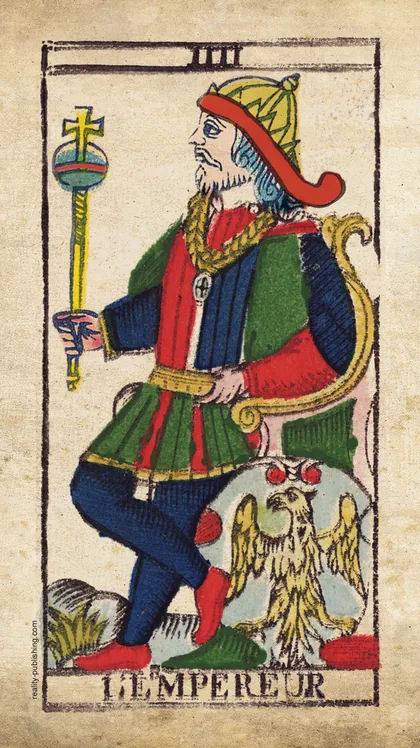
In the tradition popularized by Mary K. Greer, a total of 13 pairs the nameless arcana, the personality card, with the Emperor, the soul card.
Together they describe someone who undoes in order to rebuild: the scythe clears the ground, then a firm hand sets lasting structures on it.
Death in two decks
On Conver’s version (1760) of the Marseille tarot, card XIII shows a figure holding a scythe, with nothing written beneath the image.
The Rider-Waite, published in 1909, gives it a name, where the Marseille tarot leaves it “nameless,” and a very different scene: a knight in armor, mounted on a white horse, carries a black banner marked with a white rose.
Day + month + year, reduced while the total is above 22 → 13.
Is this really your birth card?
Your two birth cards
Personality cardXIII · Death
Soul cardIV · The Emperor
1 + 3 = 4
A tradition passed on by Angeles Arrien and popularized by Mary K. Greer, an American author of books on tarot.
Frequently asked questions about Death
What does tarot birth card 13 mean?
Birth card 13, the nameless arcana (Death), shows a silhouette with a scythe on ground where shoots are already growing back. It speaks of transformation: closing a cycle, leaving behind what no longer serves, making room for the new. It announces nothing unfortunate; it describes an aptitude for changing course.
Which birth date gives tarot birth card 13?
With July 19, 2003, you get 19 + 7 + 2003 = 2029, then 2 + 0 + 2 + 9 = 13. It is among the uncommon cards: around three births in a hundred since 1940. If your date does not lead to it, your card will be another one, and that is no kind of lack.
Birth card 13 and life path 4: what is the link?
Add 1 and 3: you get 4, which is also the life path of these dates. This number speaks of method and building: the scythe of the 13 clears the ground, the 4 lays foundations on it. You can therefore read this path as a series of transformations that build something solid.
Why does tarot birth card 13 have no name?
No one knows for certain: the old tarots left no explanation. Two readings are found. The name may have been left out so as not to weigh down a strong image; or it lets each person give their own meaning. The reading offered here keeps the sense of transformation, the one that links up with the 4 of numerology.
Illustrations: Nicolas Conver’s Tarot de Marseille, dated 1760, restored by Tarot World Project, CC BY-SA 4.0 license, via Wikimedia Commons — images resized and compressed by Versana.