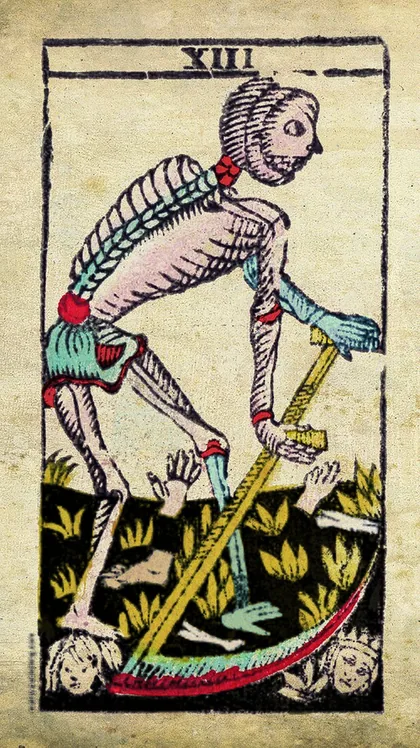
Learning to let go is the lesson of the nameless arcana (Death): closing what is worn out so that life can renew itself.
letting go
endings embraced
inner renewal
The essentials
Arcana 13 as a life lesson at a glance
A strength
This lesson offers a rare kind of freedom. Each attachment you untie, an object, a habit, a grudge, lightens you and leaves you available for what comes next. People who have absorbed it move through the turning points of life with surprising flexibility, and their presence soothes those who dread change.
Something to watch
Two opposite slopes lie in wait for this lesson. On one side, holding on to everything out of fear of emptiness: a home that is too big, a bond that has gone cold, memories piled up. On the other, cutting everything off out of impatience, leaving and starting over without ever finishing anything. Between clinging and breaking, the right way is to finish things carefully, one at a time.
At the bottom of the diamond is what the path is trying to teach.
With the nameless arcana (Death), the lesson is about endings: sensing when a cycle is closing, letting it go, and welcoming what follows.
The method, which reads this point alongside the karmic tail, sees in it the imprint of stories interrupted before this life: forced departures, losses never accepted, transformations refused. Whether you take this idea literally or as an image, it describes a very real difficulty: a relationship to endings that swings between fear and haste. It shows up in familiar reflexes: keeping things on principle, or leaving at the first sign of wear.
On the card, the figure scythes a dark field where young shoots are already appearing. Nothing is destroyed for pleasure: the gesture clears room. That is the meaning of the lesson. It is not about loving rupture, but about understanding that renewal needs it. One season ends so that another can begin; one identity comes undone so that another, truer one can form.
In practice, the lesson is worked out in small things as much as in large ones. Sorting your belongings, finishing one project before opening another, saying goodbye to a place, thanking a relationship that is ending. You can also write down what a period taught you before closing it, or visit a beloved place one last time before leaving it. Each ending lived consciously prepares the next one and makes the big passages less frightening: a change of career, children leaving home, retirement.
Around age sixty, this point can come into its own. People who have walked this path often arrive lighter, rid of what no longer suited them. They know that you can lose a great deal and keep what matters, and this quiet certainty becomes their finest legacy: showing others that after every ending, life starts again.
Death in your life
In everyday life
The letters from an old love story have been sleeping at the bottom of a drawer for fifteen years.
One Sunday, you read them one last time, keep two or three memories that make you smile, and send the rest to recycling. The gesture seems tiny; yet it frees up unexpected room. In the weeks that follow, other decisions come more easily: quitting an activity you no longer enjoy, proposing a new project at work, calling someone you lost touch with. One chosen ending leads to others, gentler ones.
What helps
What helps
Finish every project, even a modest one, before starting a new one
Mark each important ending with a gesture, a word, or a ritual
Tell what is worn out apart from what simply needs rest
Death, life lesson: nuances
Where it sits in the matrix
These points: life lesson, karmic tail (entry), karmic tail (middle).
Life lesson
What your path asks you to learn. Takes its place around age 60.
Karmic tail (entry)
The first number of the karmic tail, the one closest to you.
Karmic tail (middle)
The middle number of the karmic tail.
A symbolic reading of the Destiny Matrix: food for thought about yourself, never a verdict or an established fact.
The life lesson adds the three starting numbers, already reduced: day, month, year.
For the fictional birth of March 14, 1987, 14, 3, and 7 give 24, then 2 and 4 give 6, the Lovers. The tail entry adds the center to the lesson, 6 and 3, making 9; the middle adds the lesson and the entry, 6 and 9, making 15. The tail reads from the center downward: 9, 15, 6. This sequence is one of the named combinations, called “World of Passions and Tales.”
Frequently asked questions: arcana 13 as a life lesson
Does the nameless arcana as a life lesson mean the end of life?
No. In tarot as in the matrix, this card stands for transformation and the end of cycles. The lesson concerns the thousand small endings of a life: a stage, a relationship, a habit, an identity. It invites you to live them fully, so that each passage becomes a renewal rather than a loss you simply endure.
How do you know whether you have learned the lesson of the nameless arcana?
Endings frighten you less and are lived with less upheaval. You can leave a place, a job, or a relationship by saying goodbye, without fleeing or clinging. Your inner world grows lighter and your commitments become clearer. And when a change is needed, you feel curiosity where anxiety used to rise.
Why does this lesson so often feel frightening?
Because it touches on loss, which nobody likes to face. The image on the card, a figure with a scythe, is also striking. Yet the lesson aims at the opposite of a threat: it teaches you to free yourself from what is finished. Once tamed, it becomes a lasting source of lightness and self-confidence.
Illustrations: Nicolas Conver’s Tarot de Marseille, dated 1760, restored by Tarot World Project, CC BY-SA 4.0 license, via Wikimedia Commons — images resized and compressed by Versana.