Skip to content

Three of Swords tarot card: meaning and reversed

The Three of Swords evokes grief: a sorrow or disappointment that has to be acknowledged before you can move on.

  • sorrow
  • hurtful word
  • clarity
The essentials

Three of Swords at a glance

For you

A sorrow or a word that hit home asks to be acknowledged, and facing it opens a useful questioning.

A strength

The clarity to name a sorrow without disguising it, which lets you go through it rather than around it.

Something to watch

Staying on the wound can freeze it: a harsh word reread a hundred times ends up weighing more than the facts.

Tone
Questioning
Read more

By Thomas Guilhot · updated

Upright

The Three of Swords makes visible a sorrow that is often carried in silence.

A word that hurt, a disappointment, a gap between what you hoped for and what happened: the image does not look away. It reads as a situation, a moment when you have to acknowledge what hurts, and not as a sentence.

The blade invites an honest questioning: what point was touched, and what words remain to be said? Naming the sorrow makes it smaller than the silence surrounding it.

The Three of Swords promises nothing: it leaves room for time, for speech, and for the attention you give yourself.

  • sorrow
  • hurtful word
  • clarity

Three of Swords in your life

In love

A word or a silence hit home; talking about it gently helps you grasp each person’s part in the exchange.

The image of the heart is a metaphor for feeling, not a verdict on the relationship. It invites you to say what hit home, to listen to what the other felt, and to let time do its work of repair.
At work

A criticism or a disappointing project can weigh; drawing out what is useful helps you find a solid base.

A rough exchange, a refusal, or a criticism leaves a mark. The blade suggests separating what concerns the facts from what concerns the tone, then asking for clarification rather than ruminating.

With money

A disappointment tied to a project or an exchange asks to be looked at precisely rather than with resentment.

Nothing financial here, only a stance: looking at a concrete disappointment without inflating it, noting what really happened, then deciding calmly what comes next.

As a feeling

A weight on the heart, in the sense of a feeling, that becomes more bearable once acknowledged and expressed.

As an action

Say or write what hurt, without looking for someone to blame, then give yourself a calm moment before answering.

Reversed

The sorrow eases: the intensity falls, words become less cutting, and distance lets you look differently.

In a yes or no reading

Rather reserved

The tendency is rather reserved: the Three of Swords shows a disappointment to face. Better to clarify your request and read the neighboring cards before concluding.

Questions to ask yourself

  • What sorrow asks to be named before you can move on?
  • Which word or silence hurt you, and what would you like to say about it?
  • What could you accept from this sorrow without letting it decide for you?

A sentence to keep: “I acknowledge what hurt me, and I say it gently.”

Yes or no tarot

What the card depicts

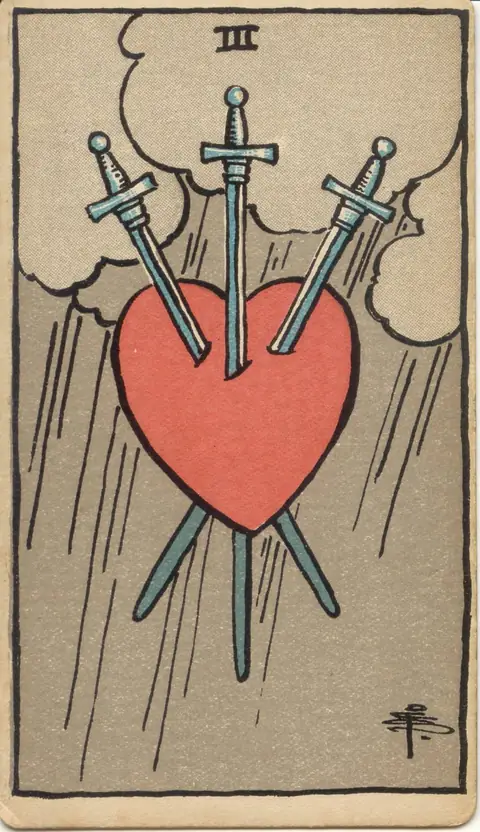
A red heart, pierced by three swords, appears under clouds from which rain falls, in a very direct image.

Two decks

Three of Swords, Marseille and Rider-Waite

The Tarot de Marseille repeats the suit’s pips; the Rider-Waite illustrates each card with a scene.

IIIThree of SwordsDiagram
Tarot de Marseille · pip diagramThree of Swords
Rider-Waite · London, 1909Three of Swords
Three of Swords: what changes from one deck to the other
AspectTarot de MarseilleRider-Waite
NameTrois d’épéesThree of Swords
ImageThe Marseille deck draws no scene: the patterns of the suit are enough, and when reversed the blade says little there.Rider-Waite draws a red heart pierced by three swords, under clouds and rain.
ReversalOften not readCommonly read (reversed cards)

Tarot de Marseille: Nicolas Conver, dated 1760, restored by the Tarot World Project, CC BY-SA 4.0 license, via Wikimedia Commons. Rider-Waite: drawings by Pamela Colman Smith, 1909, public domain, via Wikimedia Commons. Images resized and compressed by Versana; Marseille Minor Arcana diagrams and card back drawn by Versana.

Three of Swords: nuances and combinations

In love, depending on your situation

Two situations, two readings: in a current relationship, then in a period without one, and reversed.

Depending on the position in a spread

The position changes the reading: 7 common positions, each upright then reversed.

Which cards it reads well with

Six cards calculated by the combination rules: two that reinforce it, two that nuance it, two in friction. None is “bad.”

The card’s place in the suit

Number 3 of the suit of air, between the two and the four. Saturn, in the second decan of Libra, is its reference point.

The card’s number

The card carries the number 3: in numerology as in the suit, one stage of a progression from 1 to 10.

Go further

  • Libra 2nd decanThe decan the Golden Dawn assigns to this card
  • RehaelThe angel of the same decan, according to Lenain
  • IeiazelThe angel of the same decan, according to Lenain

How is it built?

Suit and number read on the deck; decan and planet reported according to the Golden Dawn tradition, never as facts.

Frequently asked questions about Three of Swords

What does the Three of Swords mean in tarot?

The Three of Swords represents a sorrow, a word that hurt, or a disappointment. The image of the pierced heart is symbolic: it reads as a situation to face, never as a sentence nor as an image of the body.

What does the Three of Swords mean reversed?

Reversed, the sorrow eases: the intensity falls, words become less cutting, and distance lets you look differently at what happened. The blade can then accompany a return to calm.

Which cards go well with the Three of Swords?

With the card of hesitation, the disappointment follows a doubt. With the card of rest, a pause comes to receive it. With a Cup, the feeling is acknowledged; with a Wand, momentum sets things moving again. The cards suggested above show other pairs.

The Three of Swords in a yes or no reading?

The tendency is rather reserved: the card shows a disappointment, which pushes toward restraint more than momentum. It remains to be placed within your wording and among the neighboring cards.