Skip to content

The Fool tarot card: meaning, upright and reversed

The Fool is the card of freedom: setting out light, trusting the road, and welcoming the unexpected.

  • departure
  • lightness
  • trust
The essentials

The Fool at a glance

For you

A light departure, a curiosity that opens the road: the traveler moves on despite the snags, without knowing the way in advance.

A strength

The drive of the first step: setting out light, accepting that you do not know everything, and keeping the taste for moving on despite the snags.

Something to watch

Too much lightness and carefreeness can turn into recklessness: a look at the terrain remains useful before launching out.

Tone
Transition
Yes or no
Nuanced
Read more

By Thomas Guilhot · updated

Upright

Upright, the Fool is read as a departure: the traveler walks with little baggage, the animal harasses, and the traveler keeps going.

The card is unnumbered in the Marseille deck, 0 in Waite’s, and counted as 22 when you calculate the birth arcana; it occupies a place apart in the series, which speaks of a freedom that fits in no box. Its tone is that of passage.

In a concrete situation, the Fool can accompany a beginning, a change of scenery, a wish to try without a guarantee. It invites trust and curiosity, taking a first step without demanding the complete map of the road. Its strength lies in spontaneity; its limit, in forgetting the terrain. The right use is to keep the lightness while watching where you put your feet.
  • departure
  • lightness
  • trust

The Fool in your life

In love

A light meeting, a new impulse, or a need for space: some spontaneity, while telling the other person your intentions.

For a relationship, the Fool can speak of a light meeting, a new impulse, or the need for space. It invites you to keep some spontaneity without jostling the other person, and to state your intentions before launching out.

At work

The start of an assignment, a new idea, a change of setting: boldness is in order if the essentials are ready.

For a career, the Fool evokes the start of an assignment, a career change under consideration, or a new idea. It encourages boldness and curiosity, provided you prepare the essentials before leaving and state your intention frankly.

With money

A light, sometimes impulsive way of acting: a project launched without a net calls for a margin of caution.

On the resources side, the Fool speaks of a light, sometimes impulsive way of acting: a purchase on a whim, a project launched without a net. It invites you to keep a margin of caution before committing, and to look at what you are really taking with you.

As a feeling, as an action

As a feeling

The urge to launch before understanding everything, with a little vertigo before the unknown.

As an action

Take a modest first step, carry the essentials, and keep an eye on the terrain as you go.

Reversed

When carefreeness becomes recklessness, momentum forgets the terrain and lightness runs away to the point of excess, at the expense of the essentials.

In a yes or no reading

Nuanced

The Fool stays nuanced: its tendency depends on how the question is asked, on the caution it calls for, and on the neighboring cards around it.

Questions to ask yourself

  • What light first step can I try without waiting to understand everything?
  • What would I leave in my bag to travel lighter?
  • Which person or landmark could help me keep my feet on the ground?

A sentence to keep: “I set out with little baggage and a curious eye on the road.”

Yes or no tarot

What the card shows

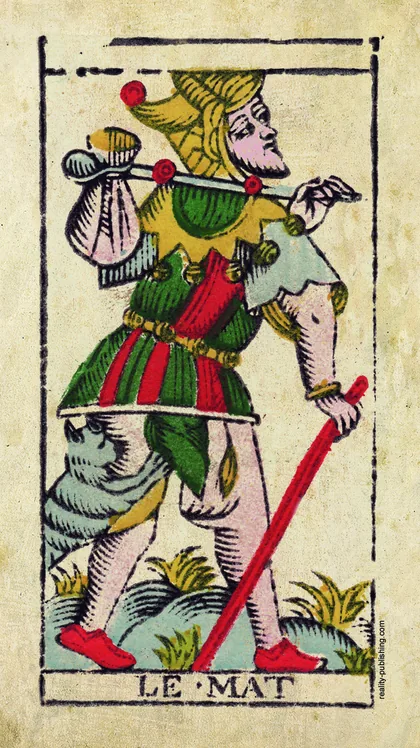
A traveler in a bell-tipped cap carries a bundle on a stick over the shoulder and leans on a red staff; an animal leaps at the leg, and the traveler keeps walking.

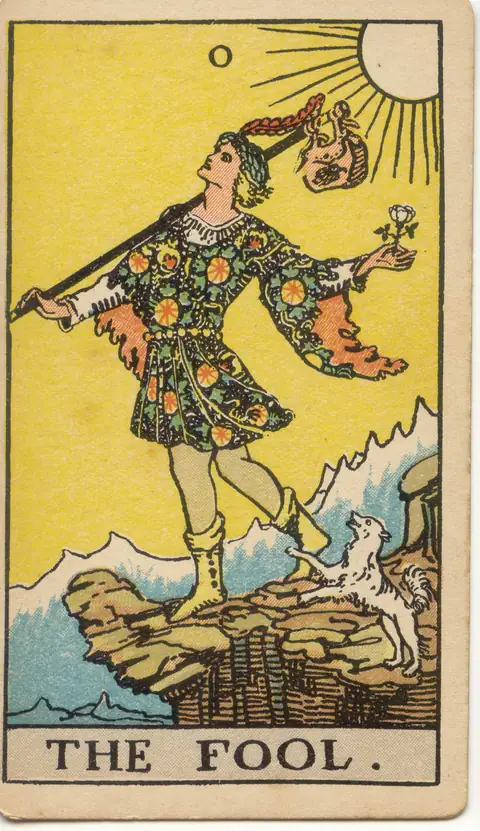
The Marseille drawing carries no number, and the animal leaping at the traveler’s leg tears the clothing without stopping the walk. In the Rider-Waite deck, the card is numbered 0: at the edge of a cliff, a figure looks up toward the sky, a bundle on a stick. The figure holds a white rose; at the feet, a small white dog leaps. A white sun and snowy mountains complete the setting. In both versions, an animal presence accompanies the movement: the scene is read as a momentum that snags do not interrupt.

Two decks

The Fool, Marseille and Rider-Waite

The same card in the two reference decks: Conver’s drawing, dated 1760, and Pamela Colman Smith’s scene, 1909.

Tarot de Marseille · Conver, dated 1760The Foolunnumbered
Rider-Waite · London, 1909The Fool0
The Fool: what changes from one deck to the other
AspectTarot de MarseilleRider-Waite
NameLe MatThe Fool
Numberunnumbered0
ImageIn the Marseille deck, the card is unnumbered: an animal leaps at the traveler’s leg and tears the clothing, but the traveler keeps walking.In Waite’s deck, the Fool is numbered 0: at the cliff edge, the figure holds a white rose, and a white dog leaps at the feet.
ReversalOften not readCommonly read (reversed cards)

Tarot de Marseille: Nicolas Conver, dated 1760, restored by the Tarot World Project, CC BY-SA 4.0 license, via Wikimedia Commons. Rider-Waite: drawings by Pamela Colman Smith, 1909, public domain, via Wikimedia Commons. Images resized and compressed by Versana; Marseille Minor Arcana diagrams and card back drawn by Versana.

The Fool: nuances and combinations

In love, depending on your situation

Two situations, two readings: in a current relationship, then in a period without one, and reversed.

Depending on the position in a spread

The position changes the reading: 7 common positions, each upright then reversed.

Which cards it reads well with

Six cards calculated by the combination rules: two that reinforce it, two that nuance it, two in friction. None is “bad.”

The history of the card

Unnumbered in the Marseille deck, numbered 0 by Waite, counted as 22 for the birth arcana: the Fool has a place apart, at the beginning or at the end of the series.

Go further

How is it built?

Numbers and names read on Conver’s cards and in Waite’s text; correspondences reported according to the Golden Dawn tradition, never as facts.

Frequently asked questions about The Fool

What does the Fool mean in tarot?

The Fool is read as a departure: an unnumbered traveler, light, who keeps going despite the snags. Its tone is passage, and the card invites trust, curiosity, and the freedom of the first step.

What does the Fool mean reversed?

Reversed, the Fool tips into excess: carefreeness becomes recklessness, and lightness forgets the terrain. The reading then invites you to slow down, check the essentials, and look at where you set your foot before setting out again.

Which cards go well with the Fool?

The Fool evokes a fresh start next to cards of review, and opens a new cycle next to cards of fulfillment, once the old one is closed. Unnumbered in the Marseille deck, it takes meaning mostly from its neighboring cards. Detail: the pairings above.

The Fool in a yes or no reading?

On a closed question, the Fool stays nuanced: its tendency varies with the wording, the caution the situation calls for, and the neighboring cards. A precise question helps to read it.