Skip to content

Page of Wands tarot card: meaning and reversed

The Page of Wands means the urge to explore: an idea that sparks and pushes you to try something new.

  • curiosity
  • trial
  • enthusiasm
The essentials

Page of Wands at a glance

For you

The enthusiasm of a first try: a new curiosity, a wand examined up close, the urge to understand through practice.

A strength

A frank curiosity: it dares to try without waiting to be sure, and this freshness makes you want to jump in too.

Something to watch

Enthusiasm can stay at the stage of an idea: look at what you really plan to do with this wand before getting carried away.

Way of acting
Learning
Yes or no
Nuanced
Read more

By Thomas Guilhot · updated

Upright

The Page of Wands speaks of a beginning: a new desire, a project barely sketched, a curiosity looking for its first ground.

Its way of acting is that of the trial: you jump in to see, without claiming to have mastered anything yet.

This card invites you to give value to that first movement, even a clumsy one, because it sets something in motion. It can also remind you that a wand looked at too long stays a wand: momentum takes shape when you set it moving, even on a small scale.

In a reading, it is often seen as a passage, a stage of learning where enthusiasm outweighs experience, and where a beginner’s frankness becomes a strength rather than a flaw.

  • curiosity
  • trial
  • enthusiasm

Page of Wands in your life

In love

A sincere curiosity for someone or for a way of loving, lived with spontaneity and without a long-term plan.

In matters of the heart, the card evokes a curiosity that shows itself without calculation: a new interest, a spontaneous message, the urge to try. It invites you to let that freshness exist, without demanding lasting results right away.

At work

A new idea to propose, a learning process starting: momentum counts for more here than experience.

At work, the card resembles an idea put forward, a first try, a learning process under way. Enthusiasm serves as the engine; a simple method, set up from the start, then helps you go the distance.

With money

A small-scale trial to test an idea, learning as the results come in rather than committing heavily.

On the money side, it evokes a small-scale trial: testing an idea, learning by doing, without committing more than you can follow closely.

As a feeling

A light, curious excitement, that of someone discovering a new object and eager to know what it is for.

As an action

Launch a modest first try without waiting to be ready, and see what it teaches you.

Reversed

An enthusiasm slow to act: blocked energy stays inside, at the stage of an idea, with no first gesture to free it.

In a yes or no reading

Nuanced

The tendency calls for nuance: the enthusiasm is real, but experience is still lacking. The page invites you to test before deciding, then to ask the question again once the first try is done.

Questions to ask yourself

  • What first try can I make without waiting to be sure?
  • Which idea have I kept in mind for a long time without testing it?
  • What would I gain by trying on a small scale what I do not dare on a large one?

A sentence to keep: “I try a new idea with curiosity, without waiting to have planned everything.”

Yes or no tarot

What the card depicts

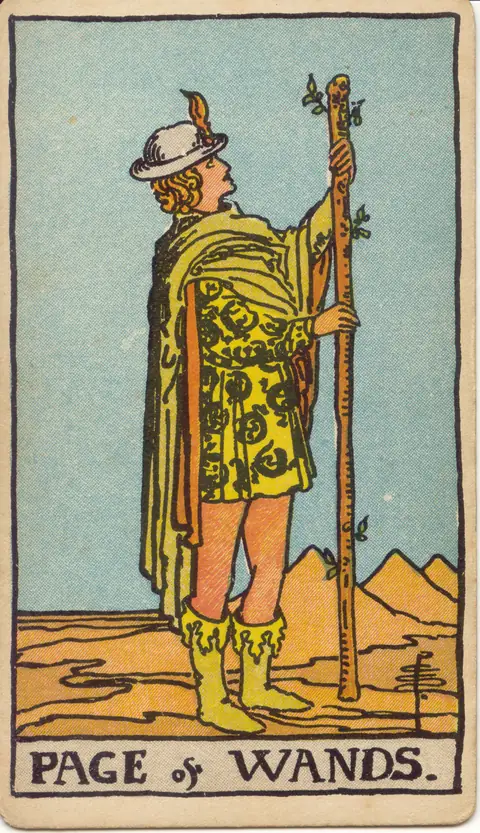
A person stands in a desert landscape, with dunes or pyramids. They wear a feathered hat and a tunic scattered with salamanders, and hold an upright wand.

Two decks

Page of Wands, Marseille and Rider-Waite

The Tarot de Marseille repeats the suit’s pips; the Rider-Waite illustrates each card with a scene.

Page of WandsDiagram
Tarot de Marseille · pip diagramPage of Wands
Rider-Waite · London, 1909Page of Wands
Page of Wands: what changes from one deck to the other
AspectTarot de MarseilleRider-Waite
NameValet de bâtonsPage of Wands
ImageThe Tarot de Marseille leaves little setting to read; the reading rests mainly on the figure of the page and on the suit of Wands.The Rider-Waite deck adds to the page a desert landscape, a tunic of salamanders, and a gaze resting on the wand: details that feed the reading.
ReversalOften not readCommonly read (reversed cards)

Tarot de Marseille: Nicolas Conver, dated 1760, restored by the Tarot World Project, CC BY-SA 4.0 license, via Wikimedia Commons. Rider-Waite: drawings by Pamela Colman Smith, 1909, public domain, via Wikimedia Commons. Images resized and compressed by Versana; Marseille Minor Arcana diagrams and card back drawn by Versana.

Page of Wands: nuances and combinations

In love, depending on your situation

Two situations, two readings: in a current relationship, then in a period without one, and reversed.

Depending on the position in a spread

The position changes the reading: 7 common positions, each upright then reversed.

Which cards it reads well with

Six cards calculated by the combination rules: two that reinforce it, two that nuance it, two in friction. None is “bad.”

The card’s place in the suit

The page is the court card of Wands that stands for beginning, tied to the fire of the suit. The tables differ on the element belonging to the court cards; only that of the suit is kept here.

How is it built?

Suit and number read on the deck; decan and planet reported according to the Golden Dawn tradition, never as facts.

Frequently asked questions about Page of Wands

What does the Page of Wands mean in tarot?

The Page of Wands evokes the enthusiasm of a beginning: a new idea, a first try, a curiosity looking for its ground. It reads as a way of going about things, that of someone discovering without yet having experience, rather than as a person.

What does the Page of Wands mean reversed?

Reversed, the Page of Wands is read mainly as blocked energy, held back inside: the enthusiasm exists, but the act is slow to come. The desire stays in the head, for lack of a concrete first gesture.

Which cards go well with the Page of Wands?

Alongside the other fire court cards, the page tells of the same flame at different stages. Next to a card of pause, it shows a momentum waiting for its moment; next to a card of action, it invites you to move on to the trial.

The Page of Wands in a yes or no reading?

The tendency calls for nuance. The page carries a real but still inexperienced enthusiasm: it is better to sharpen the question, test before committing, and look at the neighboring cards before concluding.