Skip to content

King of Cups tarot card: meaning and reversed

The King of Cups describes emotional balance: kindness, wisdom, and composure in the face of feelings.

  • mastery
  • kindness
  • stability
The essentials

King of Cups at a glance

For you

A calm held in the midst of turbulence: emotion is welcomed without taking the wheel, and kindness joins mastery.

A strength

A calm held in the midst of turbulence, a steady kindness, the ability to welcome emotions without being swept away by them.

Something to watch

The risk is that surface calm holds emotions back: mastering is not the same as feeling.

Way of acting
Leading
Yes or no
Nuanced
Read more

By Thomas Guilhot · updated

Upright

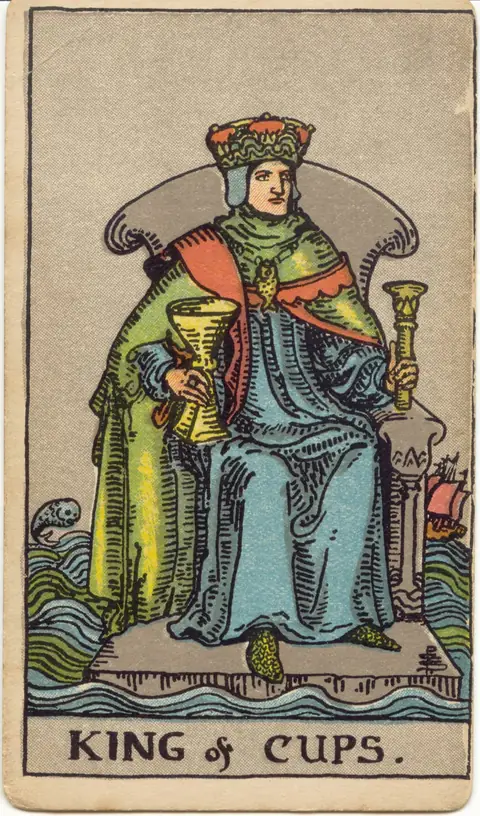
The King of Cups holds his cup and scepter in the middle of a rough sea, the way you keep your calm without cutting yourself off from what you feel.

The card values kindness, diplomacy, composure, and the ability to advise without imposing. It reminds us that you can welcome a strong emotion without letting it drive. Its balance lies in nuance: staying steady without becoming distant, and letting gentleness flow. It is then read as a support for yourself and for others.

  • mastery
  • kindness
  • stability

King of Cups in your life

In love

A steady affection, a measured word; the bond gains from letting emotions flow too, rather than keeping them at a distance.

In intimacy, he suggests a steady affection, a reassuring presence, a measured word. He invites you to let emotions flow too, rather than holding them behind a calm that is too strict.

At work

An art of diplomacy and measured advice, which calms a turbulent atmosphere without imposing your own view.

Facing a team, this figure favors diplomacy, mediation, and measured advice. He encourages you to hold your place with kindness, even when the atmosphere is turbulent.

With money

Moderation and composure guide your choices; deciding at a distance from the mood of the moment gives more clarity.

In matters of resources, moderation and composure lead the way: deciding without being swept away by the mood of the moment, and keeping an overall view. This is not financial advice.

As a feeling

A confident calm on the surface, with deeper movements that you acknowledge without being carried away by them.

As an action

Hold your course in the middle of the agitation, advise with moderation, and leave a little room for what is felt.

Reversed

Surface calm holds emotions back: nothing comes out, everything stays within, and mastery becomes a way of protecting yourself.

In a yes or no reading

Nuanced

The King of Cups is a “maybe”: calm is an asset, but you need to check that emotions are not simply hidden behind it.

Questions to ask yourself

  • How can you keep your calm without ceasing to feel?
  • Which emotion could you let flow without losing your calm?
  • Where does your calm truly serve others, and where does it mostly protect you?

A sentence to keep: “I stay steady amid the waves without ceasing to feel.”

Yes or no tarot

What the card depicts

On a stone throne floating on a rough sea, a crowned figure holds a cup and a scepter; a fish leaps on one side, a ship passes on the other.

Two decks

King of Cups, Marseille and Rider-Waite

The Tarot de Marseille repeats the suit’s pips; the Rider-Waite illustrates each card with a scene.

King of CupsDiagram
Tarot de Marseille · pip diagramKing of Cups
Rider-Waite · London, 1909King of Cups
King of Cups: what changes from one deck to the other
AspectTarot de MarseilleRider-Waite
NameRoi de coupesKing of Cups
ImageThe floating throne, the fish, and the ship are Rider-Waite details; the Marseille figure has a different design.The Rider-Waite deck places the stone throne on a rough sea, with a fish on one side and a ship on the other: stability standing in the middle of movement.
ReversalOften not readCommonly read (reversed cards)

Tarot de Marseille: Nicolas Conver, dated 1760, restored by the Tarot World Project, CC BY-SA 4.0 license, via Wikimedia Commons. Rider-Waite: drawings by Pamela Colman Smith, 1909, public domain, via Wikimedia Commons. Images resized and compressed by Versana; Marseille Minor Arcana diagrams and card back drawn by Versana.

King of Cups: nuances and combinations

In love, depending on your situation

Two situations, two readings: in a current relationship, then in a period without one, and reversed.

Depending on the position in a spread

The position changes the reading: 7 common positions, each upright then reversed.

Which cards it reads well with

Six cards calculated by the combination rules: two that reinforce it, two that nuance it, two in friction. None is “bad.”

The card’s place in the suit

Last of the four court figures of water, the King comes after the Page, the Knight, and the Queen.

How is it built?

Suit and number read on the deck; decan and planet reported according to the Golden Dawn tradition, never as facts.

Frequently asked questions about King of Cups

What does the King of Cups mean in tarot?

The King of Cups is read as emotional mastery: a calm held in the midst of turbulence, a steady kindness, measured advice. He welcomes what stirs without being carried off by the waves.

What does the King of Cups mean reversed?

Reversed, he is read as blocked energy, folded in on itself: a surface calm that holds emotions back. He invites you to acknowledge what stirs beneath the mastery, and to give it a way of being expressed.

Which cards go well with the King of Cups?

He pairs readily with the other court cards of Cups, for the progression from discovery, proposal, and listening to mastery, and with action cards that help him act with moderation. The combination refines the nuance without changing the underlying meaning.

The King of Cups in a yes or no reading?

When a clear-cut answer is expected, this card prefers nuance. Calm is an asset, but you need to check that emotions are not simply being held back. Framing the question better and reading the surrounding cards adds depth.