Skip to content

Nine of Swords tarot card: meaning and reversed

The Nine of Swords marks worry: thoughts that circle at night and make troubles grow.

  • worry
  • rumination
  • weight of thoughts
The essentials

Nine of Swords at a glance

For you

A worry that fills the whole mind and grows in silence, until you set it down somewhere other than in your head.

A strength

Recognizing that worry takes up a lot of space, and bringing it back to its size by putting it into words.

Something to watch

Letting scenarios run on their own, until you confuse what you dread with what is.

Tone
Withdrawal
Read more

By Thomas Guilhot · updated

Upright

Upright, the Nine of Swords often evokes a retreat into worry: thoughts that keep coming back, “what ifs” that chain together, a weight you carry alone.

Swords speak of thought; here, it runs away. The card invites you to take these thoughts out of your head and set them down elsewhere: a conversation, a list, a written page. It describes a state, not a verdict on the situation. Within a spread, its neighbor clarifies what can soothe and what feeds the rumination.

  • worry
  • rumination
  • weight of thoughts

Nine of Swords in your life

In love

A worry kept to yourself, which takes up space in the relationship as long as it goes unspoken.

A relationship may be crossed by a worry you keep to yourself. Confiding it to the other person, simply, without looking for an immediate answer, often makes it shrink. The card describes an inner climate.
At work

A file turned over and over, a fear of doing it wrong that spills beyond working hours.

It can evoke concerns that spill beyond the professional frame: a file turned over and over, a fear of doing it wrong. Listing what depends on you helps give each worry its proper place.

With money

A money worry bigger than the numbers, which settles once the accounts are laid out.

It evokes a money worry bigger than the numbers: laying the accounts out in writing makes it possible to tell the real from the anticipated. A readable budget calms more than repeated calculations.

As a feeling

A weight in the head, thoughts going around, and the need to be heard without being corrected.

As an action

Get the worry out of your head, in writing or by confiding it, to give it back its real size.

Reversed

Worry loosens its vise: thoughts become less frequent, and the situation regains fairer proportions.

In a yes or no reading

Rather reserved

Here, reservation dominates: worry weighs on the question and deserves to be set down before answering.

Questions to ask yourself

  • Which thought keeps coming back in a loop, and whom could you confide it to?
  • Which thought would come back less strongly if you said it aloud?
  • In this night, what is a fact, and what is a fear?

A sentence to keep: “I put my thoughts into words, and they regain the size they really have.”

Yes or no tarot

What the card depicts

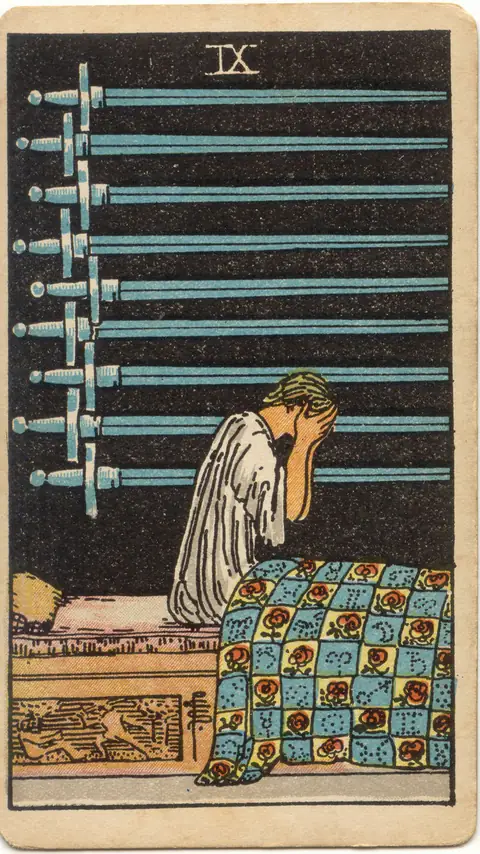
A figure sits up in bed, face in hands; nine horizontal swords stand out against a black background, and the blanket is scattered with roses and astrological signs.

Two decks

Nine of Swords, Marseille and Rider-Waite

The Tarot de Marseille repeats the suit’s pips; the Rider-Waite illustrates each card with a scene.

VIIIINine of SwordsDiagram
Tarot de Marseille · pip diagramNine of Swords
Rider-Waite · London, 1909Nine of Swords
Nine of Swords: what changes from one deck to the other
AspectTarot de MarseilleRider-Waite
NameNeuf d’épéesNine of Swords
ImageNine swords in a pattern, with no figure or bed: in the Marseille deck, the number nine and the suit of air speak alone.An intimate scene: a figure sitting up in bed, nine swords on the wall against a black background, a blanket of roses and signs.
ReversalOften not readCommonly read (reversed cards)

Tarot de Marseille: Nicolas Conver, dated 1760, restored by the Tarot World Project, CC BY-SA 4.0 license, via Wikimedia Commons. Rider-Waite: drawings by Pamela Colman Smith, 1909, public domain, via Wikimedia Commons. Images resized and compressed by Versana; Marseille Minor Arcana diagrams and card back drawn by Versana.

Nine of Swords: nuances and combinations

In love, depending on your situation

Two situations, two readings: in a current relationship, then in a period without one, and reversed.

Depending on the position in a spread

The position changes the reading: 7 common positions, each upright then reversed.

Which cards it reads well with

Six cards calculated by the combination rules: two that reinforce it, two that nuance it, two in friction. None is “bad.”

The card’s place in the suit

The ninth card of Swords, it follows the retreat of the eight and precedes the ten, that of a clean ending: worry builds before the situation resolves.

The card’s number

The card carries the number 9: in numerology as in the suit, one stage of a progression from 1 to 10.

Go further

  • Gemini 2nd decanThe decan the Golden Dawn assigns to this card
  • HarielThe angel of the same decan, according to Lenain
  • HakamiahThe angel of the same decan, according to Lenain

How is it built?

Suit and number read on the deck; decan and planet reported according to the Golden Dawn tradition, never as facts.

Frequently asked questions about Nine of Swords

What does the Nine of Swords mean in tarot?

The Nine of Swords represents the worry that fills the mind. The image shows a figure sitting up in bed, face in hands, in front of nine horizontal swords hung on the wall against a black background. The card describes an inner state, not an event.

What does the Nine of Swords mean reversed?

Reversed, it evokes a worry that loosens its grip: thought settles, the swords lose some of their weight, and you find room to breathe. In the Marseille deck, this reversal is barely noticeable.

Which cards go well with the Nine of Swords?

It is clarified next to a card of speech, which shows whom to confide in, or a card of comfort. The associations block on the page refines this reading, calculation in hand, without pronouncing a verdict.

The Nine of Swords in a yes or no reading?

Its tendency is rather reserved: worry weighs on the question. It is better to first set it down, in writing or aloud, then ask yourself what exactly you dread, and since when.