Skip to content

Temperance tarot card: meaning, upright and reversed

Temperance is the card of the right measure: reconciling, balancing the doses, and letting time do its work.

  • measure
  • balance
  • patience
The essentials

Temperance at a glance

For you

Each element finds its fair share: a patient balance of doses settles in, and equilibrium is built by blending without forcing.

A strength

It brings measure: a patient adjustment in which each element finds its fair share and nothing is lost.

Something to watch

It can be mistaken for lukewarmness; yet its measure demands attention, constancy, and precision.

Tone
Stability
Read more

By Thomas Guilhot · updated

Upright

Upright, Temperance is read as the moment when things find their proportions.

Nothing dazzling, but a patient adjustment: blending what seemed opposite, balancing effort and rest, speech and silence, drive and caution. Many readers see in it a period of stability, in which you move forward by fine tuning rather than by forcing. The figure keeps one foot in the water and the other on land: it links what is felt and what holds. The card invites regularity, patience, and listening to what really suits you, rather than the pursuit of an immediate result. The tendency is rather favorable, because a balance built slowly lasts. It suggests rushing nothing, tasting each proportion before changing it, and giving the mixture time to set.

  • measure
  • balance
  • patience

Temperance in your life

In love

Harmony is built by small touches: each person adjusts their rhythm to the other’s, with neither fusion nor withdrawal.

In a relationship, the card evokes a harmony built by small touches: each person adjusts, listens, and tunes their rhythm to the other’s. It can also invite you to find a fair distance, neither fusion nor withdrawal.

At work

The card evokes balanced collaboration and a sustainable rhythm, in which effort is shared and viewpoints are blended.

On the work side, the card speaks of regularity, balanced collaboration, and a sustainable rhythm. It invites you to share out efforts, to listen to different points of view, and to look for the formula that suits everyone.

With money

Measured management, in which you spend and set aside in good proportions, without deprivation or excess.

For money, it evokes measured management: spending and setting aside in good proportions, without deprivation or excess. This is a way of acting day to day, never investment advice or figures to follow.

As a feeling, as an action

As a feeling

A quiet easing, the sense that the pieces are finally falling into line with no visible effort.

As an action

Measure, taste, adjust: change one thing at a time and leave time to observe its effect.

Reversed

The balance of doses is lost: excess, imbalance, or an overflowing momentum take over again, and the right proportion is slow to come.

In a yes or no reading

Rather favorable

Rather favorable tendency: the card speaks of a balance settling in. It suggests forcing nothing and moving at a good pace.

Questions to ask yourself

  • What proportion needs to be found again between two things I hold together?
  • Which ingredient would I add in a smaller amount to find the right flavor again?
  • What is my rhythm, and what is the other person’s?

A sentence to keep: “I adjust one thing at a time and leave it to time to blend the rest.”

Yes or no tarot

What the card shows

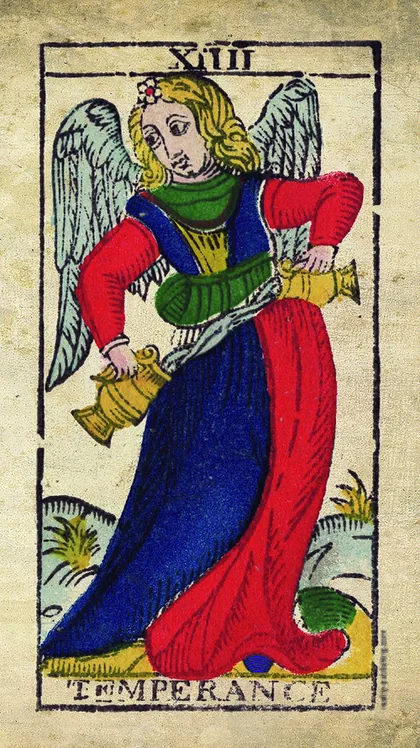
On the Marseille card, a winged figure with a flower in the hair pours a liquid from one vessel into another. The stream passes at a slant, from one hand to the other.

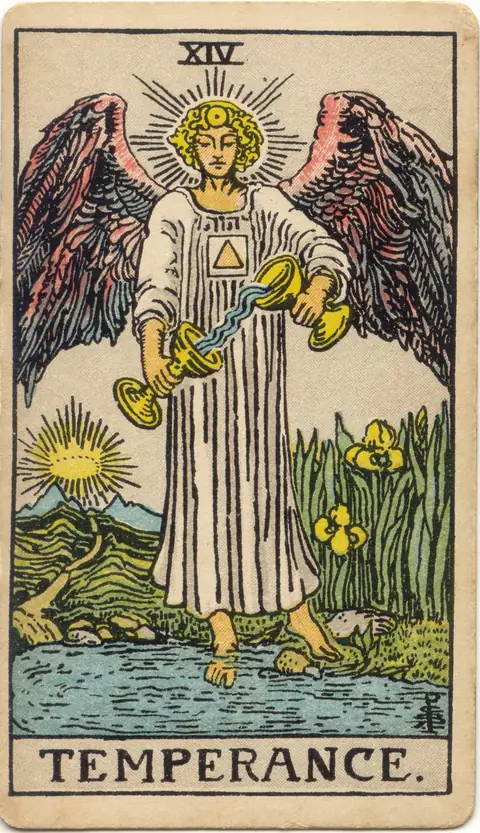
Everything rests on that stream passing at a slant: the gesture is slow, precise, and nothing overflows. The red and blue robe brings together two colors that everything sets apart, and the ground with its plants is a reminder that this measure is exercised on earth, not in the clouds. In the Rider-Waite, the winged figure with red wings wears a white robe marked with a triangle in a square, and a solar disc on the forehead. It pours water from one cup into the other, one foot in the water, the other on land. Yellow irises line the path that climbs toward a glowing crown between two peaks. In both versions, the image invites you to hold two elements together without sacrificing either.

Two decks

Temperance, Marseille and Rider-Waite

The same card in the two reference decks: Conver’s drawing, dated 1760, and Pamela Colman Smith’s scene, 1909.

Tarot de Marseille · Conver, dated 1760TemperanceXIIII
Rider-Waite · London, 1909TemperanceXIV
Temperance: what changes from one deck to the other
AspectTarot de MarseilleRider-Waite
NameTempéranceTemperance
NumberXIIIIXIV
ImageIn the Marseille deck, the winged figure holds a flower in the hair and the stream passes at a slant, over ground with plants.The Rider-Waite puts one foot in the water, the other on land, with irises and a path toward a glowing crown.
ReversalOften not readCommonly read (reversed cards)

Tarot de Marseille: Nicolas Conver, dated 1760, restored by the Tarot World Project, CC BY-SA 4.0 license, via Wikimedia Commons. Rider-Waite: drawings by Pamela Colman Smith, 1909, public domain, via Wikimedia Commons. Images resized and compressed by Versana; Marseille Minor Arcana diagrams and card back drawn by Versana.

Temperance: nuances and combinations

In love, depending on your situation

Two situations, two readings: in a current relationship, then in a period without one, and reversed.

Depending on the position in a spread

The position changes the reading: 7 common positions, each upright then reversed.

Which cards it reads well with

Six cards calculated by the combination rules: two that reinforce it, two that nuance it, two in friction. None is “bad.”

The history of the card

Fourteenth Major Arcana, written XIIII in the Marseille deck and numbered 14 by Waite, Temperance has the reduced number 5, that of movement.

Go further

  • SagittariusThe sign the Golden Dawn assigns to this card
  • 14:14The hour that bears the card’s number

How is it built?

Numbers and names read on Conver’s cards and in Waite’s text; correspondences reported according to the Golden Dawn tradition, never as facts.

Frequently asked questions about Temperance

What does Temperance mean in tarot?

Temperance, card XIIII, speaks of measure and adjustment. A winged figure pours a liquid between two vessels: you blend, you balance, you find the right proportion. It is often read as a period of patient stability.

What does Temperance mean reversed?

Reversed, it speaks of a lost balance of doses: excess, imbalance, a momentum that overflows with no restraint. The card then invites you to slow down and find a proportion that suits, rather than push harder.

Which cards go well with Temperance?

Temperance is strengthened near the cards of gentleness and patience, invites you to loosen an excess near the cards of tension, and makes balance more joyful near the cards of clarity. After a card of passage, it helps stabilize what has just changed. Details: the associations above.

Temperance in a yes or no reading?

The tendency is rather favorable, because a balance built slowly is solid. The card suggests, however, not mistaking measure for immobility: if the question calls for a clear leap, it calls for nuance.