Skip to content

The Hermit tarot card: meaning, upright and reversed

The Hermit is the card of stepping back: seeking your own truth, away from the noise and at your own pace.

  • withdrawal
  • inner clarity
  • caution
The essentials

The Hermit at a glance

For you

A chosen withdrawal in order to see clearly: the lantern lights just enough to move forward, and that is sometimes enough.

A strength

Knowing how to withdraw in order to see clearly, and moving forward by the light of what you have understood rather than what you merely believe.

Something to watch

Retreat can drag on into isolation, and caution can become a way of avoiding other people.

Tone
Withdrawal
Yes or no
Nuanced
Read more

By Thomas Guilhot · updated

Upright

Upright, the Hermit is often read as a withdrawal with a purpose: you step away from the noise, the opinions, and the habits to hear your own question.

The card does not speak of flight. The figure walks, holds a lantern, and knows where to set each foot; solitude here is a method.

Its light is modest. It does not illuminate the whole road, only the next few steps, and many readers see in it a wisdom of measure: understanding what matters before choosing, and accepting that your view is only partial.

In a spread, the Hermit turns inward whatever surrounds it. With a card of drive, it raises the question of motives before departure; with a card of connection, it reminds you that a need for distance can be voiced without breaking things off.

  • withdrawal
  • inner clarity
  • caution

The Hermit in your life

In love

A need for distance in the relationship, which has to be said out loud so it is not mistaken for indifference.

The card invites you to tell the need for solitude apart from the fear of closeness. With no relationship at the moment, it can describe a period in which you get to know yourself before meeting someone. In a couple, it asks you to say out loud that time apart before it is guessed.

At work

A project that gains from being thought through apart before it is presented: take the time for a thorough analysis.

The Hermit evokes deep work: expertise, study, a project ripened away from interruptions. It can also signal that you are shutting yourself inside one skill without sharing it, out of caution or a habit of doing everything yourself, without ever asking for an opinion.

With money

A cautious way of looking at your accounts: take stock with a calm head, without letting yourself be rushed.

Here, money is a matter of clear sight more than of investment: taking stock with a calm head, telling the essential from the superfluous. What remains to be seen is whether this caution helps you choose, or only delays the moment of facing the figures.

As a feeling, as an action

As a feeling

The need for calm, for silence, for time to yourself to sort out what really matters from the noise around you.

As an action

Make room for a deliberate time alone, then come back with a precise question rather than a vague unease.

Reversed

Retreat that drags on: what served to see clearly becomes a way of keeping everything at a distance.

In a yes or no reading

Nuanced

The Hermit calls for nuance: the outcome needs some distance, and becomes clearer once you take the time to look at what you really want.

Questions to ask yourself

  • What time of silence would help you tell what really matters?
  • What distance would truly help you, and how could you tell someone close to you?
  • What do you hope to find in this time apart, and how will you know it is enough?

A sentence to keep: “I step back to see clearly, then I return to others.”

Yes or no tarot

What the card shows

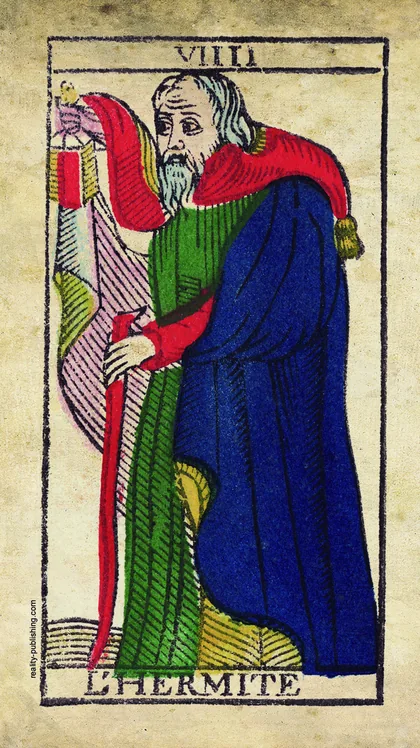
A hooded figure walks to the left, raising a lantern half hidden by a fold of a blue cloak lined with yellow, and leaning on a red staff.

In the Conver deck, the lantern lights up very little: a fold of the cloak half covers it, as if the light were being kept for the road rather than put on show. The cloak is blue, lined with yellow; the red staff supports every step. The whole figure looks to the left, toward what it leaves behind or toward what only it can see.

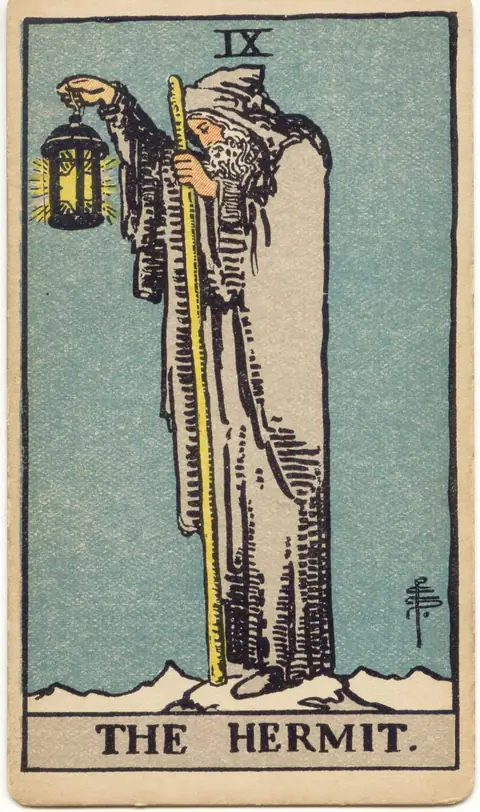
In Waite’s deck, the scene changes setting: the figure stands on a snowy summit, eyes lowered, in a gray hooded robe. The lantern shows a six-pointed star, and the staff is yellow. The light is no longer veiled: it is offered to anyone who would climb that far.

Two decks

The Hermit, Marseille and Rider-Waite

The same card in the two reference decks: Conver’s drawing, dated 1760, and Pamela Colman Smith’s scene, 1909.

Tarot de Marseille · Conver, dated 1760The HermitVIIII
Rider-Waite · London, 1909The HermitIX
The Hermit: what changes from one deck to the other
AspectTarot de MarseilleRider-Waite
NameL’HermiteThe Hermit
NumberVIIIIIX
ImageA fold of the cloak half covers the lantern, and the figure walks to the left, leaning on a red staff.On a snowy summit, eyes lowered, the figure shows a lantern in which a six-pointed star shines; the staff is yellow.
ReversalOften not readCommonly read (reversed cards)

Tarot de Marseille: Nicolas Conver, dated 1760, restored by the Tarot World Project, CC BY-SA 4.0 license, via Wikimedia Commons. Rider-Waite: drawings by Pamela Colman Smith, 1909, public domain, via Wikimedia Commons. Images resized and compressed by Versana; Marseille Minor Arcana diagrams and card back drawn by Versana.

The Hermit: nuances and combinations

In love, depending on your situation

Two situations, two readings: in a current relationship, then in a period without one, and reversed.

Depending on the position in a spread

The position changes the reading: 7 common positions, each upright then reversed.

Which cards it reads well with

Six cards calculated by the combination rules: two that reinforce it, two that nuance it, two in friction. None is “bad.”

The history of the card

Marseille numbers it VIIII, Waite places it at nine; the number reduces to 9. Virgo and the Hebrew letter Yod are its correspondences.

Go further

  • VirgoThe sign the Golden Dawn assigns to this card
  • 09:09The hour that bears the card’s number

How is it built?

Numbers and names read on Conver’s cards and in Waite’s text; correspondences reported according to the Golden Dawn tradition, never as facts.

Frequently asked questions about The Hermit

What does the Hermit mean in tarot?

The Hermit represents a chosen withdrawal in order to see clearly: a figure walks apart with a lantern that lights just enough to move forward. Many readers see in it caution, inner searching, and the need for silence. It is a card of reflection, and it describes neither abandonment nor punishment.

What does the Hermit mean reversed?

Reversed, the Hermit is read mostly as an excess: retreat becomes isolation, and caution a way of avoiding other people. Several readers see in it the lantern kept hidden just when someone would need its light. It remains a reading, to be nuanced according to the question.

Which cards go well with the Hermit?

The Hermit tempers the cards of connection with a time of distance, and invites you to test the cards of drive before departure. The companion cards suggested above come from the site’s own affinity calculation, with no judgment.

The Hermit in a yes or no reading?

The Hermit leaves the question open: its tendency calls for nuance. It points to a subject that needs some distance, and whose answer becomes clearer when you allow yourself a time of silence. The useful question becomes: what do I need in order to see clearly?