Skip to content

Ace of Wands tarot card: meaning and reversed

The Ace of Wands is the card of fresh momentum: the energy of a beginning, the inspiration that pushes you to act.

  • momentum
  • initiative
  • beginning
The essentials

Ace of Wands at a glance

For you

A fresh wish is looking to take shape: this is the moment for a first gesture, without waiting for everything to be ready.

A strength

A clean starting point: desire, initiative, and the first step take up space without requiring a complete plan.

Something to watch

A fresh impulse does not have a form yet; letting it scatter in a thousand directions would keep it from taking root.

Tone
Momentum
Read more

By Thomas Guilhot · updated

Upright

Upright, the Ace of Wands is read as the first breath of a project, a wish, or a desire to launch out.

It keeps a raw quality: it is not yet an achievement, it is the possibility of beginning. The card invites you to seize what presents itself, to try, to act before planning everything. Others also recognize in it a trust that returns, a taste for undertaking things that stirs. The risk would be to confuse a spark with endurance: what has just caught still has to be tended.

  • momentum
  • initiative
  • beginning

Ace of Wands in your life

In love

A momentum that rekindles, a wish to try a spontaneous gesture or to offer the relationship something different.

In a relationship, the card evokes a momentum that rekindles: a proposal, a spontaneous gesture, the wish to try something else. For someone who is single, it can be read as a new openness to meeting people.

At work

An idea ready to start, an initiative to take, or a project to open with a simple first trial.

At work, it corresponds to an idea getting started, an initiative to take, a project to open. It invites you to launch a first trial rather than wait for a perfect version.

With money

A lead to open, an activity to test: the card speaks of a way of going about it, not of a gain.

For finances, it is read as a way of acting: opening a lead, testing an activity, putting an idea to the test. It says nothing about a gain, only about a starting point.

As a feeling

An impulse rising, a warmth that makes you want to move, with a little impatience to see the thing get started.

As an action

Try a first concrete gesture, very simple, rather than wait for the perfect moment to launch.

Reversed

Reversed, the momentum does not start or turns inward: the desire exists, but it waits before finding its way out.

In a yes or no reading

Rather favorable

The card leans toward yes: the fire of the start supports what is beginning, as long as you do not stop at the first impulse.

Questions to ask yourself

  • What first gesture can you make right now, without waiting for everything to be ready?
  • What desire stays on standby in your love life, for lack of a first step?
  • What would you like to propose to someone, even in a very simple way?

A sentence to keep: “I let my desire take shape, one gesture after another.”

Yes or no tarot

What the card depicts

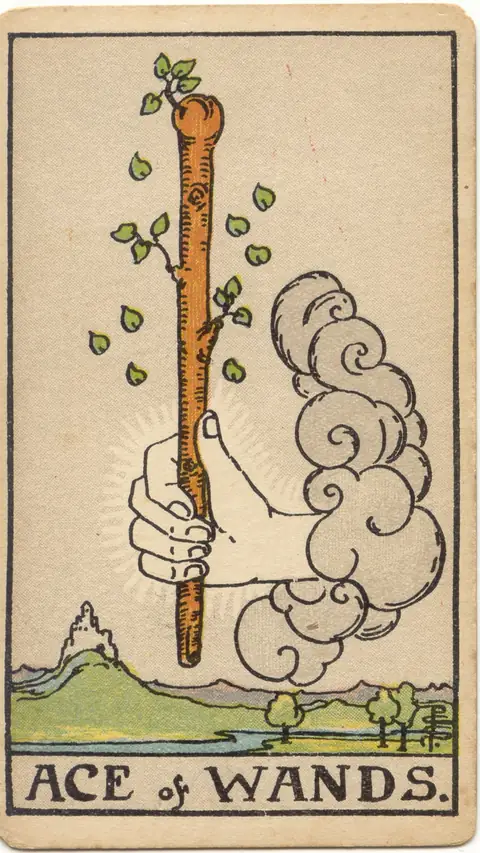
Emerging from a cloud, a hand holds a thick staff still covered in buds, with a few leaves falling away above a landscape of hills and a river.

Two decks

Ace of Wands, Marseille and Rider-Waite

The Tarot de Marseille repeats the suit’s pips; the Rider-Waite illustrates each card with a scene.

IAce of WandsDiagram
Tarot de Marseille · pip diagramAce of Wands
Rider-Waite · London, 1909Ace of Wands
Ace of Wands: what changes from one deck to the other
AspectTarot de MarseilleRider-Waite
NameAs de bâtonsAce of Wands
ImageIn the Marseille deck, the Ace is not symmetrical: a hand holds the wand, and the composition is read through that single gesture.In the Rider-Waite deck, the hand comes out of a cloud, and a landscape of river, trees, and castle spreads under the budding wand.
ReversalOften not readCommonly read (reversed cards)

Tarot de Marseille: Nicolas Conver, dated 1760, restored by the Tarot World Project, CC BY-SA 4.0 license, via Wikimedia Commons. Rider-Waite: drawings by Pamela Colman Smith, 1909, public domain, via Wikimedia Commons. Images resized and compressed by Versana; Marseille Minor Arcana diagrams and card back drawn by Versana.

Ace of Wands: nuances and combinations

In love, depending on your situation

Two situations, two readings: in a current relationship, then in a period without one, and reversed.

Depending on the position in a spread

The position changes the reading: 7 common positions, each upright then reversed.

Which cards it reads well with

Six cards calculated by the combination rules: two that reinforce it, two that nuance it, two in friction. None is “bad.”

The card’s place in the suit

First of the suit of Wands, associated with fire, the Ace carries the number 1: that of the beginning, before all the other cards of the series.

The card’s number

The card carries the number 1: in numerology as in the suit, one stage of a progression from 1 to 10.

How is it built?

Suit and number read on the deck; decan and planet reported according to the Golden Dawn tradition, never as facts.

Frequently asked questions about Ace of Wands

What does the Ace of Wands mean in tarot?

The Ace of Wands represents a beginning: a hand holds out a budding wand, a sign of a wish or an initiative ready to take shape. The root of fire: that is how tradition names this ace. It invites you to take the step without waiting for total certainty.

What does the Ace of Wands mean reversed?

Reversed, the momentum seems not to start or to turn inward: the idea stays inside you, and the blocked energy waits for a chance to come out. The reading invites you to look for what holds back the first step, without blaming yourself.

Which cards go well with the Ace of Wands?

The Ace of Wands continues next to the following card of the series, where the momentum enters a phase of reflection, then further on when it looks out to sea. With a card of the same suit, the fire strengthens; with another suit, it takes on its color. Six cards above shed light on it.

The Ace of Wands in a yes or no reading?

The tendency is rather favorable: the fire of the start supports what is beginning. It remains a leaning, not a guarantee, and depends on the question asked. Frame it around an action to undertake and read the neighboring cards.