Skip to content

Ace of Cups tarot card: meaning and reversed

The Ace of Cups means an opening heart: love, joy, and tenderness that overflow.

  • momentum
  • welcome
  • openness
The essentials

Ace of Cups at a glance

For you

A surge of the heart appears: a new affection or emotion, to welcome without trying to hold on to it.

A strength

A surge of the heart that offers itself unasked: the card opens the suit on what overflows and only asks to be received.

Something to watch

What pours out can also slip away: an emotion only half welcomed risks being left without follow-through.

Tone
Momentum
Read more

By Thomas Guilhot · updated

Upright

The Ace of Cups opens the suit of water, the suit of emotions, with a beginning: the cup is full before you have asked for anything.

It is often read as affection, a frank emotion, or a surge of the heart looking for somewhere to land. The card invites you less to act than to receive: let the emotion show itself, name it, make room for it. It suggests that a bond may be born or renewed, and that a long-contained sensitivity might finally find words.

Nothing requires you to decide right away: it marks a starting point, not a conclusion. If the cup overflows, there is room for more feeling than you allowed yourself.

  • momentum
  • welcome
  • openness

Ace of Cups in your life

In love

A feeling opens or renews: a tenderness, a sincere word, a bond that finds room to breathe.

In matters of the heart, the card speaks of a feeling that opens: the start of a bond, a rediscovered tenderness, a sincere word that could be said or received. It invites you to let gentleness circulate without putting it to the test.

At work

A sincere enthusiasm shows itself: a wish, an idea that moves people, a setting where you feel welcomed.

In a team, it reads as a surge of sincere enthusiasm: a wish, an idea that moves people, a setting where you feel welcomed. It invites you to follow what puts heart into the work.

With money

Here money reads as generosity: what you give or receive simply, and what truly nourishes.

For money, the full cup speaks of abundance felt more than counted: what truly nourishes, and how to give or receive simply. It invites you to look at what matters before counting.

As a feeling

A soft warmth rises, as if the heart were loosening and letting through what had been waiting.

As an action

Let an emotion be spoken, accept an offered kindness, and answer simply rather than out of caution.

Reversed

Reversed, the cup turns inward: the emotion is there, but it stays held back and is still looking for a way out.

In a yes or no reading

Rather favorable

The tendency leans toward yes: the cup is offered, the water overflows. It remains a reading inclination, to be confirmed by the neighboring cards and the question asked.

Questions to ask yourself

  • Which emotion is asking today to be received rather than held back?
  • What would you welcome if you stopped checking first that it is safe?
  • To whom could you offer a sincere word today, without waiting for an answer?

A sentence to keep: “I open my cup without demanding a guarantee: what I feel has a right to exist.”

Yes or no tarot

What the card depicts

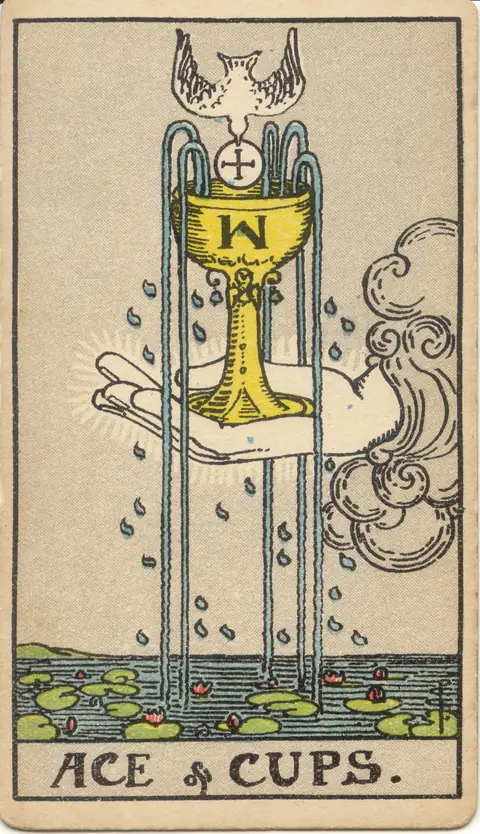
Emerging from a cloud, a hand presents a cup from which five streams of water pour; a dove descends toward it, a wafer marked with a cross in its beak.

Two decks

Ace of Cups, Marseille and Rider-Waite

The Tarot de Marseille repeats the suit’s pips; the Rider-Waite illustrates each card with a scene.

IAce of CupsDiagram
Tarot de Marseille · pip diagramAce of Cups
Rider-Waite · London, 1909Ace of Cups
Ace of Cups: what changes from one deck to the other
AspectTarot de MarseilleRider-Waite
NameAs de coupesAce of Cups
ImageIn the Tarot de Marseille, the Ace of Cups is not symmetrical: the cup is oriented, and the drawing remains that of a sign, without a scene.Rider-Waite adds the hand emerging from the cloud, the dove with the wafer, and the pond of water lilies: a complete scene where Marseille stays with patterns.
ReversalOften not readCommonly read (reversed cards)

Tarot de Marseille: Nicolas Conver, dated 1760, restored by the Tarot World Project, CC BY-SA 4.0 license, via Wikimedia Commons. Rider-Waite: drawings by Pamela Colman Smith, 1909, public domain, via Wikimedia Commons. Images resized and compressed by Versana; Marseille Minor Arcana diagrams and card back drawn by Versana.

Ace of Cups: nuances and combinations

In love, depending on your situation

Two situations, two readings: in a current relationship, then in a period without one, and reversed.

Depending on the position in a spread

The position changes the reading: 7 common positions, each upright then reversed.

Which cards it reads well with

Six cards calculated by the combination rules: two that reinforce it, two that nuance it, two in friction. None is “bad.”

The card’s place in the suit

The ace opens the suit of Cups: first number of water, it comes before the Two of Cups, where momentum becomes exchange. It is the root of the element water.

The card’s number

The card carries the number 1: in numerology as in the suit, one stage of a progression from 1 to 10.

How is it built?

Suit and number read on the deck; decan and planet reported according to the Golden Dawn tradition, never as facts.

Frequently asked questions about Ace of Cups

What does the Ace of Cups mean in tarot?

The Ace of Cups reads as the beginning of an emotion: an offered cup, overflowing water, a surge of the heart to welcome. It speaks of openness and sensitivity more than action, and invites you to receive what presents itself before trying to master it.

What does the Ace of Cups mean reversed?

Reversed, the Ace of Cups turns the momentum inward. The emotion is present but held back: blocked energy, a reserve, a feeling that has not yet found its words. The card invites you to spot what holds it back rather than force expression.

Which cards go well with the Ace of Cups?

The Ace of Cups readily extends into the card that comes next, where momentum becomes exchange, then the one where it is shared. With a more tense card, the emotion gains nuance: the offered cup meets what holds it back, and the reading gains depth. Six pairings above detail this.

The Ace of Cups in a yes or no reading?

For a closed question, the Ace of Cups leans toward the favorable: the water overflows and the cup is offered. This inclination is weighed against the surrounding cards and the way the request is put.