Skip to content

Queen of Swords tarot card: meaning and reversed

The Queen of Swords stands for discernment: an independent, honest gaze free of illusions.

  • clarity
  • perspective
  • frankness
The essentials

Queen of Swords at a glance

For you

Seeing clearly and saying it plainly: a clarity that steps back, sorts out what is essential, and cuts through without cruelty when it must.

A strength

Saying things clearly, without detours or cruelty, and cutting through when it is time to decide.

Something to watch

Clear sight can cool into distance, and frankness can turn into dryness.

Way of acting
Welcoming
Yes or no
Nuanced
Read more

By Thomas Guilhot · updated

Upright

The Queen of Swords suggests an art of stepping back and being precise.

She invites you to move a little aside from the tumult to sort out what matters, then to put it into words precisely. The card is often read as the ability to tell a useful truth without making it hurtful, to cut through when needed, to prefer clarity to vagueness. Withdrawal here is not rejection: it is time to think. Many readers see in it a measured word that must nonetheless stay warm in order to be heard.

  • clarity
  • perspective
  • frankness

Queen of Swords in your life

In love

Naming your expectations and limits simply, with respect, while leaving the door open.

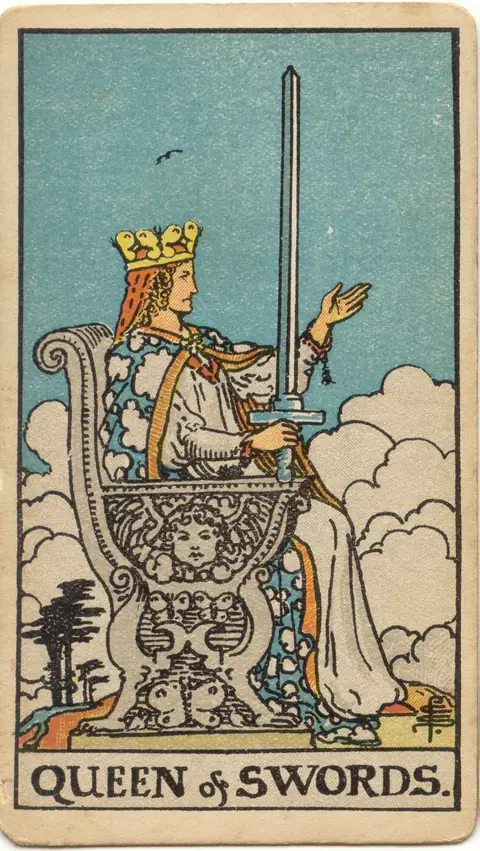
In a relationship, the card invites you to name your expectations and limits simply, with respect. A little distance can help you see clearly, as long as the door stays open, like the outstretched hand in the image.

At work

Precise analysis, clean decisions, and sober communication: seeing a file’s weaknesses and naming them.

At work, she evokes precise analysis, clean decisions, and the ability to reread a file with perspective and name its weaknesses. Clear, sober communication is valued here.

With money

Numbers looked at sharply and choices made cleanly: a clear-eyed attitude rather than investment advice.

On money questions, the card argues for clear numbers and clean choices: sort, name, decide. It describes a state of mind, not an investment instruction.

As a feeling

A slightly cool clarity, the need to put distance between yourself and the tumult in order to discern what really matters.

As an action

Step back to sort out what is essential, then state your position precisely, without detours and without harshness.

Reversed

Clarity turning into coldness: frankness becomes dry, distance cuts you off from the rest, and the clear word stops reaching the other person.

In a yes or no reading

Nuanced

A “maybe”: the card argues for clarity and discernment, but its withdrawal asks you to check what the distance hides. Neighboring cards show whether caution wins out.

Questions to ask yourself

  • What do I see clearly, and how can I say it so that it is heard?
  • What truth am I keeping quiet out of fear of hurting, and how could I say it gently?
  • What specific fact can I base my decision on, rather than an impression?

A sentence to keep: “I say what I see clearly, and I say it with consideration.”

Yes or no tarot

What the card depicts

A figure crowned with butterflies sits in profile on a throne decorated with a winged head. She holds a sword upright and extends her other hand, beneath low clouds where a bird passes.

Two decks

Queen of Swords, Marseille and Rider-Waite

The Tarot de Marseille repeats the suit’s pips; the Rider-Waite illustrates each card with a scene.

Queen of SwordsDiagram
Tarot de Marseille · pip diagramQueen of Swords
Rider-Waite · London, 1909Queen of Swords
Queen of Swords: what changes from one deck to the other
AspectTarot de MarseilleRider-Waite
NameReine d’épéesQueen of Swords
ImageThe Tarot de Marseille reads the queen through her rank and the suit of Swords; the outstretched hand and the scene in this version add a further nuance.In the Rider-Waite version, the outstretched hand softens the raised sword and reminds us that clarity can also be offered, which other versions do not always stress.
ReversalOften not readCommonly read (reversed cards)

Tarot de Marseille: Nicolas Conver, dated 1760, restored by the Tarot World Project, CC BY-SA 4.0 license, via Wikimedia Commons. Rider-Waite: drawings by Pamela Colman Smith, 1909, public domain, via Wikimedia Commons. Images resized and compressed by Versana; Marseille Minor Arcana diagrams and card back drawn by Versana.

Queen of Swords: nuances and combinations

In love, depending on your situation

Two situations, two readings: in a current relationship, then in a period without one, and reversed.

Depending on the position in a spread

The position changes the reading: 7 common positions, each upright then reversed.

Which cards it reads well with

Six cards calculated by the combination rules: two that reinforce it, two that nuance it, two in friction. None is “bad.”

The card’s place in the suit

Among the court cards of Swords, the Queen is the third, after the Knight and before the King: the moment when momentum settles in order to look.

How is it built?

Suit and number read on the deck; decan and planet reported according to the Golden Dawn tradition, never as facts.

Frequently asked questions about Queen of Swords

What does the Queen of Swords mean in tarot?

The Queen of Swords is read as clear sight expressed with frankness: seeing clearly, sorting, cutting through without cruelty. Her keynote is withdrawal, a step back that serves thinking. She describes a way of acting more than a person.

What does the Queen of Swords mean reversed?

Reversed, the card warns against excess: clarity turns into coldness, frankness becomes dry, and distance cuts you off from the rest. The card then invites you to warm your tone, to acknowledge what the other person feels, and to keep your hand outstretched.

Which cards go well with the Queen of Swords?

With other Swords, she reinforces the precision and sharpness of ideas. Next to Cups, clarity meets emotion; next to Pentacles, it lights up the concrete; next to Wands, it gives a frame to the drive of a project.

The Queen of Swords in a yes or no reading?

For a closed question, the answer stays a “maybe.” The Queen favors discernment more than a verdict; the reading depends on the neighboring cards and on the distance you keep from the subject.